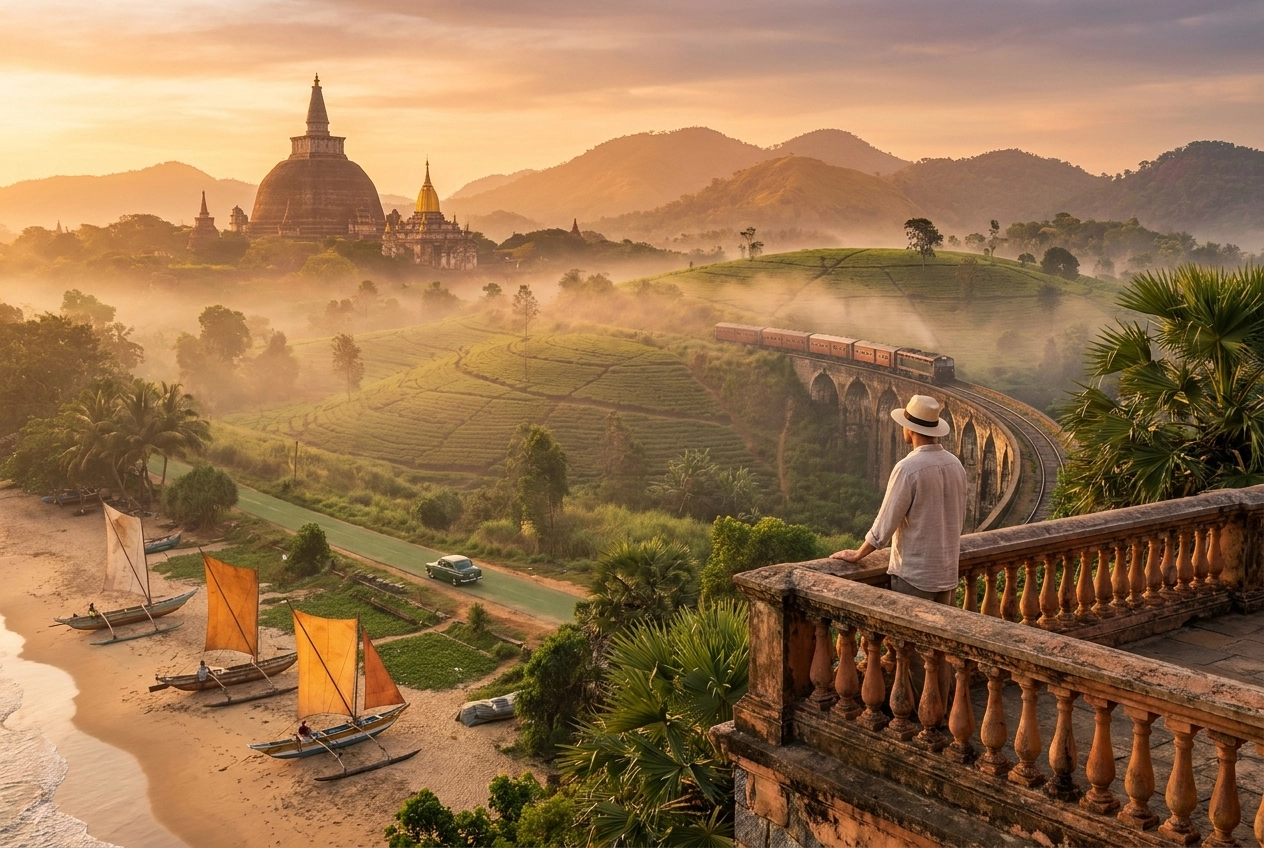
Sri Lanka has been quietly stealing hearts for years, and honestly, it is not hard to see why. Stunning beaches, ancient temples, misty tea plantations, and wild elephants all packed into one small island nation. The only problem? Figuring out how to see it all without losing your mind in the process.
If you have been searching for a 9-day Sri Lanka itinerary that does not leave you exhausted or skipping the good stuff, you are in the right place. Nine days is actually a sweet spot for this destination. It gives you enough time to experience the highlights without rushing through every single stop like you are speed-running a video game.
In this guide, we are breaking down exactly where to go, how long to stay, and what to prioritize so you can make the most of your trip. Whether you are a first-time traveler or just new to visiting South Asia, this itinerary keeps things simple, realistic, and genuinely enjoyable. No confusing logistics, no overwhelming lists. Just a clear, practical plan that actually works for real travelers.
Why Nine Days is the Sweet Spot for Sri Lanka
Sri Lanka rewards thoughtful planning, and nine days happens to be the length that lets the island reveal itself properly, without turning your holiday into a breathless checklist.
The island divides naturally into three geographic zones: the Cultural Triangle in the north-central region (think Sigiriya and Dambulla), the mist-covered hill country around Kandy and Ella, and the sun-warmed southern coast stretching from Galle to Mirissa. Nine days gives you genuine time in each zone rather than a rushed overnight at every stop. The key is routing that uses a hub-and-spoke approach, spending two or three nights in one well-placed base and exploring the surrounding area on day trips, rather than shifting accommodation every single night.
Pacing is the concern we hear most often from travellers researching Sri Lanka for the first time, and it is a fair one. Nine days, structured sensibly, directly addresses it.
For Australians flying from Sydney, Melbourne, Brisbane or Perth, the arithmetic also works in your favour. Flights to Colombo typically route via Singapore or Kuala Lumpur, adding roughly two travel days to your trip. Nine days on the ground translates to around eleven nights away in total, which sits comfortably within a standard leave window for most professionals and couples without requiring heroic amounts of annual leave.
Sri Lanka's compact geography helps considerably. The island is roughly the size of Tasmania, which means well-planned transfers between major regions rarely stretch beyond three to four hours by road. That scale makes multi-zone travel genuinely manageable rather than punishing.
Nine days also pairs naturally with a broader long-haul itinerary. Many Australian travellers choose to combine Sri Lanka with South India or Kerala, making the most of a single long-haul flight commitment. If that kind of multi-destination journey across South Asia appeals to you, our team at Taj Voyages can design the whole trip as one cohesive experience.
The Three-Base Approach: How to Move Without Over-Moving
The single most practical decision you can make when planning a 9-day Sri Lanka itinerary is this: choose three base locations and stay with them. Rather than shifting hotels every night, you settle into each base for two to three nights, leave your luggage behind, and explore the surrounding region through day excursions. It sounds simple, and it is. That simplicity is precisely why experienced planners and well-travelled visitors consistently recommend it.
The three natural bases for a southern-focused circuit fall into place almost intuitively. Your first is the cultural and highland gateway, either Kandy or Sigiriya, where you're well-positioned for rock climbing, temple visits and wildlife encounters at Minneriya. Your second is Ella, the heart of Sri Lanka's hill country and the much-loved arrival point for the scenic Kandy to Ella train journey. Your third is the southern coast, whether you anchor in Mirissa, Tangalle or Galle, with beaches, whale watching and coastal day trips all within reach.
What makes this structure genuinely comfortable rather than just logical is what happens in between the bases. A specialist coordinates your transfers so that private air-conditioned vehicles and pre-booked train seats are arranged before you leave home. Timings are designed to get you to each new location in daylight, settled and ready for the following morning.
This matters especially if Sri Lanka is new to you. You may be a confident, well-travelled person, yet completely unfamiliar with Sri Lanka's road distances, regional rhythms and transport quirks. Having those transitions thoughtfully designed for you removes a quiet layer of pre-trip anxiety that many travellers don't realise they're carrying until it's gone.
Day-by-Day: A Recommended 9-Day Sri Lanka Itinerary
What follows is a single recommended routing, not a menu of options to mix and match. It reflects genuine specialist thinking about how to move through Sri Lanka in nine days: where to slow down, where a single night simply won't do, and how to sequence the journey so the landscapes and experiences build on each other rather than feel like disconnected stops. There are brief variation notes along the way for travellers whose interests pull in a slightly different direction, but the core logic holds for most first-time visitors travelling between December and March, when all three zones of this itinerary are at their best simultaneously.
Days 1 and 2: Negombo (Arrival and Orientation)
Suggested base: Negombo Travel time: 5 to 10 minutes from Bandaranaike International Airport
Negombo earns its place at the start of this itinerary for one straightforward reason: the airport sits effectively in its backyard. After a long-haul flight from Australia, the last thing you want is a two-hour transfer to your first hotel. Negombo puts you on a sun-warmed beach terrace within minutes of landing, and that matters.
Day 1 is genuinely a rest day, and you should treat it as one. Settle in, have a swim, eat well, sleep long. On Day 2, the town reveals a quiet charm worth a few hours of your time. Negombo has a working canal system lined with fishing boats, a Dutch-era fort, and a lively morning fish market that gives you an early, unfiltered window into everyday Sri Lankan life. A tuk-tuk ride along the lagoon at dusk costs almost nothing and is unexpectedly lovely.
If you prefer an urban arrival, Colombo is a viable alternative, adding roughly 30 to 45 minutes to your airport transfer but rewarding you with colonial-era architecture, excellent restaurants and a vibrant city atmosphere around the Pettah bazaar and Galle Face Green esplanade. For travellers who enjoy a city launch to a journey, Colombo works beautifully. For those arriving late or prioritising rest, Negombo is the smarter call.
Specialist note: Two nights here is deliberate. It gives you one recovery day and one exploratory morning before the inland drive to the Cultural Triangle. Trying to push straight to Sigiriya on arrival day is possible, but it starts your holiday on a rushed note that takes a day or two to recover from.
Days 3 and 4: Sigiriya and the Cultural Triangle
Suggested base: Sigiriya Travel time: Approximately 3 to 4 hours by road from Negombo
This is the cultural heartland of Sri Lanka, and it is extraordinary. The drive inland takes you through coconut groves and paddy fields before the landscape starts rising toward the dry-zone forests of the north-central province. By the time Sigiriya Rock appears on the horizon, rising almost 200 metres out of the jungle, the anticipation has been building for an hour.
The Lion Rock fortress climb is the centrepiece of Day 3. Built as a royal palace complex in the 5th century, Sigiriya is one of Sri Lanka's eight UNESCO World Heritage Sites, and it deserves the full morning. The ascent passes ancient frescoes of celestial maidens painted into a rock face, a mirror wall inscribed with poems from early visitors, and the famous lion-paw gate before the final climb to the summit. Go early, before the heat and the crowds, and bring more water than you think you need.
Day 4 is Dambulla, just 20 kilometres south of Sigiriya and another UNESCO site. Five cave temples carved into a granite outcrop contain more than 150 Buddha statues and approximately 2,100 square metres of ceiling murals, some dating back more than 2,000 years. It is a genuinely moving space, particularly if you visit during morning prayers when incense and chanting fill the caves. If time and energy allow, the drive to Kandy in the late afternoon sets you up perfectly for the train the following morning.
Specialist note: Some travellers base in Kandy for these days rather than Sigiriya, and if the Temple of the Tooth Relic is a priority for you, that's a reasonable swap. Kandy's setting on a lake surrounded by hills is beautiful, and the evening cultural dance performances are worth attending. The trade-off is an earlier start for Sigiriya and Dambulla as day trips. Sigiriya-as-base is slightly more efficient; Kandy-as-base is slightly richer in atmosphere.
A word on elephant experiences in this region: if you're interested in seeing elephants, please seek out ethical sanctuaries that prioritise observation and natural behaviour over riding or performance. Your Taj Voyages specialist can point you toward responsible options in the Cultural Triangle.
Days 5 and 6: Ella and the Hill Country
Suggested base: Ella Travel time: Approximately 6 to 7 hours by train from Kandy (the journey itself is the experience)
The train from Kandy to Ella is one of the great rail journeys of the world, and that is not hyperbole. For six to seven hours, the line climbs through tea plantations that drape the hillsides in every shade of green, passes waterfalls and stone viaducts, and winds through mountain mist at elevations that make the coastal heat feel like another country. Book your seats in advance, particularly if you want a spot in the observation carriage; this train fills quickly with travellers who know exactly how special it is.
Ella sits at around 1,000 metres above sea level, and the cooler, cleaner air is immediately noticeable. It's a small town with a relaxed rhythm, good coffee and spectacular views in every direction. Day 5, after the train arrives, is best spent unwinding and perhaps walking to a viewpoint for sunset with a drink in hand.
Day 6 is for the iconic Nine Arches Bridge, a colonial-era stone viaduct best photographed from the surrounding tea fields when a train passes through (the schedule is loose, so local guesthouse owners usually know the rough timings). Little Adam's Peak is a two to three hour return hike from town, manageable for most fitness levels, and the panoramic views from the summit are a genuine highlight of the whole trip. Ella Rock is longer and steeper; worth it if you have the legs and the morning for it.
Specialist note: Two nights in Ella is the minimum. Travellers who try to do it in one night consistently feel they didn't quite get the place. The best weather for the highlands is around March; October and November are the wettest months and best avoided for this part of the route.
Days 7, 8 and 9: The Southern Coast, Yala and the Sea
Suggested base: Mirissa or Tangalle Travel time: Approximately 3 hours by road from Ella
The descent from the highlands to the southern coast is a geographical shift that feels almost theatrical. Within a few hours, you're trading cool mist and tea gardens for coconut palms, warm turquoise water and the unhurried atmosphere of Sri Lanka's most beautiful coastline.
A base between Mirissa and Tangalle gives you the broadest range of experiences for these final three days. Mirissa is the better choice for whale watching; the season runs from November to April, and blue whales and sperm whales are regularly spotted in these waters. An early morning boat excursion is unforgettable and worth prioritising on Day 7. Tangalle is quieter, less developed, and positioned closest to the turtle conservation sanctuaries at Rekawa Beach, where ethical night visits allow you to witness nesting activity with local conservation guides.
Day 8 is for Yala National Park, reached in roughly an hour from either base. Book a morning game drive, departing around 6am when wildlife is most active and the light is golden. Yala has one of the highest leopard densities of any national park in the world, alongside elephants, crocodiles, sloth bears and a remarkable variety of birdlife. It is a proper safari experience and a genuinely thrilling way to spend a morning.
Day 9 can be spent at leisure on the coast, or you might use the morning for a visit to Galle Fort, the Dutch colonial walled city that is another UNESCO World Heritage Site and one of the most atmospheric places in Sri Lanka. It's around 45 minutes from Mirissa and well worth a few hours of wandering its ramparts and cobbled streets before the drive back toward Colombo for your departure flight.
Specialist note: If your interests lean more toward culture and history, a Galle-orbit base is a strong alternative to Mirissa or Tangalle, with Unawatuna and Ahangama beaches within easy reach, plus Koggala Lake for a gentle boat excursion. The trade-off is slightly more distance to Yala for the day trip. Talk to your Taj Voyages specialist about which southern base best fits your particular priorities.
This routing works beautifully as a foundation. If you'd like to explore how it translates into a fully tailored journey, the Sri Lanka itineraries on the Taj Voyages website are a good starting point for the conversation.
The Kandy to Ella Train: What You Need to Know Before You Book
Of all the experiences woven into a well-crafted 9-day Sri Lanka itinerary, the train journey from Kandy through the hill country to Ella tends to be the one travellers remember most vividly. The route climbs through cascading tea estates, passes colonial-era viaducts, and threads through mist-draped mountain villages in a way that no road journey can replicate. Expect the trip to take somewhere between seven and ten hours in real-world conditions; trains in Sri Lanka run on their own schedule, and building in that buffer is simply good planning rather than a cause for concern.
The first-class observation car is where you want to be. Positioned at the rear of the train, it offers panoramic windows and unobstructed views back along the track as the landscape unfolds behind you. The catch is that seats are genuinely limited and they sell out weeks in advance, particularly during the January to March window when Australian and other international travellers are most active. Leaving this to chance, or attempting to book it as an afterthought once you've arrived in Sri Lanka, is a risk that a well-designed itinerary simply doesn't take.
Booking from Australia through the Sri Lanka Railways online system is possible, but the interface, booking windows and seat class availability can make the process frustrating and unreliable. Working with a specialist means the train is confirmed and ticketed before you depart, sitting alongside your accommodation and transfers as a fixed itinerary element rather than a hopeful addition.
Timing matters too. Arriving into Ella in the late afternoon gives you a first gentle evening in the hills before a full day of exploration begins. That unhurried arrival sets the tone for everything that follows in the hill country.
If you'd like to understand how this journey fits into a fully coordinated Sri Lanka trip, the team at Taj Voyages can walk you through the details and handle every booking on your behalf.
Choosing Your Safari: Yala or Udawalawe?
Your southern coast days are when the wildlife question comes into focus, and it's worth thinking about this before you arrive rather than deciding at the hotel breakfast table.
Yala: Sri Lanka's Leopard Capital
Yala National Park is Sri Lanka's most visited wildlife reserve, and its reputation for leopard sightings is genuinely well-earned. The park's dense dry scrub and forest terrain creates an atmospheric setting for game drives, with leopards, elephants, sloth bears, crocodiles and an impressive variety of birdlife all calling it home. Zone 1 is where most visitors head, offering the highest concentration of game-viewing activity. If you'd prefer a quieter, less trafficked experience, Zone 5 is worth discussing with your specialist; it draws far fewer jeeps and suits travellers who value an unhurried pace over the bustle that can sometimes accompany a popular sighting in Zone 1.
Udawalawe: Where Elephants Take Centre Stage
Udawalawe National Park is a genuinely different experience, and for many travellers it turns out to be the more rewarding choice. The terrain here is open grassland savannah rather than dense scrub, which means animals are far easier to spot. More importantly, Udawalawe has a large resident elephant population and sightings are remarkably reliable. If watching a herd of elephants move through open country in good light is what you're really after, this is your park.
Making the Choice Within Nine Days
Within a nine-day itinerary, most travellers sensibly choose one park rather than attempting both. Both are accessible as day excursions from a Mirissa or Tangalle base, so your accommodation location doesn't need to change. The decision really comes down to your primary interest: leopards point you toward Yala, elephants toward Udawalawe.
One practical consideration that often gets underestimated is the early start. Standard hotel pickups for a Yala morning safari run between 4:30 and 5:00 AM, which means a 4:00 AM alarm is a realistic expectation. A well-located, comfortable property makes that considerably more bearable than a poorly situated one; it's one of the reasons your accommodation choice on the southern coast matters more than it might first appear.
If wildlife is a genuine centrepiece of your trip rather than one item among many, it's worth having that conversation with your specialist early. Timing, base location and the specific zones visited can all be adjusted to make the most of the best game-viewing windows available during your travel dates. You can share your travel interests with the Taj Voyages team to start shaping the southern coast portion of your itinerary around what matters most to you.
Making the Most of the Southern Coast
The southern coast is where your 9-day Sri Lanka itinerary broadens out beautifully, and the temptation to simply settle onto a sun lounger and stay there is entirely understandable. But this stretch of coastline offers far more than beach time, and the experiences you layer around it are what give the final days of your trip genuine depth.
Galle Fort: A Half-Day Worth Every Minute
Galle Fort is a UNESCO World Heritage-listed Dutch colonial fortification, and its compact, walkable interior is unlike anything else on the island. Ramparts, centuries-old churches, boutique galleries, low-key cafes and small accommodation houses sit side by side within walls that have stood since the 17th century. A half-day here adds real cultural texture, particularly welcome after the wildlife and landscape focus of Yala or Udawalawe. It does not require a full day to appreciate; it simply requires a little unhurried time.
Choosing Your Beach Base with Intention
Not all southern beaches feel the same, and this distinction genuinely matters. Unawatuna and Hikkaduwa are livelier, more developed and well set-up for those who enjoy company and activity around them. Tangalle and Hiriketiya sit at the quieter end of the spectrum, offering a more relaxed, less commercialised atmosphere. Your choice of base should reflect the kind of coastal experience you are actually after, rather than simply wherever happens to be convenient.
River Safaris and Whale Watching
A boat safari on the Madu River or Koggala Lake is one of those experiences that resets your pace entirely. Narrow mangrove channels, cinnamon islands and abundant birdlife create a completely different ecosystem to the dry scrub of a morning game drive. It is unhurried, genuinely absorbing and well worth building into your southern days.
Off Mirissa, whale and dolphin watching is best between November and April, when blue whales move through these waters with remarkable frequency. It is an extraordinary experience when conditions align well.
Two to three nights on the southern coast is the minimum needed to properly absorb all of this. The three-base structure in your itinerary ensures that time is already set aside for you.
Best Time to Visit Sri Lanka on a 9-Day Circuit
Timing shapes everything on a Sri Lanka circuit, and it's worth giving this more thought than a quick weather search. The island operates on two distinct monsoon systems that affect different regions at different times, which means a date that works beautifully for the south coast might be less ideal for the highlands, and vice versa.
January through March is the most consistently rewarding window for a 9-day itinerary that combines the highland rail corridor with the southern coast. During these months, dry and warm conditions prevail across all three bases of a typical circuit simultaneously. The south coast settles into its best beach weather, the hill country is clear and cool, and the Cultural Triangle enjoys comfortable temperatures for sightseeing. If you have flexibility in your dates, this is the window to aim for.
The highland region around Kandy and Ella tends to be at its wettest from October through November. This doesn't make travel impossible, and the landscape has its own misty drama in the rain. But road conditions can be slower, and the cloud cover on the Kandy to Ella train journey may soften those sweeping valley views that travellers come specifically to see. Worth knowing before you book, rather than discovering on the morning of your journey.
The southern coast faces a different seasonal challenge. The south-west monsoon arrives roughly from May through September, making beach time and offshore experiences like whale-watching near Mirissa considerably less reliable during those months. If the coast is central to your plans, this period calls for honest expectation-setting.
April is increasingly popular with Australian travellers, and it's easy to understand why. School holidays align, the shoulder season offers a quieter experience at most sites, and the monsoon hasn't yet arrived in earnest. Early April, in particular, is generally manageable. That said, the January to March window remains more predictably rewarding if you want settled conditions across all bases in a single trip.
One timing consideration that often surprises travellers: Kandy's Esala Perahera, held across July and August, is one of the most extraordinary cultural festivals in Asia. The processions, the decorated elephants, the drumming and firelight create an atmosphere that simply cannot be replicated at any other time of year. Visiting during the festival season does mean navigating wetter highland conditions and a less settled south coast, but for travellers whose priority is cultural depth over beach days, it can be a genuinely worthwhile trade-off.
A good specialist can help you map your specific travel dates against the festival calendar, regional weather patterns, and your own priorities, so the timing works in your favour rather than against it. Reach out to the team at Taj Voyages to talk through what the right window looks like for your trip.
Planning from Australia: Visas, Flights and Timing
Before you board your flight, there are a few practical planning steps worth sorting early, and none of them are complicated with the right guidance.
Your ETA: Simple, but Entirely Your Responsibility
Australian passport holders need an Electronic Travel Authorisation (ETA) to enter Sri Lanka, and it must be in place before you depart Australia. The good news is that the process is straightforward and handled entirely online through the Sri Lankan government's official portal. The ETA is electronically linked to your passport and is valid for 30 days with a double-entry facility. Apply at least 10 days before travel, as processing is not always instant. If you renew your passport after receiving approval, you will need to apply again.
Your travel specialist can point you in the right direction, but visa outcomes remain the individual traveller's responsibility. The Australian Government's Smartraveller page for Sri Lanka is the authoritative source to consult for current entry requirements and any updates before you travel.
Getting There: Flights and Journey Times
Flights from Sydney or Melbourne to Colombo's Bandaranaike International Airport typically route through Singapore, Kuala Lumpur or Dubai. Depending on your layover, total journey times generally sit between 12 and 16 hours, though more direct routings can come in closer to 11 or 12 hours. It is a manageable long-haul commitment, notably shorter than flying to Europe.
One consideration worth raising with your specialist: combining Sri Lanka with South India or Kerala as a single trip makes excellent sense for Australian travellers. Both destinations sit within the same long-haul flight corridor, and a well-designed multi-country itinerary means you cover two remarkable regions without doubling your travel overhead or your time in transit.
Arrival Timing and the Time Zone Advantage
Arriving into Colombo or nearby Negombo the evening before your itinerary officially begins is strongly recommended, and any well-constructed 9-day plan will build this in. Landing exhausted and losing half your first day to airport transfers and recovery is entirely avoidable with deliberate design.
The time zone adjustment also works in your favour. Sri Lanka Standard Time runs approximately 4.5 hours behind Australian Eastern Standard Time during summer, which is a genuinely comfortable adjustment. Most travellers find they settle in within a day, which means your first full morning in the Cultural Triangle or the hill country is actually productive rather than hazy.
Accommodation That Adds to the Experience
Where you sleep in Sri Lanka matters more than you might expect. The country's accommodation landscape spans everything from large resort-style hotels to intimate boutique retreats and heritage colonial properties, and the difference between a good choice and the right choice can genuinely shape how a place feels. On a well-designed itinerary, each property is chosen because it enhances where you are, not simply because it has availability.
Hill Country: Where Your View is Part of the Experience
In the Ella region and across the broader hill country, the most rewarding properties tend to be smaller boutique hotels set within or beside working tea estates. Waking to mist drifting across terraced hillsides is one of those quietly unforgettable moments, but it only happens if your room is oriented toward the valleys rather than a car park. A well-positioned property here can also save you meaningful time in the mornings, particularly if you're catching an early train or heading out before the mist clears. A town-centre hotel in Ella simply offers a different experience, and not necessarily the one you came for.
The Southern Coast: More Choice, More Discernment Required
The southern coast has seen a genuine expansion in quality properties over recent years. Galle Fort offers characterful colonial villas where history is woven into the architecture itself. Further east toward Tangalle and Hiriketiya, the style shifts toward open-air boutique resorts that feel more immersed in the coastline. Both are wonderful in different ways, but which suits you depends entirely on what you value.
This is where on-the-ground knowledge earns its place. Many properties photograph beautifully and deliver inconsistently. A specialist who understands the full picture, including which properties genuinely match their reputation, removes that uncertainty entirely.
Matching Properties to You, Not to a Default List
Before a single hotel is confirmed, a short conversation about your preferences makes an enormous difference. Whether you want a pool as a daily retreat, a strong preference for garden settings over open-plan layouts, a desire for privacy over social atmosphere, or a particular fondness for heritage character over contemporary design, these details allow each property to be matched to your travel style. The result is an itinerary where your accommodation feels considered at every stop, contributing to the overall sense of journey rather than simply filling the nights between experiences.
If you'd like guidance on building an itinerary with accommodation choices that genuinely reflect where you're going and how you like to travel, the team at Taj Voyages is always glad to have that conversation.
Combining Sri Lanka With South India or Kerala
If you're already making the journey from Australia, it's worth pausing to ask whether Sri Lanka alone tells the full story you're hoping to experience. The island sits just off the southern tip of India, and the flight routing from Australia means that adding South India or Kerala to your itinerary requires far less extra travel than most people assume. For a trip of this scale, combining both destinations can transform a wonderful holiday into something genuinely comprehensive.
What a Kerala Extension Brings
Kerala adds a completely different texture to your journey. Backwater cruises through palm-fringed canals, visits to spice and tea gardens, and time spent with Ayurvedic traditions offer experiences that don't overlap with anything you've done in Sri Lanka. The coastal and wildlife character of your Sri Lanka circuit is complemented beautifully, not repeated. These are two distinct worlds that happen to sit close together, and pairing them feels natural rather than rushed.
What a South India Extension Brings
For travellers who find themselves drawn to Sri Lanka's Cultural Triangle, Tamil Nadu's temple towns offer a resonant continuation of that same story. The great temples of Madurai, the Pallava monuments along the Coromandel Coast, the layered heritage of Chennai; these are cultural experiences that deepen everything you've already encountered, adding new chapters rather than revisiting familiar ones.
How Taj Voyages Handles the Complexity
Taj Voyages designs multi-country itineraries across India and Sri Lanka as part of its core offering, which means the cross-border logistics, accommodation sequencing and routing connections are handled as a single coordinated plan. You don't need to stitch two separate trips together yourself.
If a combined journey is on your radar, raise it early in your planning conversation. Even if Sri Lanka is your primary focus, knowing your broader travel appetite from the outset allows the entire itinerary to be built with sensible connections, rather than adding a second destination as an afterthought.
How a Specialist Turns This Outline Into Your Itinerary
Everything you've read in this guide is a well-considered starting point. What turns it into a trip that actually works is the layer of thinking that happens underneath: which driver has the right experience for highland roads, which properties in Ella and Yala-adjacent areas need to be secured months in advance, when to depart for the train to get the best light through the tea country, and what the backup plan looks like if a safari is disrupted by weather.
That gap, between a plan that reads well and a trip that flows beautifully, is exactly where a specialist earns their place.
At Taj Voyages, every Sri Lanka itinerary begins with a conversation rather than a template. Before any routing is proposed, we want to understand how you travel: whether you prefer unhurried mornings or early starts, whether wildlife or culture takes priority, whether this is a first trip to South Asia or part of a longer regional journey. That conversation shapes everything that follows.
From there, the practical coordination happens as part of the design process, not as an afterthought. Train reservations on the Kandy to Ella route, safari jeep allocations at Yala, boutique property bookings that fill quickly during peak season, and guided experiences that require advance arrangement are all managed on your behalf. Nothing is left for you to sort out independently after the itinerary is confirmed.
For travellers who are experienced internationally but new to Sri Lanka, this isn't about being guided through every moment. It's about the quiet confidence of knowing someone who genuinely knows the destination has thought it through properly, and that if anything needs adjusting on the ground, support is available.
Reaching out is simply a conversation. Get in touch with the Taj Voyages team to talk through your 9-day Sri Lanka trip, with no obligation and no pressure, just an expert ready to help you plan it well.
Ready to Plan Your Sri Lanka Journey?
Nine days in Sri Lanka, planned with care, is genuinely enough to experience the cultural heart of the island, the magic of the hill country and the unhurried pace of the southern coast without feeling like you've rushed through any of it. The three-base structure that runs through this guide is the reason that's possible: it removes the daily packing-and-moving fatigue that turns a beautiful trip into an exhausting one.
That structure works best when the logistics are designed and managed by a specialist rather than assembled piece by piece. Sequencing the right train carriage, pairing the right safari with the right base, knowing which roads to take and when: these details make the difference between a trip that flows and one that constantly requires problem-solving.
For Australian travellers, Sri Lanka is a particularly compelling choice. The flight time is manageable, the January to March weather window aligns well with the Australian summer, and the natural pairing with South India adds genuine depth if your schedule allows.
The next step is simply a conversation. Share your travel dates and interests with the Taj Voyages team and let a specialist shape an itinerary that reflects exactly how you want to experience this remarkable island.
Frequently Asked Questions
Is 9 days enough for Sri Lanka?
Yes. Nine days is the sweet spot for a first visit, giving you genuine time across the three zones — the Cultural Triangle, the hill country and the southern coast — using a three-base, hub-and-spoke approach rather than moving hotels every night.
When is the best time to visit Sri Lanka?
January to March is the most reliable window, with dry, warm conditions across all three zones at once. The south coast is best November to April for whale watching; the highlands are wettest in October and November.
Do Australians need a visa for Sri Lanka?
Australian passport holders need an Electronic Travel Authorisation (ETA), applied for online before departure. It's valid for 30 days with double entry. Apply at least ten days ahead, and reapply if you renew your passport after approval.
Should I choose Yala or Udawalawe for safari?
Yala for leopards and dramatic scrub terrain; Udawalawe for reliable elephant sightings in open grassland. Within nine days most travellers choose one, and both are reachable as day trips from a southern-coast base.
Conclusion
Sri Lanka is one of those rare destinations that genuinely delivers on its promise, and nine days is the perfect amount of time to experience it properly. To recap the key takeaways: nine days gives you a realistic pace without burnout, focusing on the highlights beats trying to see everything, planning your route geographically saves you time and stress, and flexibility always makes a trip better.
Now it is your turn to make it happen. Save this itinerary, start researching flights, and begin building your packing list. The ancient ruins, misty hillside tea fields, and golden coastlines are waiting.
Sri Lanka does not just check boxes on a travel list. It gets under your skin in the best possible way. Book the trip, trust the plan, and get ready for an adventure you will be talking about for years.