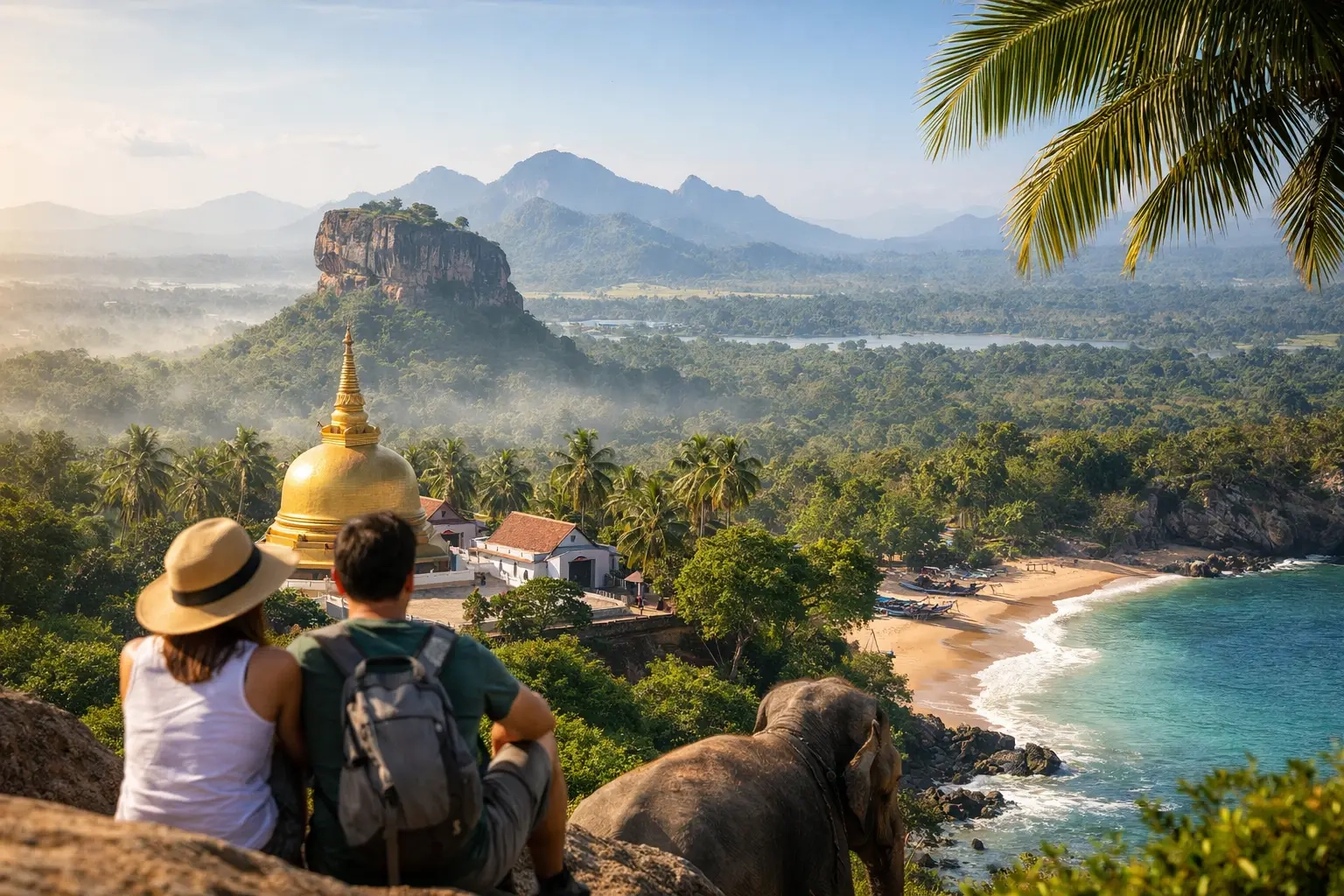
Sri Lanka is the rare destination where there is no bad time to go. There is only a wrong coast.
The island has two separate monsoons arriving from opposite directions at opposite times of year, which means that in almost any month, one side is in its dry season while the other is in its wet one. Get the side right and you can travel comfortably in June or January. Get it wrong and you'll be watching rain from a beach in what your guidebook promised was peak season.
That single fact does more to shape a Sri Lankan itinerary than anything else.
The two monsoons
The southwest monsoon (Yala) runs roughly May to September. It brings rain to the west and south coasts and the hill country — so Colombo, Bentota, Galle, Mirissa, and the tea estates around Nuwara Eliya and Ella.
The northeast monsoon (Maha) runs roughly October to February. It brings rain to the east and north — Trincomalee, Arugam Bay, Jaffna.
Which produces a neat inversion:
When you travel | Go here | Avoid |
|---|---|---|
December – March | West and south coasts, hill country, Cultural Triangle | East coast |
May – September | East coast — Trincomalee, Arugam Bay | South and west coasts |
April and October | Inter-monsoon: generally fine island-wide, occasional thunderstorms | — |
April and October sit between the two systems. Conditions are usually good almost everywhere, with afternoon thunderstorms that pass. These shoulder weeks are genuinely underrated, and prices reflect the fact that most people don't know it.
December to March — the main season
This is when most Australians travel to Sri Lanka, and for good reason. The south and west coasts are dry and warm, the hill country is clear, and the Cultural Triangle — Sigiriya, Dambulla, Polonnaruwa, Anuradhapura — is at its most comfortable for climbing and walking.
It's also when whale watching off Mirissa is at its best, roughly December to April.
The trade-offs are crowds and price. Christmas through mid-January is the busiest and most expensive fortnight of the year, and the best properties on the south coast book out many months ahead. February and early March give you much the same weather with noticeably more room.
May to September — the season most people skip
This is the period most itineraries avoid, and it shouldn't be.
The east coast is at its best: Trincomalee's beaches, the bay at Arugam for surfing, and water clear enough for snorkelling at Pigeon Island. It's a quieter, less developed side of the island with a different cultural character, and very few Australian visitors see it.
It's also the strongest window for Yala and Udawalawe national parks in terms of wildlife concentration, and for leopard sightings in the dry months.
What you give up is the hill country and the south coast, both of which will be wet. So this isn't a "see everything" season — it's a different, more focused trip. If what you want is beach, wildlife and quiet, May to September is arguably better than December.
The hill country is its own climate
Worth separating out, because it surprises people: Nuwara Eliya and Ella are cold. Not cool — cold. Nights can drop into single figures and the colonial-era hotels have fireplaces for a reason.
The hill country is at its best January to March, and the train journey from Kandy through the tea estates is one of the genuinely great rail trips anywhere. Bring a jacket, whatever the rest of your itinerary suggests.
Dates worth planning around
Esala Perahera in Kandy, usually July or August, is one of Asia's most spectacular religious processions — elephants, dancers, fire, over ten nights. If you're travelling in that window it's worth building the itinerary around, but accommodation in Kandy books out far in advance and prices rise sharply.
Sinhala and Tamil New Year in mid-April is a major family holiday. The island is festive and much of it closes. Lovely to witness, awkward to travel through without planning.
Poya days fall on each full moon and are public holidays. Alcohol isn't sold and some businesses close. Rarely a problem, occasionally a surprise.
Which trip do you actually want?
The question we ask first isn't "when can you travel" but "what's the point of the trip", because the answer changes the whole shape of it.
Culture and sightseeing — Cultural Triangle, Kandy, the hill country: January to March.
South coast beaches and whales — Bentota, Galle, Mirissa: December to April.
East coast, surfing and quiet — Trincomalee, Arugam Bay: June to September.
Wildlife and national parks — Yala, Udawalawe, Wilpattu: February to September, with the driest months strongest for sightings.
Value and space — April and October, if you'll accept the occasional thunderstorm.
Ten to fourteen days covers the island comfortably, which is part of what makes Sri Lanka such a good first trip to South Asia — the distances are short and the landscape changes every couple of hours. Our Sri Lanka journeys are built around that pace.
If you're weighing it against India, our comparison of India and Sri Lanka for a first trip goes into which suits which traveller.
One practical note
Australians need an Electronic Travel Authorisation for Sri Lanka, applied for before departure at the official portal, and since 25 May 2026 it has been free of charge for 30-day tourist stays. The rules have changed more than once recently, so confirm the current position close to your travel date — our regional visa guide covers how it works.
Tell us when you can travel and what you want out of it, and we'll tell you which coast that means. Start the conversation here.