Bhutan is the one country in this region you cannot simply book flights to and figure out on arrival. That's deliberate, it's the reason the place feels the way it does, and understanding it is most of what you need before planning a trip.
The system, plainly
You must travel through a licensed Bhutanese tour operator. Independent travel isn't permitted for most visitors. Your visa is processed as part of that booking — you don't apply separately.
There is a Sustainable Development Fee, payable per person per night, on top of your travel costs. It funds free healthcare and education for Bhutanese citizens and conservation of the environment. It is set by the government and changes from time to time, so we'll confirm the current rate when we quote you rather than publishing a figure here that may be out of date.
Your itinerary includes a guide and a driver throughout. This isn't supervision — it's how the country has chosen to manage tourism, and in practice it's one of the better parts of the experience. Bhutanese guides are well trained, and the religious and architectural context is dense enough that you'd miss most of it alone.
The effect of all this is that Bhutan has far fewer visitors than its neighbours, the sites aren't crowded, and the culture hasn't been reshaped around tourism. That's what you're paying for.
Practical consequence: Bhutan needs planning earlier than anywhere else in the region. Flights into Paro are limited, the airline is one of only two that fly there, and festival dates sell out many months ahead.
What a trip actually contains
Paro is where you land, and the approach itself is memorable — the aircraft descends between mountains into a narrow valley. The town is small and the valley holds Rinpung Dzong and the national museum.
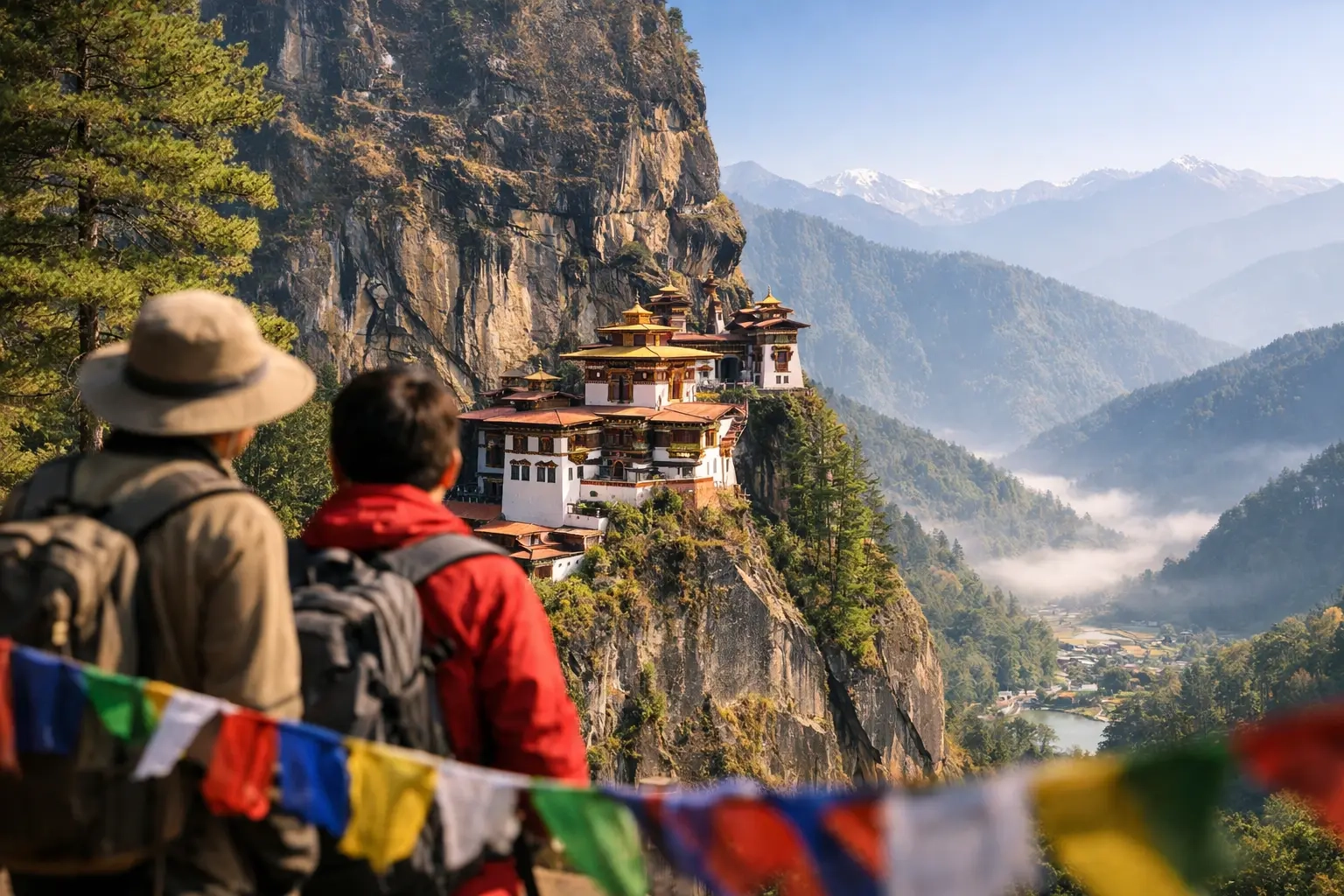
Taktsang, the Tiger's Nest, is the image everyone has of Bhutan: a monastery clinging to a cliff face 900 metres above the valley floor. It's a three to five hour round-trip hike, uphill, at altitude, with a long flight of steps at the end. Ponies can take you part of the way up but not down. It is achievable for most reasonably fit people who take it slowly, and it is the single most rewarding thing in the country. Plan it for later in your trip, not day two — you want a few days of acclimatisation first.
Thimphu is the capital, and the only one in the world without traffic lights. The weekend market, the enormous Buddha Dordenma statue, the textile museum, and a government and monastic complex at Tashichho Dzong.
Punakha sits lower and warmer, reached over the Dochula Pass where, on a clear day, the Himalaya opens out in front of you. Punakha Dzong, at the confluence of two rivers, is the most beautiful building in Bhutan and few people argue with that.
The Phobjikha valley, further east, is a glacial valley where black-necked cranes winter from late autumn. Quieter, higher, and a good addition if you have the days.
How long to allow
Five to seven nights is the sensible minimum: Paro, Thimphu, Punakha, and the Tiger's Nest hike with a buffer day.
Eight to ten nights adds Phobjikha or Bumthang and a slower pace, which Bhutan suits.
Fewer than four nights isn't really worth the cost and the effort of getting there. The fee is per night, but so is the experience, and a rushed Bhutan trip is a poor use of both.
Bhutan combines well with Nepal or North India — you'll most likely route through Kathmandu, Delhi or Bangkok anyway.
When to go
March to May and September to November are the two good windows. Clear skies, comfortable days, and the major festivals.
The tshechus — masked dance festivals held at dzongs across the country — are extraordinary and worth planning the whole trip around. Paro's is usually in spring, Thimphu's in autumn, with smaller ones year-round. Dates follow the Bhutanese lunar calendar and move each year, so this is a conversation to have early.
December to February is cold and some high passes can close, but the valleys are clear and it's the season for the black-necked cranes.
June to August is the monsoon. Cloud sits on the mountains, the views go, and flights into Paro are more often delayed.
What to be realistic about
Altitude. Paro and Thimphu are around 2,200–2,300 metres, and passes go considerably higher. That's enough that some people feel it. Build easy days at the start and don't schedule the Tiger's Nest on arrival.
The hike is a real hike. If mobility is a consideration, tell us at the planning stage and we'll shape the itinerary around what's comfortable — there's plenty in Bhutan that doesn't require it.
Roads are slow. Distances look short and take much longer than the map suggests. A well-built itinerary accounts for that rather than discovering it.
Flights into Paro are weather-dependent. Don't book a tight onward connection the day you leave.
Why people go
Bhutan isn't a bargain and doesn't try to be. What it offers is a Himalayan Buddhist culture that is still genuinely itself, landscapes that haven't been built on, and a quietness that is increasingly rare.
The travellers who get the most from it are the ones who arrive curious rather than ticking something off, and who give it enough days to stop feeling like a tour.
We handle the licensed operator arrangements, the visa, the fee, the internal routing and the pre- and post-Bhutan nights wherever you're connecting through. Tell us roughly when you'd like to travel — and if a festival appeals, the earlier that conversation starts, the better. See our Bhutan journeys for how we usually shape it.