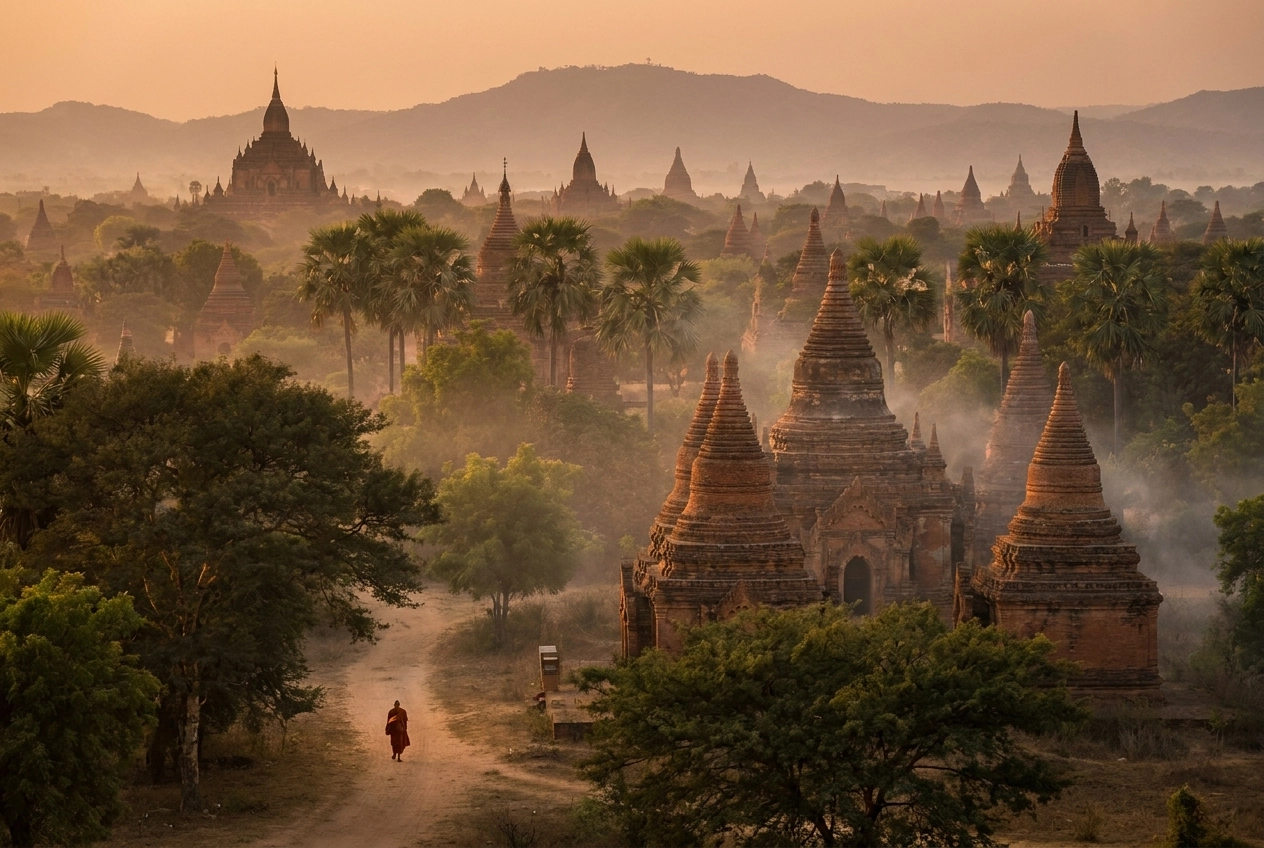
There is something quietly transformative about walking the same paths that millions of devoted seekers have traveled for centuries. Whether you are deepening your meditation practice, exploring Buddhist philosophy, or simply feeling the pull of something sacred, embarking on a Buddhist pilgrimage is one of the most meaningful journeys you can take.
Across Asia, ancient temples, mountain shrines, and holy cities carry a spiritual energy that is genuinely difficult to describe until you experience it yourself. These are not just tourist attractions. They are living, breathing centers of faith where monks chant at dawn, butter lamps flicker through the night, and ordinary people arrive carrying extraordinary hopes.
In this post, we are rounding up some of the most significant and awe-inspiring sacred sites spread across the continent. From the birthplace of the Buddha in Nepal to the cliffside monasteries of Bhutan and the ancient stupas of Sri Lanka, you will discover where to go, why each site matters, and what makes visiting truly special. Consider this your starting point for planning a journey that could change the way you see the world.
India's Four Sacred Buddhist Sites: The Heart of the Pilgrimage
There is a reason Buddhist pilgrimage in India draws travellers from every corner of the world. These are not symbolic reconstructions or spiritual approximations. They are the actual places where one of history's most transformative lives unfolded, and standing within them carries a weight that is genuinely difficult to put into words.
Bodhgaya: Where It All Began
At the centre of any meaningful Buddhist pilgrimage sits Bodhgaya, a modest town in Bihar that holds an almost incomprehensible significance. This is where Siddhartha Gautama sat beneath the Bodhi Tree and attained enlightenment, becoming the Buddha. The Mahabodhi Temple Complex, inscribed as a UNESCO World Heritage Site in 2002, is the spiritual heart of the entire circuit. You can meditate beneath the direct descendant of that original Bodhi Tree, walk the circumambulation path, and observe monks and lay practitioners from Sri Lanka, Thailand, Japan and Myanmar engaged in quiet, earnest devotion. The atmosphere is deeply layered and genuinely moving, regardless of your personal faith tradition.
Sarnath: The First Teaching
A short drive from Varanasi, Sarnath is where the Buddha delivered his very first sermon after enlightenment, an event referred to in Buddhist tradition as "turning the Wheel of Dharma." The archaeological park here is beautifully preserved and unusually peaceful, anchored by the Dhamek Stupa and the Mulagandha Kuti Vihara, where pilgrims gather in contemplative silence. Sarnath has a quality that many travellers find unexpectedly affecting; the calm streets and unhurried pace offer genuine breathing room between the more sensory-intensive experiences on the circuit.
Kushinagar: Quiet and Profound
Kushinagar in Uttar Pradesh tends to be the site that surprises travellers most. As the place of the Buddha's Parinirvana, his final passing and liberation, it carries an extraordinary stillness. The Mahaparinirvana Temple houses a remarkable 5th-century reclining Buddha statue, and the nearby Ramabhar Stupa marks the cremation site. Kushinagar receives far fewer visitors than Bodhgaya, which makes it one of the most genuinely contemplative stops on the entire journey. Travellers who allow themselves adequate time here consistently describe it as one of their most treasured memories.
Varanasi: Ancient, Sacred and Endlessly Alive
Varanasi operates on its own extraordinary frequency. One of the world's oldest continuously inhabited cities, it holds deep significance for both Hindu and Buddhist traditions, and Sarnath sits just outside its boundaries. The evening Ganga Aarti ceremony at Dashashwamedh Ghat is a spectacular sensory experience; fire, chant, incense and river mist combining into something genuinely transcendent. A sunrise boat ride along the ghats the following morning completes the picture beautifully.
Putting the Circuit Together
The real art in planning this journey lies in the routing. Bodhgaya, Sarnath, Kushinagar and Varanasi are spread across Bihar and Uttar Pradesh, and visiting them as isolated stops rather than a coherent trail makes the experience feel fragmented. A well-designed specialist itinerary typically allows seven to nine days for this Indian leg alone, building in travel time between sites, adequate time for reflection, and the flexibility to linger where you feel called to. Explore how Taj Voyages approaches this circuit to understand what a thoughtfully sequenced pilgrimage itinerary can feel like when the logistics are fully handled.
Nepal: Lumbini and the Kathmandu Valley
Nepal holds a quietly profound place on the Buddhist pilgrimage circuit, and it earns that position for good reason. Two destinations in particular anchor any well-considered Nepal leg: Lumbini in the south, and the Kathmandu Valley in the centre of the country.
Lumbini: Where It All Began
Lumbini is recognised as the birthplace of Siddhartha Gautama, the historical Buddha, and carries UNESCO World Heritage Site status to reflect that significance. At its heart is the Maya Devi Temple, which marks the precise spot of his birth. Around it spreads a tranquil sacred garden that feels unlike anywhere else on this journey. What makes Lumbini particularly moving is the international monastic zone that encircles the garden, where Buddhist nations from Thailand and Japan to Germany and Sri Lanka have each built their own monastery pavilions. The architectural variety is remarkable, but the atmosphere is entirely cohesive; this is an active place of practice, not a museum precinct. Allowing two full days here is genuinely worthwhile, with one day devoted to the Sacred Garden and one to exploring the international monasteries at a comfortable pace.
The Kathmandu Valley: Dense, Walkable and Extraordinary
The Kathmandu Valley delivers something rare in multi-country travel: an extraordinary concentration of significant sites within a genuinely compact area. Boudhanath Stupa is among the largest spherical stupas in the world and remains a living, breathing centre of Tibetan Buddhist culture. Visit in the early morning or at dusk when devotees perform kora (circumambulation), spin prayer wheels and light butter lamps, and you will understand immediately why this place resonates so deeply with pilgrims. Swayambhunath, perched on a prominent hill to the west of Kathmandu, is one of the valley's oldest sacred sites and blends Buddhist and Hindu traditions in a way that reflects Nepal's singular spiritual character. Then there is Patan, whose Newar Buddhist bahals (living courtyard monastery communities) are not heritage displays; they are functioning religious spaces where monastic life continues much as it has for centuries.
Even a focused stay of two to three days in the valley yields a genuinely rich experience, which matters considerably when you are managing a multi-country itinerary with limited time.
The Quieter Side: Monastery Life Beyond the Monuments
Beyond the headline sites, Nepal's monasteries offer something the great pilgrimage monuments cannot quite replicate: intimacy. Many welcome respectful visitors to witness morning prayers, butter lamp offerings and the rhythms of daily monastic life. The atmosphere is unhurried and unguarded in a way that leaves a lasting impression, particularly when contrasted with the more formal energy of major sacred sites. Namo Buddha, accessible as a day trip or overnight stay from Kathmandu, is one of Nepal's most revered Buddhist pilgrimage sites and repays the short journey considerably.
Connecting Nepal to India: The Practical Logic
A well-designed Nepal leg combines Lumbini and the Kathmandu Valley within a single continuous journey, then links onward to India's sacred Buddhist sites via a short internal flight. This is standard practice in thoughtfully constructed multi-country itineraries, and it eliminates the frustrating backtracking that occurs when travellers plan these two countries as entirely separate trips. The routing simply makes sense geographically and experientially, keeping the journey coherent rather than fragmented.
If you would like to explore how Nepal fits into a broader Buddhist pilgrimage itinerary, the team at Taj Voyages can design a seamless circuit that connects Nepal's sacred sites with India's pilgrimage trail, Bhutan's living monasteries, and beyond.
Bhutan: A Living Vajrayana Buddhist Kingdom
Of all the destinations on a Buddhist pilgrimage circuit, Bhutan occupies a category entirely its own. Where other countries preserve Buddhist heritage within a broader cultural or political landscape, Bhutan is structured around it. Vajrayana Buddhism, specifically the Drukpa Kagyu school, is the official state religion, and its influence extends well beyond temple walls. It shapes the national calendar, the architecture of every town and valley, the concept of Gross National Happiness that guides government policy, and the daily rhythms of ordinary Bhutanese life. Vajrayana, sometimes called Tantric Buddhism, is a tradition that emphasises direct, experiential paths to enlightenment through ritual, meditation and sacred art, and in Bhutan, those practices remain vibrantly alive rather than museum-preserved. For travellers who have visited India's historical Buddhist sites or Nepal's ancient stupas, arriving in Bhutan feels like stepping into a dimension where the pilgrimage is still happening, continuously, all around you.
Tiger's Nest and the Hike as Pilgrimage
Paro Taktsang, known universally as Tiger's Nest, is the image most people carry when they picture Himalayan Buddhism. A cluster of white-walled temples clings to a sheer granite cliffside at 3,120 metres, with prayer flags strung across the void below and the Paro Valley spread out in the distance. Getting there involves a hiking trail that takes roughly two to three hours each way, and that journey is considered as much a part of the pilgrimage as the monastery itself. The path ascends through blue pine and rhododendron forest, past a waterfall and a traditional teahouse where most visitors pause to rest and take in the first full view of the complex. Note that the monastery opens from 9 am to noon and again from 2 to 5 pm, with a midday closure, so timing your ascent matters. Spring and autumn offer the clearest conditions; both seasons bring mild temperatures and exceptional visibility across the valley.
Dzongs: Where Buddhism Meets Governance
Beyond Tiger's Nest, Bhutan's network of dzongs rewards the curious traveller with something genuinely rare: Buddhist architecture that is still functional civic infrastructure. Each of Bhutan's 20 districts is anchored by a dzong, a fortress-monastery that serves simultaneously as administrative centre, monastic residence and ceremonial venue. Punakha Dzong is perhaps the most striking of them all. Positioned at the confluence of the Pho Chhu and Mo Chhu rivers, roughly three hours from the capital Thimphu, it rises from the water with an almost theatrical grandeur. Visiting during the annual Punakha Tsechu, when monks perform sacred masked dances (cham) in the courtyard, connects you to a living religious tradition rather than a historical one.
Festival Timing and Entry Planning
Tsechu festivals are held annually at dzongs throughout the country and bring together ceremonial masked dance, religious instruction and community celebration in a way that has changed little over centuries. For culturally curious travellers, timing a visit to coincide with a Tsechu adds a layer of meaning that no amount of sightseeing alone can replicate. Dates shift slightly each year according to the lunar calendar, so advance research and flexible planning are worthwhile.
Access to Bhutan does require careful preparation. All visitors must enter through a licensed Bhutanese operator, and independent travel is not permitted. A Sustainable Development Fee and a visa application process apply to Australian passport holders, and logistics such as internal flights and accommodation in popular valleys need to be secured well ahead of travel, particularly for festival-period visits. None of this is complicated when you have the right support in place. Planning a visit to Tiger's Nest involves understanding permit requirements and seasonal considerations that a specialist can navigate seamlessly on your behalf.
Working with an experienced specialist who knows Bhutan's entry framework and can build it into a broader pilgrimage itinerary means you arrive informed, prepared and free to focus entirely on the experience. To explore how Bhutan might fit into your journey, get in touch with the Taj Voyages team for a tailored conversation.
Sri Lanka's Buddhist Heritage: An Often Overlooked Circuit
When most travellers think about Buddhist pilgrimage, their minds go straight to India and Nepal. Sri Lanka rarely features in that first conversation, and that's a genuine oversight. This island nation holds one of the oldest continuous Buddhist traditions anywhere on earth, having received the teachings in the 3rd century BCE when Mahinda, son of the great Emperor Ashoka, arrived on the hill of Mihintale near Anuradhapura. That moment set in motion more than two thousand years of unbroken Buddhist practice, and the physical legacy of that tradition is extraordinary. Sri Lanka's Cultural Triangle in the island's north-central region preserves some of the most significant early Buddhist monuments in all of Asia, with eight UNESCO World Heritage Sites concentrated within a few hours' drive of one another.
Anuradhapura: A Living Connection to Bodhgaya
Anuradhapura was founded around 380 BCE and served as Sri Lanka's first capital for over a millennium, making it one of the ancient world's great Buddhist cities. What draws pilgrims here above all else is the Sri Maha Bodhi, a sacred fig tree grown from a cutting of the original Bodhi Tree in Bodhgaya, under which the Buddha attained enlightenment. This is not a replica or a symbol; it is a direct living descendant of that tree, carefully tended and venerated for more than 2,300 years. Visiting Anuradhapura after Bodhgaya creates a quietly profound continuity, a thread connecting two countries across centuries of devotion. The city also shelters the towering Ruwanwelisaya Stupa and the ruins of the Jetavanaramaya Monastery, both reminders of how architecturally ambitious this ancient capital once was.
Polonnaruwa and Kandy: Medieval Grandeur and Sacred Relics
Polonnaruwa, Sri Lanka's 12th-century medieval capital, offers a different kind of encounter. Its centrepiece for Buddhist travellers is the Gal Vihara rock temple, where four monumental Buddha figures have been carved into a single granite face. The 14-metre reclining Buddha in particular is considered among the finest examples of Buddhist sculpture in Asia, its serene scale quietly stopping visitors mid-step. The full breadth of these Cultural Triangle sites rewards a minimum of five to seven days to absorb properly.
From Polonnaruwa, the circuit naturally moves south to Kandy, home to the Temple of the Sacred Tooth Relic (Sri Dalada Maligawa). This is Sri Lanka's most revered Buddhist shrine, housing a relic of the Buddha's tooth and drawing pilgrims from across the Buddhist world for its daily puja ceremonies. In July and August, Kandy transforms entirely during the Esala Perahera, one of Asia's most spectacular religious processions, with elaborately decorated elephants, dancers, drummers and torchbearers winding through the city over ten nights. Timing a visit around this festival adds a remarkable dimension to any itinerary.
A Natural Extension of the Broader Circuit
What makes Sri Lanka particularly compelling for Australian travellers is how naturally it rounds out a multi-country Buddhist journey. After the intensity of India's four sacred sites and Nepal's contemplative valley monasteries, Sri Lanka offers a different rhythm. A few days on the island's south coast or amongst the mist-draped tea estates of the hill country provides genuine breathing room before or after the circuit's more demanding legs. Because Taj Voyages holds deep, practical expertise across both South Asia and Sri Lanka, weaving this island into a broader itinerary covering India and Nepal is genuinely seamless rather than just an add-on. If you'd like to explore how Sri Lanka could form part of your own Buddhist pilgrimage journey, get in touch with the Taj Voyages team to start designing an itinerary that brings the full circuit together.
Putting It Together: Multi-Country Itinerary Considerations
Having explored each destination individually, the question becomes how to bring them together into a journey that flows beautifully rather than feeling rushed or disjointed.
How long should you allow? A well-considered multi-country Buddhist pilgrimage circuit typically runs between 18 and 23 days. This isn't an arbitrary range. It reflects the genuine geographic spread of the key sites, the time required to move between countries without sacrificing meaningful time on the ground, and the simple reality that places like Bodhgaya, Bhutan's monastery valleys and Sri Lanka's ancient capitals reward those who slow down. Trying to compress this kind of journey into less than three weeks tends to produce a trip that feels more like transit than pilgrimage.
The routing logic matters enormously. For Australian travellers, a common and sensible sequence begins in India, moving through the Buddhist trail in Bihar and Uttar Pradesh (Bodhgaya, Sarnath, Kushinagar), before crossing into Nepal to visit Lumbini and spending time in the Kathmandu Valley. From there, the journey continues north to Bhutan, with Sri Lanka sitting naturally on the return leg as a quieter, warmer counterpoint to the Himalayan experience. That said, this sequence can be reversed or adjusted depending on your international flight connections, which a specialist can map out against your specific travel dates from Australian gateway cities.
Timing your journey around festivals transforms it. The Saga Dawa Festival, observed during the full moon of the fourth month of the Tibetan Buddhist calendar (typically falling in May or June), is considered the most sacred period of the year across Vajrayana Buddhist traditions. It marks the Buddha's birth, enlightenment and Parinirvana simultaneously, and the atmosphere in Nepal and Bhutan during this time carries a depth of devotion that is genuinely moving. Planning your journey around Saga Dawa, or Bhutan's Paro Tsechu in spring, adds a layer of meaning that no amount of site-visiting alone can replicate.
The logistics are genuinely complex. Coordinating visas, internal flights, ground transport, monastery permits and accommodation across four countries, each with its own entry requirements, seasonal considerations and booking lead times, is the kind of layered planning challenge that benefits significantly from specialist coordination. Bhutan requires pre-arranged travel through a licensed operator. India's e-visa process has its own timelines. Nepal and Sri Lanka each carry separate considerations.
For Australian travellers working within finite annual leave, every day counts. A thoughtfully designed itinerary eliminates wasted travel time, positions you close to the sites that matter most and sequences each country in the most time-efficient order possible. If you'd like to explore how a circuit like this might work for your timeline, the team at Taj Voyages is well-placed to help you design it properly from the start.
Best Time to Visit: Seasonal Planning Across the Circuit
Timing a journey of this scope takes some thought, and getting the seasons right can make an enormous difference to what you experience on the ground. Here's how the calendar breaks down across the full circuit.
October to December: The Optimal Window
Autumn is broadly the best time to travel the full Buddhist pilgrimage circuit, and for good reason. The monsoon clears across India and Nepal by October, leaving skies crystalline and landscapes freshly washed. Temperatures across Bihar and Uttar Pradesh, home to Bodh Gaya, Sarnath and Kushinagar, sit at their most comfortable during these months, warm through the day without the intensity of summer. In Bhutan, the autumn Tsechu festival season is in full swing, and the mountain views across the Himalayan valleys are at their most dramatic. Nepal's trekking and cultural sites are equally accessible, with clear sightlines to the high peaks and pleasant conditions throughout the Kathmandu Valley. If you can travel during only one window, October through December is the one to anchor your planning around.
February to April: The Spring Alternative
The second excellent window opens in late February and extends through April. Spring brings rhododendron blooms across Bhutan and Nepal, clear mountain panoramas, and generally agreeable temperatures across India's Buddhist trail before the pre-monsoon heat begins to build in May. Bodh Gaya and Varanasi are particularly lovely during this period, warm and manageable without the humidity that characterises later months. Bhutan's spring Tsechu festivals also fall within this window for several valleys, offering another opportunity to time your visit around these deeply moving celebrations.
Navigating the Monsoon and Shoulder Months
The monsoon, running roughly from June through September, brings heavy rainfall to Nepal, Bhutan and the Bihar-Uttar Pradesh corridor. Some travellers deliberately time a visit to Nepal in May or early June to coincide with Saga Dawa, one of the most sacred festivals in the Tibetan Buddhist calendar, which marks the birth, enlightenment and passing of the Buddha. It's a remarkable thing to witness, but changeable weather and occasional road closures are realities to factor in.
Here is where Sri Lanka becomes genuinely useful as a circuit companion. The Cultural Triangle, covering Anuradhapura, Polonnaruwa and Kandy, sits largely outside the monsoon system that affects the rest of the circuit. Its dry season runs from roughly May to September, meaning Sri Lanka can serve as a practical and rewarding starting or finishing point when conditions elsewhere are less settled.
Planning Around Bhutan's Festival Calendar
One point deserves particular emphasis: Bhutan's Tsechu festival dates shift by valley and by year. They are not fixed to the same dates annually, and specific festivals fill up quickly among travellers who understand what they're seeing. If attending a Tsechu is central to your journey, confirming dates and securing your place at least six to twelve months in advance is essential, not optional. A well-connected specialist can track this calendar closely and build your itinerary around confirmed dates, so the timing works rather than being left to chance.
What a Premium Buddhist Pilgrimage Actually Looks Like
There's a meaningful difference between a pilgrimage that stays with you for years and one that leaves you exhausted and slightly overwhelmed. More often than not, that difference comes down to the quality of expertise surrounding you at every step.
1. A private guide changes everything
The right guide doesn't just narrate facts at each site. At Bodhgaya's Mahabodhi Temple, they help you understand why the Bodhi Tree is not simply a tree but a living continuity with the moment of the Buddha's enlightenment. At Sarnath, they bring the Deer Park to life not as ruins but as the site of a conversation that changed the course of human thought. This kind of contextualised, unhurried interpretation is what transforms a well-organised sightseeing visit into something that genuinely resonates. A specialist guide with deep local and religious knowledge reads the site, reads the traveller, and finds the thread that connects them.
2. Where you sleep shapes what you carry forward
Accommodation matters on a pilgrimage in ways it might not on other journeys. Staying close to Bodhgaya in a thoughtfully designed heritage property means you can walk to the Mahabodhi Temple at dawn before the day's visitors arrive. A boutique hotel positioned within the Kathmandu Valley places you inside the living atmosphere of one of the world's great concentrations of Buddhist art and architecture. A lodge in Bhutan's Paro Valley with unobstructed Himalayan views extends the contemplative quality of the day long into the evening. These are not incidental choices; they're part of the experience itself.
3. Curated access goes beyond the itinerary
The most memorable moments on a premium pilgrimage are often the ones that don't appear on public tour schedules. Attending early morning prayers at a working monastery in Bhutan, before the day opens to general visitors. Observing a butter lamp offering ceremony at a temple in the Kathmandu Valley while the light is still soft and the crowd has not yet gathered. These experiences require relationships, timing and local knowledge that only come through specialist coordination. They shift the journey from sightseeing into something genuinely contemplative.
4. You don't need to be a practising Buddhist
Many travellers on Buddhist pilgrimage circuits are drawn primarily by the architecture, landscape, philosophy and history rather than religious devotion, and that is a perfectly rich reason to make the journey. A well-briefed guide can frame each site in ways that are intellectually and emotionally resonant without being prescriptive. The spiritual dimension of these places becomes an invitation rather than an expectation, and that's a distinction worth holding onto.
5. Invisible logistics create mental space
A multi-country circuit spanning India, Nepal, Bhutan and Sri Lanka involves permits, visa requirements, cross-border transfers, internal flights and careful sequencing. When that complexity is managed expertly in advance, it simply disappears from your experience. Transfers arrive, permits are ready, connections flow. That logistical invisibility is perhaps the most underappreciated element of premium pilgrimage travel: it creates the mental stillness to be fully present at each sacred site, rather than managing the mechanics of getting there.
If you'd like to explore what this kind of journey could look like for you, speak with the Taj Voyages team about designing a Buddhist pilgrimage itinerary tailored to your interests, timeframe and travel style.
Planning Your Buddhist Pilgrimage from Australia
Planning a Buddhist pilgrimage from Australia involves a layer of practical thinking that most general travel content simply doesn't account for. Before you even set foot at Bodhgaya or Lumbini, you've already navigated one of the longer long-haul journeys in the world. Flights from Sydney, Melbourne or Brisbane to gateway cities like Delhi, Kathmandu or Colombo typically route through Singapore, Kuala Lumpur or Bangkok, adding 18 to 24 hours of travel each way when connections are factored in. That's two to three days of your leave gone before the pilgrimage itself begins. For a circuit that genuinely does justice to even two or three countries, a minimum of three weeks on the ground is a realistic starting point; a four-week trip allows for a more considered pace and the kind of meaningful moments that this journey deserves.
Visa Coordination Across Multiple Countries
Visa requirements are one of the areas where Australian travellers can find themselves spending considerable time on research that still leaves them uncertain. India, Nepal, Bhutan and Sri Lanka each operate entirely separate visa systems, with different application processes, processing windows, associated costs and conditions. Bhutan, in particular, requires advance arrangements through an authorised operator before a visa is issued at all. Getting the sequencing right across multiple countries, and ensuring every visa aligns cleanly with your travel dates, is genuinely complex work. It's the kind of coordination that benefits from someone who manages it regularly rather than someone approaching it fresh.
How Taj Voyages Handles It End-to-End
This is precisely where working with a specialist makes a tangible difference. Taj Voyages designs tailor-made Buddhist pilgrimage itineraries across India, Nepal, Bhutan and Sri Lanka, managing everything from itinerary sequencing and accommodation to internal transport, monastery permits, visa guidance and 24/7 in-destination support. Because Taj Voyages works across all the key countries on the circuit rather than specialising in just one, your journey is planned as a single cohesive experience from the first day to the last, with consistent service and expert cultural guidance throughout. There's no hand-off between different operators in different countries; everything is held together by one team who knows the full picture.
The Most Useful First Step
Many travellers who've been considering a Buddhist pilgrimage for years find that the thing holding them back isn't a lack of interest; it's uncertainty about what's actually feasible within their timeframe and leave constraints. A conversation with a specialist cuts through that uncertainty quickly. You'll come away with a clear sense of what a personalised itinerary might look like for you specifically, what the journey actually involves on the ground, and how it can be shaped around your schedule and travel style. Reach out to the Taj Voyages team to begin that conversation; it's a low-pressure starting point that tends to make everything feel a great deal more manageable.
Begin Your Buddhist Pilgrimage Journey
A Buddhist pilgrimage across Asia is genuinely one of the most layered, rewarding journeys an Australian traveller can undertake. It weaves together ancient history, living spiritual tradition, extraordinary Himalayan and tropical landscapes, and moments of quiet contemplation that stay with you long after you've returned home. This is a journey that spans four distinct countries, connects the actual sites where the Buddha lived and taught, and offers a depth of cultural immersion that few other travel experiences can match.
The planning fundamentals are straightforward once you know them. Allow a minimum of 18 to 23 days to do the circuit justice. Travel between October and December, or February to April, when conditions across northern India and Nepal are at their most favourable. Consider Sri Lanka as a natural and richly rewarding extension. And prioritise genuine, expert-led access over a rushed progression through famous monuments.
What makes the real difference, though, is working with a specialist who knows this circuit intimately and understands the specific needs of Australian travellers: routing from Australian cities, visa coordination, appropriate pacing, and the kind of on-the-ground access that transforms a well-organised tour into something genuinely meaningful.
Reach out to Taj Voyages to begin designing your personalised Buddhist pilgrimage itinerary. The journey deserves that kind of care.
Frequently Asked Questions
Which countries make up the Buddhist pilgrimage circuit?
The core circuit spans India (Bodhgaya, Sarnath, Kushinagar and Varanasi), Nepal (Lumbini and the Kathmandu Valley), Bhutan (its living Vajrayana monasteries) and Sri Lanka (the ancient Cultural Triangle). They connect naturally into a single journey.
How long do you need for a Buddhist pilgrimage?
A meaningful multi-country circuit runs roughly 18 to 23 days. Allow a minimum of three weeks to do two or three countries justice; four weeks allows a more contemplative pace.
When is the best time to travel?
October to December is the optimal window, with clear skies across India and Nepal and Bhutan's autumn festival season. Late February to April is an excellent spring alternative. Sri Lanka's Cultural Triangle stays dry roughly May to September.
Do you need to be a practising Buddhist to make the journey?
Not at all. Many travellers come for the history, architecture, landscapes and philosophy rather than religious devotion. A good guide frames each site as an invitation rather than an expectation.
Conclusion
A Buddhist pilgrimage is far more than a travel itinerary. It is an invitation to slow down, go inward, and connect with something larger than yourself. Across these sacred sites, you will find living traditions that have endured for centuries, landscapes that inspire genuine awe, and communities of practitioners who remind you why this path matters.
The key takeaways are simple: each site carries its own unique energy and significance, preparation and respect deepen the experience enormously, and you do not need to be a devoted Buddhist to be profoundly moved by what you encounter.
Now it is your turn to begin planning. Choose one site that calls to you, research the best time to visit, and take that first step. The path is already waiting. All you have to do is show up.