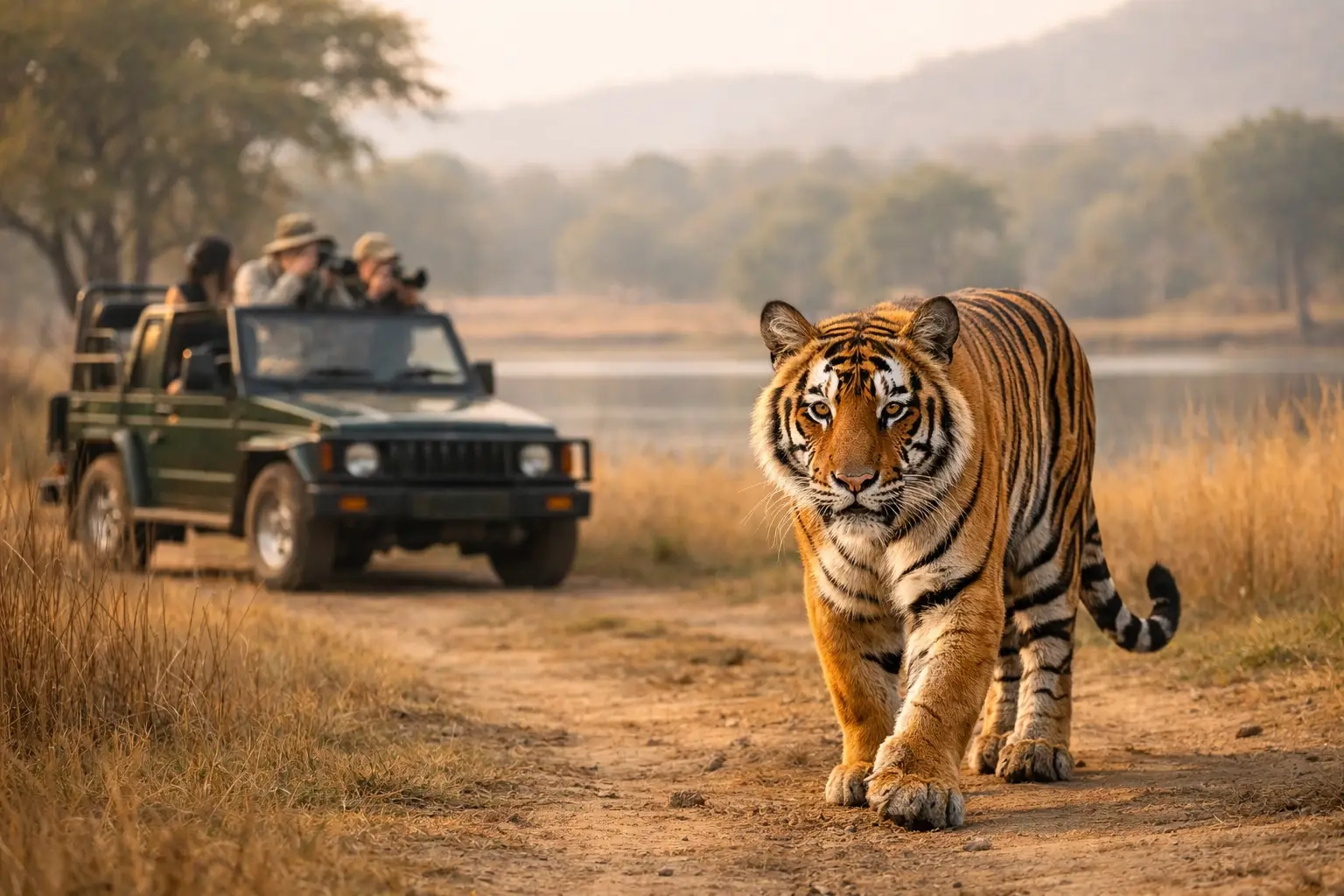
The best tiger safari itineraries are decided before the first jeep enters the forest. Which parks, in which order, how many nights in each, and how long the drives between them actually take.
Our standard recommendation for Central India is ten nights across three parks — Pench, Kanha and Bandhavgarh — all in Madhya Pradesh. Here is the route, with the drive times that most itineraries leave out.
Why these three, in this order
Each park has a different character, so they build rather than repeat.
Pench is the easiest opening, because it is closest to Nagpur airport. Teak forest and open meadows, a gentle introduction to the rhythm of safari days.
Kanha feels more expansive — the broad grassland maidans are a genuine change of landscape after Pench's denser forest. It is also the stronghold of the endangered hard-ground barasingha, which exists in meaningful numbers almost nowhere else.
Bandhavgarh closes the trip with the most dramatic terrain: hills, bamboo, grassland and the fort ruins above it all. It has a reputation for density of sightings, which is deserved but seasonal.
Three nights in each is the minimum worth doing. That gives you roughly five or six drives per park at different times of day and in different conditions, without repacking every morning. Two nights gives you three drives and a lot of pressure on each one.
The drive times, honestly
This is the part that shapes the trip.
Nagpur to Pench: around 2–2.5 hours. Easy.
Pench to Kanha: around 5–6 hours. A proper travel day.
Kanha to Bandhavgarh: around 5–6 hours. Another one.
Bandhavgarh to Jabalpur airport: around 4–5 hours.
Two long transfers in a ten-night trip is a fair trade for three distinct habitats. But they need to be real travel days with a late lunch built in, not squeezed around a morning drive and an afternoon one.
The itinerary
Day 1 — Arrive Nagpur
Fly into Nagpur and stay the night there rather than pushing straight to the forest. After a long flight from Australia, this one night does more for the trip than an extra drive would. It also absorbs a delayed connection without costing you a safari.
Days 2–4 — Pench National Park
Leave after breakfast and reach the lodge by midday, which usually leaves time for an afternoon drive subject to park timings and your permit.
Pench is dry deciduous forest, teak stands and clearings. Mornings can be misty with heavy birdlife; afternoons change character as animals move toward water. Beyond tiger, look for wild dog, gaur, sambar, jackal, and the langur-and-deer alarm system that tells your naturalist more than any radio does.
Leave the full day lightly structured: morning drive, lunch, rest, afternoon drive. The hours between drives are a real part of the experience, which is why lodge choice matters more than people expect.
Days 5–7 — Kanha National Park
A morning drive in Pench, then the transfer to Kanha, or a straight after-breakfast departure if you would rather arrive relaxed. We will plan it either way.
Two full days at Kanha with morning and afternoon drives. Zones matter here — park access is allocated by permit and the forest changes noticeably between areas, so this is not a case of any gate being as good as another. We book around what is actually available at the time of booking, and tell you what we got.
Kanha rewards travellers who enjoy the whole forest rather than only the headline animal: barasingha in tall grass, a shift in bird calls, pugmarks along a track. A good naturalist builds the morning out of those.
Days 8–10 — Bandhavgarh National Park
Another full travel day north-east, then three nights. The terrain is more undulating, the forest roads more enclosed, and Bandhavgarh Fort gives the reserve a presence the others do not have.
Two full safari days. By this point you will have had several early starts, so we would protect at least one afternoon for the lodge rather than filling every slot. Some travellers want every available drive; others are glad of a quiet afternoon by day eight. Tell us which you are and we will build it that way.
Day 11 — Depart via Jabalpur, or continue
Most travellers fly out of Jabalpur. Do not book a tight connection off the back of a morning drive — it is the one place this itinerary can go wrong.
Alternatively, continue: the safari pairs well with Rajasthan's forts and palaces, or with Agra and the Taj Mahal, or with a slower week in Kerala afterwards.
When to go
Central India's parks are closed through the monsoon, usually from around July to September, with exact dates set each year by each reserve. The safari season runs roughly October to June.
October to February is the comfortable half — crisp mornings, soft light, pleasant days. Bring layers; December and January mornings in an open jeep are genuinely cold.
March to June gets hot, and that is precisely why many serious wildlife travellers prefer it. Vegetation thins, water sources shrink, and animals concentrate around what is left. Sightings improve as the comfort declines. By May, afternoons are hard work.
There is no single best month. If you want birds and comfortable touring, come early in the season. If the tiger is the whole point and you can handle the heat, come late.
On sightings
We will not promise you a tiger, and you should be wary of anyone who does.
What a ten-night, three-park itinerary with five or six drives per park gives you is a good number of chances in a range of conditions — which is the only thing anyone can honestly offer. Most travellers on this itinerary do see tiger, often more than once. Some do not. The ones who come home happiest are generally the ones who were also interested in the forest.
The details that make it work
More coordination sits behind this trip than it appears. Safari permits are issued for specific dates, gates and vehicles, and they sell out. Lodge location determines your drive to the gate each morning. Flights, road transfers and park hours all have to agree, especially when the safari sits inside a longer India itinerary.
Lodges deserve more thought than their photographs. The right one may be the closest to your preferred gate, or the quietest, or the one with the strongest resident naturalist team — and those are rarely the same property.
We plan the whole sequence as one itinerary: parks, lodges, permits, private transfers and onward travel. Tell us when you can travel and we will tell you what is realistically available, including when the honest answer is that your dates would be better served by a different pair of parks.
Give the forests time and you will remember more than a photograph: the low call of a deer somewhere behind you, dust rising off the track, and the particular quiet that arrives just before the light changes.