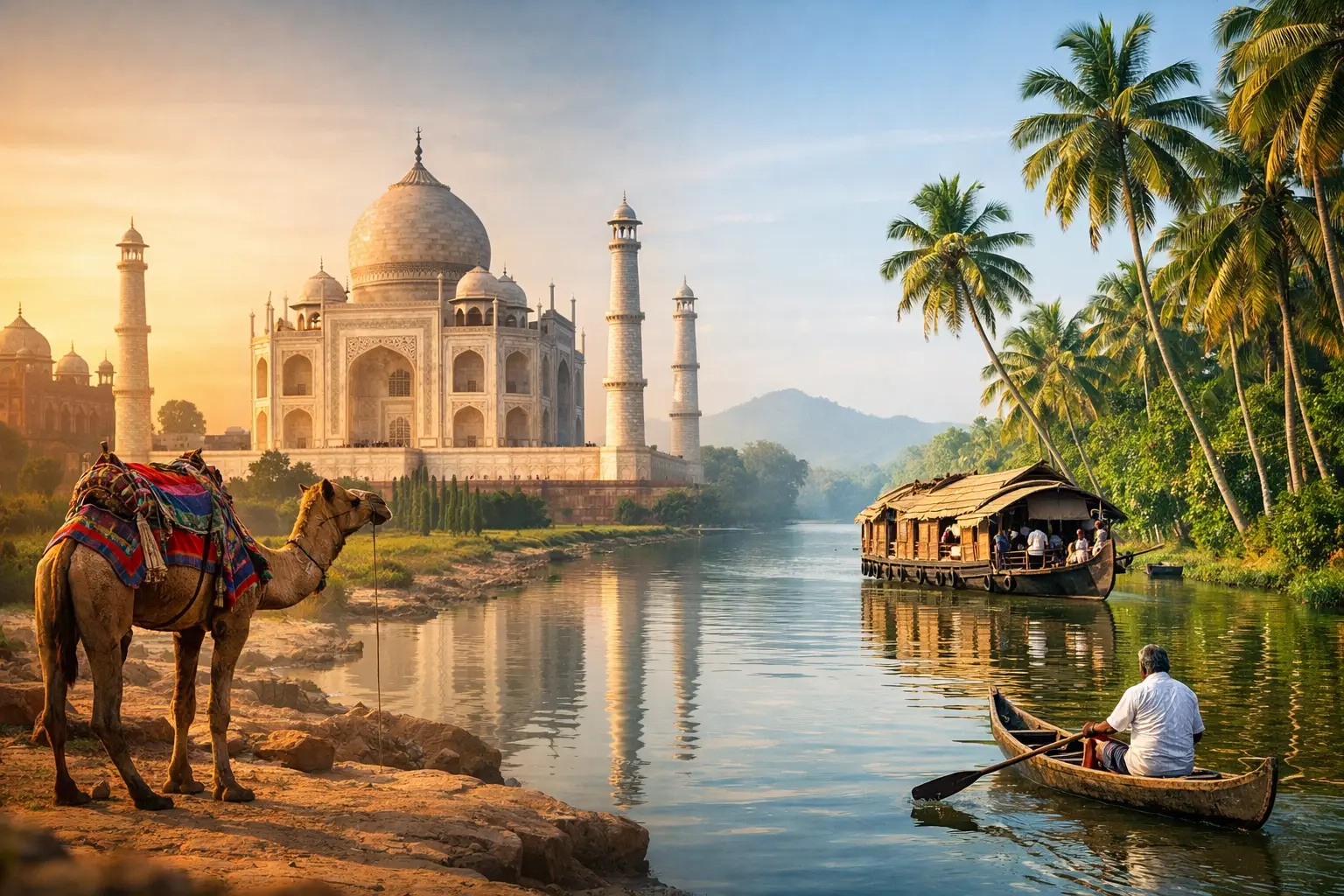
The moment you leave Jaipur's rose-hued palaces and arrive among Kerala's palms, the contrast feels deliberate rather than abrupt. Pairing the Golden Triangle with Kerala brings together two distinctly different expressions of India: the grand architecture, living history and energetic streets of the north, followed by the slower rhythms, waterways and coastal flavours of the south.
For Australian travellers covering a considerable distance to reach India, this combination makes excellent use of the time. It delivers the essential northern landmarks without asking you to stay in busy cities for the whole journey, then creates space to rest and absorb what you have seen.
Why the combination works
Delhi, Agra and Jaipur are a rich introduction to northern India. In Delhi, Mughal monuments, colonial-era avenues and contemporary neighbourhoods sit side by side. Agra centres on the Taj Mahal, whose scale and detail reward an unhurried visit. Jaipur adds royal residences, craft traditions and the landscapes of Rajasthan.
These are visually compelling places, but they make for full days — early starts to catch the major sites at their best, road transfers between cities, and a great deal to take in. Kerala is the natural counterpoint. Its appeal is shaped less by monument-hopping and more by the movement of water, the scent of spice gardens, unhurried meals and the changing view from a quiet retreat.
The point is not simply that one region is active and the other restful. Together they give each other context. The imperial ambition visible in the northern forts and mausoleums is balanced by Kerala's long maritime history, its layered traditions and its closeness to the landscape.
A considered route from north to south
A well-designed itinerary usually begins in Delhi, with an arrival night before sightseeing starts. From there, private road travel links Delhi, Agra and Jaipur in a logical sequence, with stops and stays chosen so the journey doesn't become a checklist.
The northern highlights
In Old Delhi, a guided walk or rickshaw ride reveals the texture of the markets, lanes and food traditions in a way that passing through by car cannot. New Delhi offers a different perspective, from ceremonial boulevards to elegant garden precincts. A good guide turns those contrasts into a coherent story rather than a series of separate sights.
Agra deserves more than a rushed photograph. An early morning or late afternoon visit gives the Taj Mahal a quieter, more atmospheric quality, and time at Agra Fort deepens the Mughal context. Depending on your interests, the route to Jaipur can also include local artisan traditions or the beautifully preserved abandoned city of Fatehpur Sikri.
Jaipur is most rewarding when its headline attractions are paired with smaller experiences. Amber Fort, the City Palace and Jantar Mantar are deservedly well known, but a private visit with a textile specialist, a cookery session or time with local craftspeople lends the city real depth. Your accommodation matters here too — a heritage stay extends the sense of place after the day's touring ends.
A flight then connects Jaipur or Delhi with Kochi, avoiding an unnecessarily long overland journey and letting Kerala feel like the change of scene it should be.
Kerala's slower rhythm
Kochi is an appealing first stop in the south. Its historic harbour district reflects centuries of trade and cultural exchange, with Chinese fishing nets, the synagogue precinct, churches and colonial buildings all within reach. A private guide can shape the day around art, architecture, food, or simply a relaxed walk through Fort Kochi.
From there, most journeys continue into the backwaters around Kumarakom or Alleppey. Time on a private houseboat is often the highlight, particularly as an overnight experience rather than a brief cruise. Gliding past coconut groves, village jetties and rice paddies is a genuine change of pace after the north. The quality of the vessel, the crew and the mooring arrangements makes a real difference, so this is worth getting right rather than booking on price.
The final Kerala stay might be in the cooler hills of Munnar among tea estates and forested slopes, or along the coast near Marari, where the emphasis is beachside calm. Munnar suits travellers who enjoy scenery and gentle walks; the coast suits those who would rather have fewer transfers and more uninterrupted time. Neither is the right answer — it depends on how you want the trip to end.
How long should you allow?
Twelve to fourteen nights is the ideal starting point. That allows three or four nights across Delhi, Agra and Jaipur, followed by seven or more in Kerala — enough to include the key northern sights while preserving the unhurried quality that makes the southern half work. Our guide to the Golden Triangle covers the northern leg in more detail.
A shorter itinerary is possible if your dates are fixed, but it involves trade-offs: one Kerala base instead of two, or fewer nights in Delhi and Jaipur. For travellers who value immersion, adding nights is almost always more satisfying than adding destinations. India reveals itself in the moments between the famous places — a morning chai, a conversation with a guide, a meal that lingers, the view from your room after the day visitors have left.
With more time, you might add Ranthambore National Park after Jaipur for wildlife, or extend Kerala with a hill-country stay. Both need careful sequencing around domestic flight schedules.
The details that make it feel effortless
India rewards careful coordination. The distances between northern cities, the timing of a Taj Mahal visit, flight connections to Kerala, check-in windows and luggage arrangements all shape how the holiday actually feels. A good itinerary does not fill every hour. It leaves room for a late breakfast, a swim, or a quiet afternoon when the weather calls for one.
Accommodation should change with the destination. Delhi calls for a calm city sanctuary with good access to the key districts. In Jaipur, character and heritage matter as much as location. On the backwaters, privacy and attentive service count for more than a long list of facilities. Kerala's hills and coast each invite a different style of stay.
Private drivers and knowledgeable local guides provide the continuity that holds a multi-stop itinerary together, and let you focus on the experience rather than the practicalities.
Who enjoys this combination most?
It suits couples and small private groups who want India's landmark experiences without giving up the time to slow down. It works particularly well for first-time visitors, because it includes the recognisable icons while having enough variety to feel personal rather than prescribed.
It is also a strong choice for return visitors who have seen parts of the north and want India through a different lens. Kerala's food, wellness traditions, waterways and landscape offer a restorative dimension that complements Rajasthan's colour rather than competing with it.
The balance can be shifted around what matters most to you — more heritage interpretation in the north, an extra night on the backwaters, a quieter coastal finish. The most memorable version of this journey is not the one that fits the most into each day. It is the one that gives each place the time it deserves.