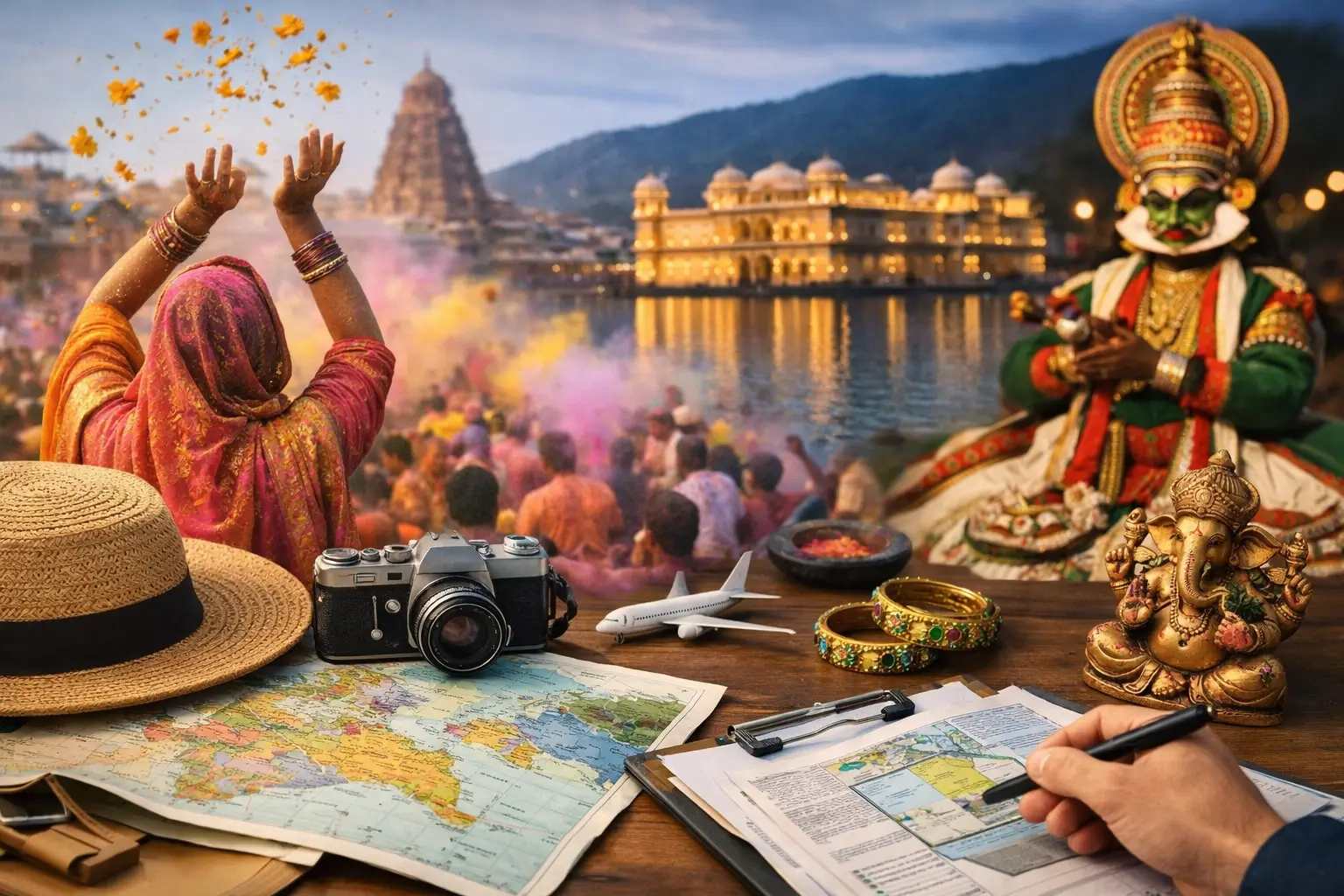
Timing a trip to India around a festival is one of the best decisions you can make, and one of the easiest to get half-right. The festivals are extraordinary. They are also crowded, expensive to book late, and in several cases genuinely disruptive to ordinary travel.
Here's what each one is actually like, when it falls, and how far ahead you need to commit.
A note on dates
Most Indian festivals follow lunar calendars, so the dates move every year — Holi can fall anywhere in March, Diwali between mid-October and mid-November. Only a few are fixed.
The practical consequence: don't book flights before confirming the date for your year. We check it as the first step of any festival itinerary, and we'll tell you exactly when it falls before you commit to anything.
Holi — March
The one everyone pictures: coloured powder, water, music, and a day when ordinary social rules are suspended.
What it's actually like: joyous and completely uninhibited. You will get soaked and stained — bring clothes you'll throw away, and expect colour in your hair for days. It's a full-contact festival.
Where to be: Jaipur and the Shekhawati towns for a manageable version; Mathura and Vrindavan for the most intense and traditional celebrations, which run for days around the main date.
The caveat we always give: in crowded public celebrations, the atmosphere can tip. Women travellers in particular can find large unmanaged Holi crowds uncomfortable. A hosted or hotel-based celebration gives you the whole experience with the edges taken off, and that's usually what we recommend.
Holi sits at the end of the good season for Rajasthan, which makes it easy to build a full itinerary around.
Diwali — October or November
The festival of lights, and the biggest in the Hindu calendar. Oil lamps and candles on every building, fireworks for several nights, families visiting, cities transformed.
Where to be: Jaipur is spectacular — the whole old city is illuminated and the markets compete on decoration. Varanasi is extraordinary, particularly Dev Deepawali a fortnight later, when the entire riverfront is lit with lamps.
What to know: the fireworks are enormous and unregulated by Australian standards. Delhi's air quality is poor around Diwali, which matters if anyone in your party has asthma. Businesses close, domestic travel is at its heaviest, and hotel prices rise sharply.
Book six to nine months out. This is not a festival to plan late.
Pushkar Camel Fair — November
Thousands of camels, horses and traders on the dunes outside a small Rajasthani town, alongside a major Hindu pilgrimage to the lake. Part livestock market, part fairground, part religious gathering.
What it's actually like: dusty, chaotic, photogenic beyond belief, and an unusual chance to see rural Rajasthan doing business rather than performing for visitors.
Where to stay: luxury tented camps set up for the duration and they sell out early. Pushkar itself is small, with limited conventional accommodation.
Pushkar falls at the best time of year for Rajasthan, which makes it the easiest major festival to combine with a classic itinerary.
Hornbill Festival, Nagaland — 1 to 10 December
A fixed date, unusually, which makes planning easier.
Seventeen Naga tribes gather at Kisama, near Kohima, in traditional dress for dance, music, craft and food. It is the most accessible window into North East India's tribal cultures, and it looks and feels unlike anywhere else in India.
What to know: Nagaland requires an Inner Line Permit for Indian nationals, and foreign visitors should register on arrival. Accommodation around Kohima is limited and basic, and it fills a long way out. This is a trip for travellers who care more about the experience than the thread count.
Pairs naturally with a wider North East India journey through Assam and Meghalaya.
Others worth knowing
Durga Puja, September or October, is Kolkata's great festival — enormous temporary pavilions housing sculpted deities, each commissioned as a work of art, and the whole city walking between them at night. Underrated by foreign visitors.
Ganesh Chaturthi, August or September, belongs to Mumbai and Pune — processions carrying Ganesh idols to the sea.
Onam, August or September, is Kerala's harvest festival, with snake-boat races and elaborate vegetarian feasts.
Rann Utsav, roughly November to February, is a long season rather than a single festival: a tented city on the white salt desert of Kutch in Gujarat, best under a full moon.
Guru Nanak Jayanti, November, fills Amritsar's Golden Temple with light and processions.
How to actually plan a festival trip
Confirm the date first, then book flights. In that order, always.
Book six to nine months ahead for Diwali, Pushkar and Hornbill. Three to six for Holi. The good accommodation goes first and the gap between good and poor is wide at festival time.
Build the festival into a longer trip rather than flying in for it. Two days around the event and ten days either side makes a holiday; three days total makes an expensive rush.
Expect disruption. Shops close, roads close, trains and domestic flights fill. A festival itinerary needs more slack than a normal one, not less.
Bring the right clothes. Modest dress for religious occasions, and genuinely disposable clothes for Holi.
Consider a hosted version of the big public festivals. You get the experience with someone who knows when to arrive, where to stand and when to leave.
What we do
We confirm the date for your year before anything is booked, secure accommodation early because that's the part that fails, and position the festival inside a wider India festival journey rather than making it the whole trip.
We'll also tell you when a festival isn't right for you. Holi with small children, or Diwali in Delhi with a respiratory condition, are both things we'd steer you away from rather than sell.
Tell us which festival appeals and roughly when you can travel — and start that conversation early. For these trips, the booking window matters more than anything else.