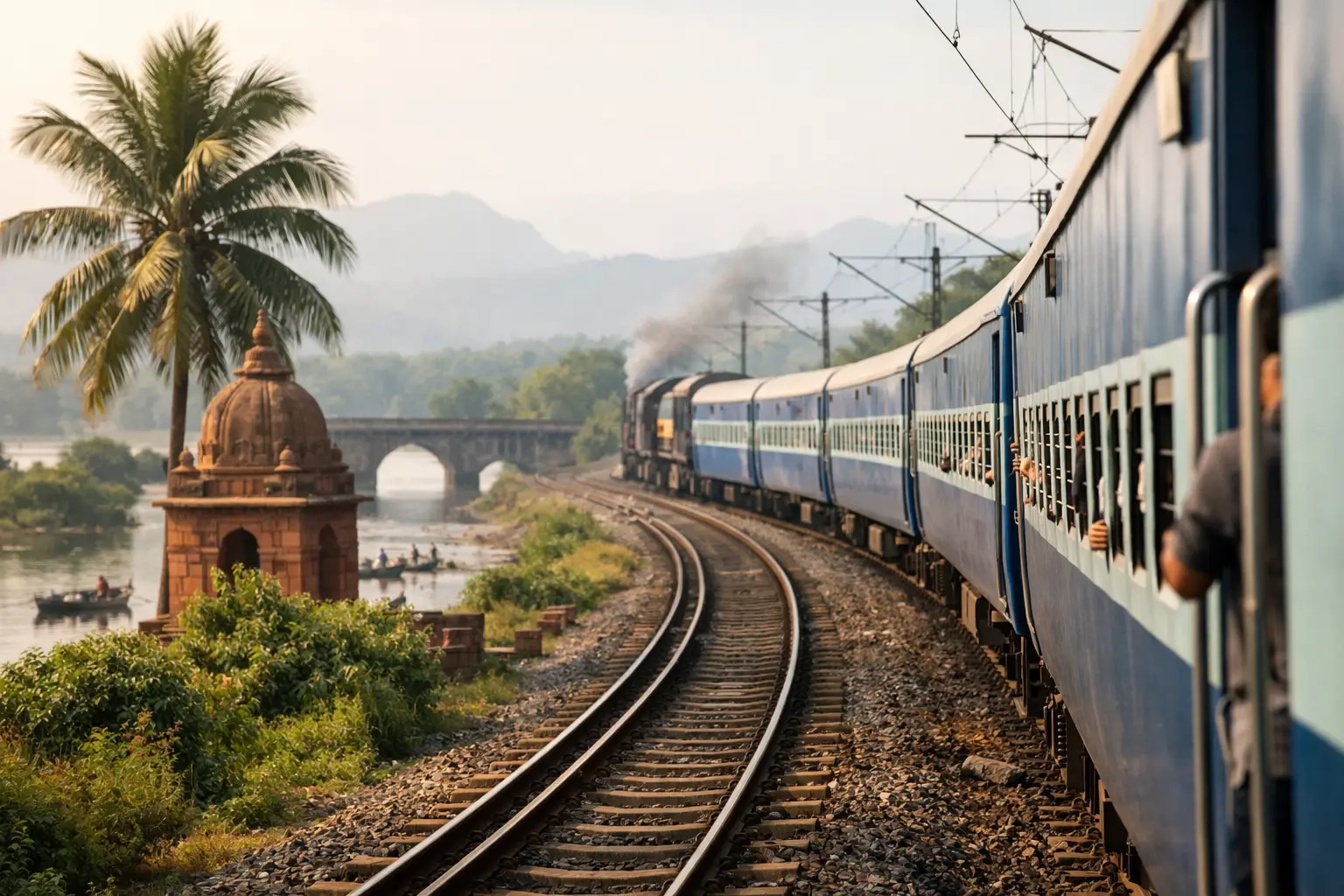
A well-planned rail holiday changes the pace of a journey through a country where every region has its own character. Instead of repeatedly checking in, checking out and queueing at airports, you settle into your carriage, watch the terrain shift past the window, and arrive close to the stories you came for. From Rajasthan's desert cities to the temple towns of the south, rail brings a welcome continuity to an itinerary with real depth.
For Australian travellers the appeal is not simply the train. It is the chance to combine India's rail heritage with well-chosen hotels, knowledgeable guides and time to absorb each destination properly. The best journeys are carefully paced — room for an early visit to a fort, an unhurried lunch, a safari or an evening performance, without turning each day into a timetable to be endured.
Why travel India by rail?
India is vast and its highlights sit in very different landscapes. Rail covers that ground while keeping you connected to the places in between. The run from Delhi towards Rajasthan reveals changing villages and open plains; southern routes move through forest, historic interiors and coastal scenery. Those transitions are part of the experience rather than time lost.
The landmark luxury trains make this especially rewarding. They pair elegant cabins and attentive service with off-train touring built around the major cultural sites, so you are not choosing between comfort and discovery. A morning might begin with tea in your cabin and lead into a guided walk through a princely city; the evening brings you back to a well-prepared meal and familiar surroundings.
There is a practical advantage too. India's most rewarding itineraries involve several stops, each with its own transfers, sightseeing and hotel requirements. A rail journey simplifies the middle of the route, leaving more energy for the places that matter most to you.
Choosing the right train
The right train depends on the region you want to understand, the time you have, and how you like to travel. Each has a distinct rhythm, and each is best treated as one element of a wider itinerary rather than a holiday in isolation.
Palace on Wheels, for Rajasthan
The Palace on Wheels is closely associated with Rajasthan, where palaces, forts, artisan traditions and desert landscapes make one of India's most compelling overland journeys. The route suits travellers drawn to Jaipur, Udaipur, Jaisalmer and Jodhpur, usually alongside Agra and the Taj Mahal.
Rajasthan rewards a considered approach. The grand monuments are essential, but the experience deepens when there is space for the smaller things — a textile workshop, a walk through an old quarter, an afternoon at a heritage hotel before the train departs. Arriving in Delhi a little earlier, and staying on afterwards, is what stops the itinerary feeling rushed.
Maharajas' Express, for wide-ranging North India
The Maharajas' Express is the most polished way to travel through North and Central India. Depending on the departure it may link Delhi, Agra, Rajasthan and destinations such as Varanasi, Ranthambore or Mumbai — a strong choice for first-time visitors who want several defining parts of India in one well-managed route.
Its value is the breadth. You might encounter Mughal architecture, Rajput history, wildlife and the spiritual atmosphere of Varanasi in a single journey. That variety is exciting, and it also means the choice of departure matters more than usual. A Rajasthan-focused route feels quite different from one that reaches the Ganges or continues to Mumbai. Start from your interests, not the departure dates.
Golden Chariot, for the south
Southern India deserves its own rail experience, and the Golden Chariot is a gracious introduction to Karnataka, Kerala, Tamil Nadu and Goa depending on the itinerary. The visual language changes entirely: carved temple complexes, former royal centres, coffee country, tropical vegetation and coastal influences in place of sandstone forts and desert horizons.
It suits travellers who have already seen the north, or whose interests run towards architecture, food, nature and slower cultural encounters. It works well alongside extra time in Bengaluru, Mysuru, Kochi or a coastal retreat. The distances down here are substantial, which is exactly why the train earns its place.
Deccan Odyssey, for the west and centre
The Deccan Odyssey opens another side of the country, with itineraries taking in Maharashtra, Gujarat, Rajasthan, Goa and the Deccan plateau. It suits travellers looking past the familiar first-time routes — urban heritage, ancient cave sites, vineyards, coast and wildlife in one journey.
This is where itinerary design matters most. The route can be complemented with time in Mumbai, a stay near a national park, or a quiet extension that gives you contrast after a run of stimulating days. There is no single right combination; it depends on whether you want more heritage, more nature, or more time to simply be somewhere.
The journey around the train matters just as much
A luxury train makes a memorable centrepiece, but it should not carry the whole holiday. International flights, arrival arrangements, accommodation either side of the rail sector, private transfers and guided touring all shape how relaxed the trip feels.
Two or three nights in Delhi, Mumbai or Bengaluru before boarding makes a considerable difference. It lets you recover from the flight and start the journey with curiosity rather than fatigue. Staying on afterwards creates room for the destinations that deserve more than an excursion — the backwaters of Kerala, the Himalayan foothills, a wildlife lodge, or a few restorative days at the coast.
Accommodation should be chosen for more than appearance. Location, access, room style, dining and service all matter, particularly after a full day of sightseeing. A heritage hotel deepens the atmosphere in Rajasthan; a contemporary city hotel offers a calm counterpoint to a busy itinerary.
Timing, pace and preparation
Rail departures run to fixed schedules, which makes advance planning genuinely valuable. Your preferred cabin category, the best hotel rooms and the most convenient flight connections all shape the final itinerary. Festival periods add something special but demand closer attention to availability and daily pacing.
Climate is the other consideration. Northern India, Rajasthan and the south follow different seasonal patterns, so a route that is ideal in one month may need rethinking in another. The aim is not simply pleasant weather, but a journey that feels balanced from morning through to evening.
Then there are the small operational details that benefit from professional handling: passport validity, visas, luggage, dining preferences, mobility needs, airport transfers. None is difficult alone, but together they become a distraction when the holiday involves several cities and a fixed departure you cannot miss.
Travel by train, but arrive with a sense of place
The most memorable rail holidays are not defined by how many destinations appear on the map. They are defined by what stays with you — dawn over a fort, regional dishes at a beautifully set table, birdsong in a national park, or the landscape passing quietly from your cabin window.
When the arrangements are properly managed, you are free to give your attention to India itself, one arrival at a time.