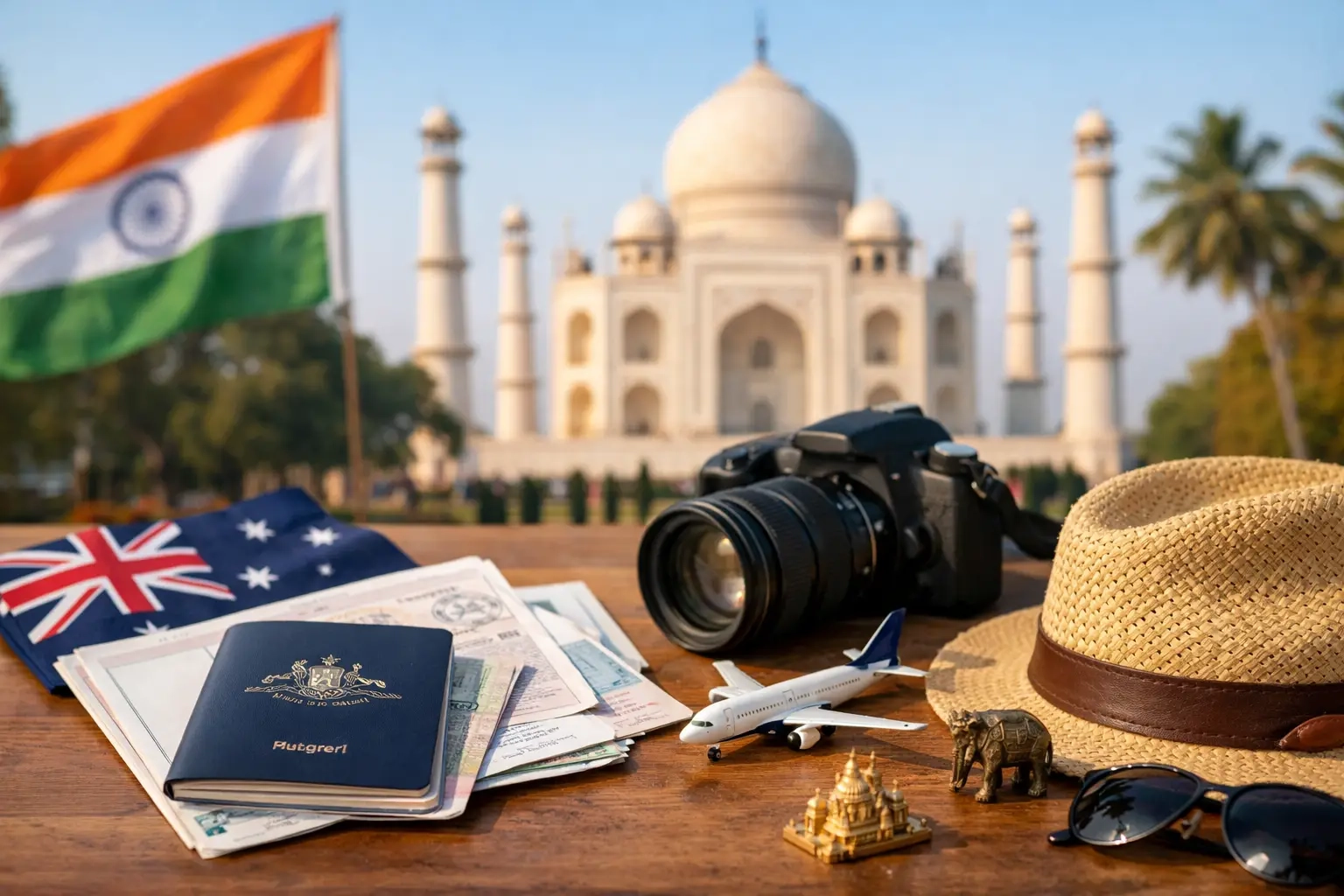
Yes, Australian passport holders need a visa for India. There is no visa-on-arrival option for Australians and no visa-free entry.
For almost every holiday, the answer is the e-Visa: applied for online before you leave, approved by email, no appointment and no passport posted anywhere. The process is genuinely straightforward. What catches people out is rarely the form — it's the timing, the photo, and the surprising number of lookalike websites that will charge you several times the real price for the privilege of filling it in on your behalf.
Here is what actually matters.
Use the official portal, and nothing else
The Indian government's e-Visa site is indianvisaonline.gov.in. That is the only site that issues the visa.
A large number of commercial sites rank well in search, look official, use similar names and colour schemes, and charge a substantial markup to submit the same form you could submit yourself. Some are legitimate agents. Some are not, and they collect your passport details along the way.
Type the official address in directly rather than clicking a search result. If a site asks you to pay before it shows you a government reference number, stop.
We tell every client this before they apply, and we'll point you to the right page when the time comes.
Which e-Visa to apply for
The e-Visa comes in several categories, and the right one depends on what you'll actually be doing:
Tourist e-Visa covers holidays, sightseeing, visiting friends and family, and short yoga or wellness programmes. This is the one almost everyone we send to India needs. It's issued for different durations, and the longer options allow multiple entries — worth considering if your itinerary dips into Nepal, Bhutan or Sri Lanka and comes back.
Business e-Visa covers meetings, trade fairs and recruitment. If your trip mixes a conference with a holiday, apply for the business category — it covers both, where the tourist category does not cover the business portion.
Medical e-Visa and its attendant categories cover treatment at a recognised hospital, with accompanying family on a separate attendant visa.
If you're uncertain which applies to your trip, ask us before you apply rather than after. Changing category means a fresh application, not an amendment.
The details that cause problems
Most rejected or delayed applications we see come down to the same handful of things.
Your passport needs at least six months' validity at the time you apply, and at least two blank pages. Check this now, not the week before. An Australian passport renewal takes longer than an Indian visa does.
The photograph has strict requirements — a plain light background, full face, no shadows, square format, and not a cropped holiday snap. This is the single most common cause of a rejected application. Take it against a white wall in good daylight rather than reusing an old passport photo.
The name must match the passport exactly. Not your preferred name, not an abbreviation, not a maiden name you still use socially. Character for character as printed.
Your port of entry and exit are declared on the form. If your itinerary changes materially after approval, tell us — some changes are fine, some are not.
You'll need a scan of the passport bio page, and depending on category, supporting documents such as a business letter or hospital correspondence.
Allow more time than you think
The e-Visa is usually processed quickly. That is exactly why people leave it too late.
We ask our travellers to apply at least three weeks before departure, and more if the trip falls near Indian public holidays or if anything about the application is unusual — a recently renewed passport, a previous visa refusal, dual nationality, a name change. The system is fast when everything is routine and much slower when it isn't, and you want the slack to exist before you need it.
Applying too early has its own catch: on the one-year and five-year e-Visas the validity runs from approval rather than from arrival, though on the 30-day visa the 30 days run from your first arrival. Three to four weeks out is the sweet spot for most holidays.
Entry decisions are not ours, or yours
Worth saying plainly: an approved e-Visa is permission to travel to India, not a guarantee of entry. Immigration officers at the border make the final decision, and they can decline. This is true of every country and almost never an issue for Australian leisure travellers, but we would rather you heard it from us than discovered it as a surprise.
Carry a printed copy of your approved e-Visa along with the digital one. Phone batteries fail at arrivals halls.
If you're also visiting Sri Lanka, Nepal or Vietnam
Each country has its own system and none of them talk to each other. Sri Lanka uses an Electronic Travel Authorisation, Vietnam has an e-visa, Nepal issues visas on arrival for Australians, and Bhutan works through a licensed operator with a daily levy.
If your trip crosses borders, our guide to visas across the region covers how they fit together — and note that re-entering India after a side trip may need a multiple-entry visa rather than the single-entry one most people default to. That's a detail worth getting right before you apply, not after.
Where we come in
We don't apply on your behalf — the application has to come from you, and anyone who tells you otherwise is adding a fee rather than a service.
What we do is tell you which category you need, when to start, what the current requirements are at the time you're travelling, and what to have ready before you open the form. Visa rules change without much warning, and part of what you're paying us for is that we're watching them.
If you're planning a trip to India and want the practical side handled properly alongside the itinerary, tell us what you have in mind. We'll have the visa conversation early, where it belongs.
This guide describes the process rather than quoting fees or processing times, because both change without notice. Always confirm current requirements at indianvisaonline.gov.in, and check the Australian Government's advice for India at smartraveller.gov.au before you travel.