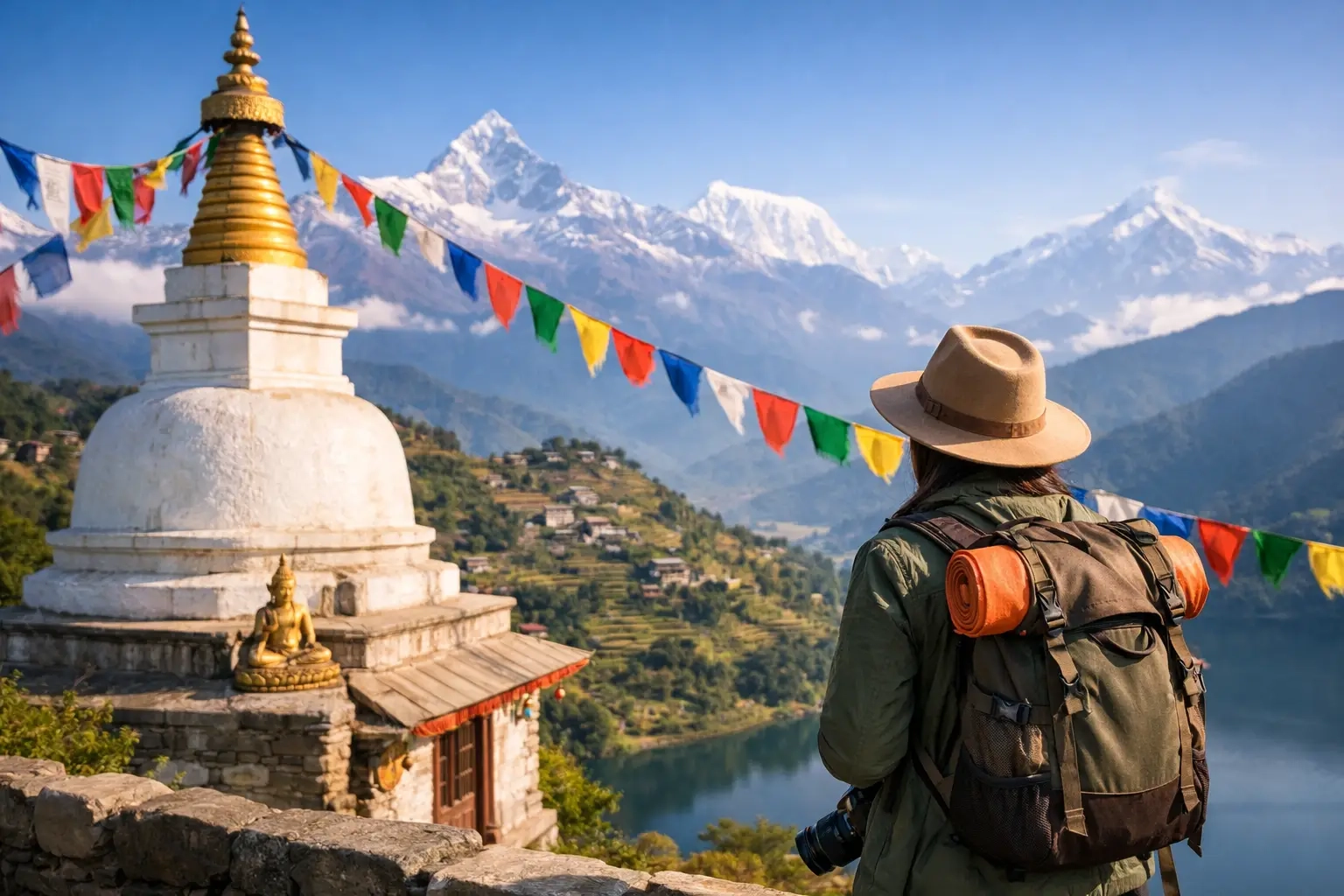
Most Australians who go to Nepal don't trek, and the ones who assume they have to often skip the country entirely. That's the misconception worth clearing up first.
Nepal rewards travellers who never put on a pair of hiking boots: three ancient royal cities within an hour of each other, a lakeside town below an 8,000-metre skyline, a jungle national park with rhino and tiger, and some of the most striking religious architecture anywhere. The Himalaya is the backdrop whether or not you walk into it.
The core of a Nepal trip
Kathmandu Valley holds three former kingdoms — Kathmandu, Patan and Bhaktapur — each with its own Durbar Square of palaces, temples and courtyards. Bhaktapur in particular is one of the best-preserved medieval cities in Asia, and a half-day there is the highlight of many trips.
Add Boudhanath, one of the largest stupas in the world and the centre of Tibetan Buddhist life in Nepal, and Pashupatinath, a major Hindu temple complex on the Bagmati river with open-air cremation ghats. Two very different faiths, a few kilometres apart, both entirely alive.
Pokhara sits beside a lake with the Annapurna range rising directly behind it. It's where people slow down. Boating on Phewa Lake, the sunrise view from Sarangkot, paragliding if you fancy it, and the easiest access to short walks with serious mountain views.
Chitwan National Park, in the lowland Terai, is the wildlife chapter — one-horned rhino, deer, crocodile, abundant birdlife, and a small tiger population. A jeep safari and a canoe trip on the Rapti river make a genuine change of pace after the valleys.
The mountain flight. An hour-long scenic flight from Kathmandu along the Himalaya, with Everest at the turnaround. Every passenger gets a window seat. For travellers not trekking, this is how you see the high mountains properly, and it's one of the best-value hours in travel.
How long to allow
Seven to eight days covers Kathmandu Valley, Pokhara and the mountain flight comfortably.
Ten to twelve days adds Chitwan, or a short walk in the Annapurna foothills, without rushing.
Two weeks or more opens up a proper trek, Lumbini (the Buddha's birthplace), or a slower route through the hill towns.
Nepal also combines well with India — it's a short flight from Delhi or Varanasi, and an India–Nepal itinerary makes good sense on three weeks.
If you do want to walk
You don't need to be a mountaineer, and you don't need weeks.
Short options — two to four days around Pokhara, such as the Ghorepani and Poon Hill route — give you sunrise over Annapurna and Dhaulagiri, teahouse nights, and rhododendron forest, at altitudes most reasonably fit people manage.
The classics — Annapurna Base Camp or Everest Base Camp — need two to three weeks, proper acclimatisation days built in, and genuine preparation. We won't sell you a compressed version of either. Rushing altitude is how people get hurt.
On altitude, plainly: Kathmandu sits around 1,400 metres and Pokhara lower still, so neither presents any issue. Altitude only becomes a consideration on treks, and a responsible itinerary builds in rest days rather than treating them as optional. If anyone in your party has a heart or lung condition, talk to your doctor before we finalise a route, not after.
When to go
October and November are the best weeks of the year: clear skies after the monsoon, crisp mountain views, comfortable days. This is peak season and it books out.
March to May is the second window, warmer, with rhododendron in flower through the hills. Hazier views than autumn but a lovely time to be there.
December to February is cold at altitude and some high routes close, but the valleys are fine and Chitwan is at its best for wildlife. Fewer people everywhere.
June to September is the monsoon — flights get delayed, mountain views disappear behind cloud, and trails are wet. We'd generally steer you elsewhere.
Visas and practicalities
Australians can get a visa on arrival at Kathmandu airport and at land borders, or apply online beforehand to shorten the queue — which, after a long flight, is worth doing. Bring passport photos.
Our regional visa guide covers how Nepal fits with India and the rest, and note the detail that catches people: a trip going India → Nepal → India needs a multiple-entry Indian visa.
Domestic flights within Nepal are weather-dependent and delays are routine rather than exceptional. We build buffer days around them rather than pretending they won't happen.
How we plan it
Every Nepal itinerary we build starts with whether you want to walk, and how much. That one answer changes the shape of everything else.
From there: private vehicle and driver between destinations, guides who can actually explain what you're looking at in the temple complexes — which matters more in Nepal than almost anywhere, because the iconography is dense and unlabelled — well-placed hotels, and a realistic view of internal flight reliability.
We'll also tell you when a plan doesn't work. A week is not enough for Everest Base Camp, and no amount of willingness changes that.
Tell us when you can travel and what appeals, and we'll tell you honestly what fits.