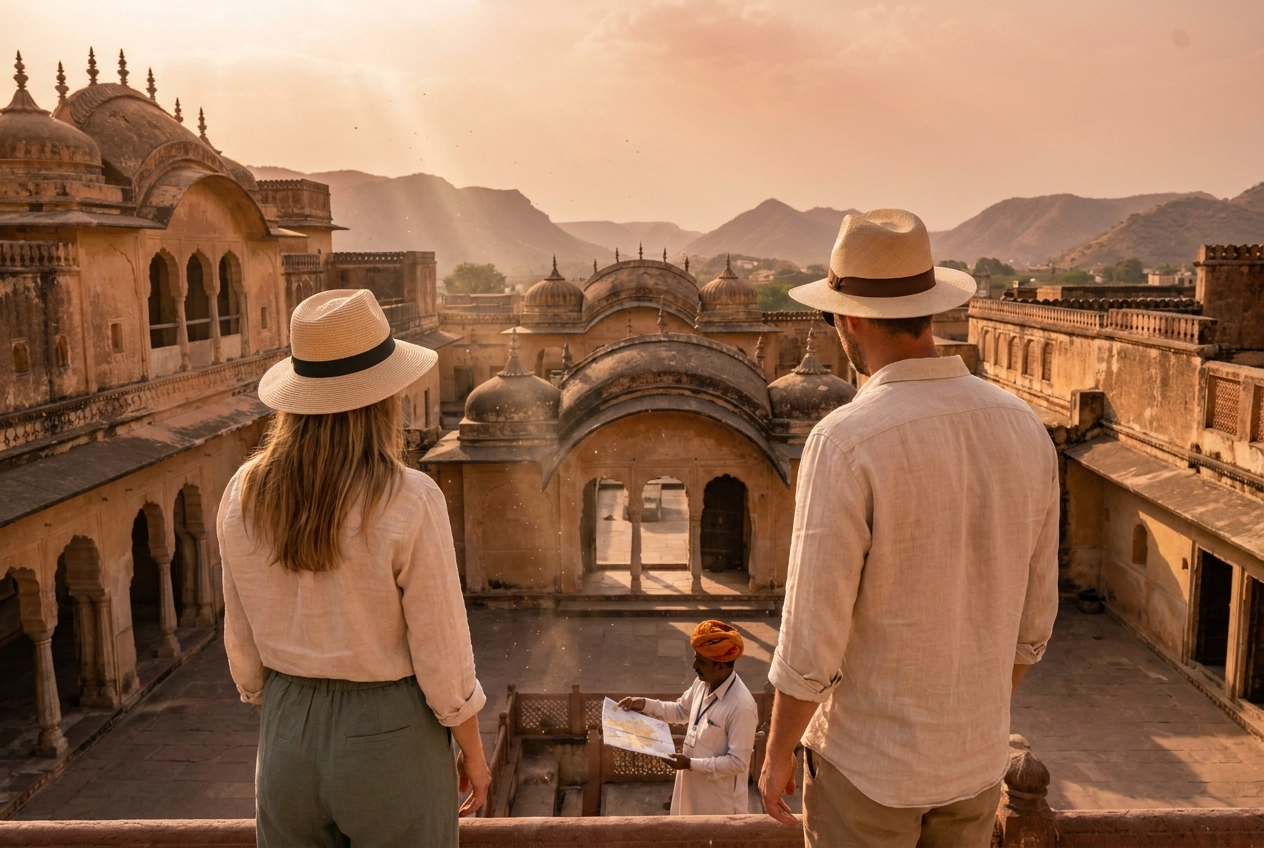
Few destinations on earth pack as much history, colour, and cultural depth into a single journey as North India. From the iconic silhouette of the Taj Mahal at dawn to the sacred ghats of Varanasi and the desert fortresses of Rajasthan, this region consistently ranks among the world's most transformative travel experiences. For Australian travellers, the distance makes it all the more important to get the planning right.
Choosing the right North India tour package can be the difference between a trip that feels rushed and disjointed and one that flows seamlessly from one breathtaking moment to the next. But with so many options available, knowing what to look for, what to avoid, and how to tailor an itinerary to suit your travel style can feel overwhelming.
This guide cuts through the noise. Whether you are a first-time visitor or returning for a deeper exploration, you will find practical advice on timing your trip, selecting reputable operators, understanding what is typically included, and making the most of your time on the ground in one of the world's most extraordinary regions.
What a North India Tour Package Actually Covers
North India is one of the most geographically and culturally expansive travel regions on earth, and understanding its true scope is the first step in planning a journey that does it justice.
The region encompasses several distinct territories, each with its own character, pace and heritage. The Golden Triangle connects Delhi, Agra and Jaipur in a rough triangle across the northern plains, forming the most-travelled introduction to India. Rajasthan extends westward through a succession of palace cities and desert landscapes: Udaipur, Jodhpur, Jaisalmer and beyond. Uttar Pradesh's spiritual heartland draws travellers to Varanasi, one of the world's oldest continuously inhabited cities, which recorded over 72 million visitors in 2025 alone. The Himalayan foothills stretch across Uttarakhand and Himachal Pradesh, taking in Rishikesh, Shimla, Dharamshala and Manali. And Punjab, anchored by Amritsar and the Golden Temple, adds a Sikh cultural dimension that stands entirely apart from anything else in the north.
A well-designed North India tour package covers far more than your international flights. It brings together vetted accommodation across each region, private transfers between destinations, guided access to major sites, internal rail or flight legs where road distances would otherwise eat into your time, and visa support to navigate India's e-Tourist Visa requirements from Australia.
For Australian travellers familiar with Bali, Vietnam or Japan, the scale of North India requires a genuine recalibration. Vietnam unfolds along a navigable north-to-south corridor; Japan connects its major cities via one of the world's most reliable rail networks. North India presents a fundamentally different logistical picture. The Golden Triangle alone involves road journeys of three to five hours between cities. Adding the Himalayan foothills or Varanasi multiplies distances considerably, and moving efficiently across the region typically means combining private cars, express trains and domestic flights.
This is why itinerary design here is a genuine skill, not simply a scheduling exercise. Rajasthan rewards slow, unhurried pacing to absorb its heritage and landscape. Varanasi operates on its own spiritual rhythm and deserves more than a single overnight stop. The Himalayan regions require seasonal awareness and contingency planning. These distinct demands cannot be compressed into one catch-all itinerary without losing depth in every region.
At Taj Voyages, we design fully tailor-made North India itineraries calibrated to the specific pace and character of each region you wish to explore, handling every logistical layer so your focus remains on the experience itself.
5 North India Itinerary Styles Worth Considering
No two travellers arrive in North India with the same expectations, and that's precisely why itinerary style matters as much as destination. The five frameworks below represent the most coherent and rewarding ways to structure a North India journey, whether you're visiting for the first time or returning to go deeper.
1. Classic Golden Triangle (7–10 Days)
Delhi, Agra and Jaipur form a natural routing loop that remains the most logical entry point into North India for first-time visitors. The three cities sit within a manageable triangle of roughly 200 kilometres between Delhi and Agra, and 240 kilometres between Agra and Jaipur, making road and rail connections genuinely practical. You'll move through Mughal architecture at its most magnificent, from the Taj Mahal and Agra Fort to Delhi's Qutub Minar and Red Fort, before stepping into the Rajput heritage of Jaipur's Amer Fort and City Palace. Seven to ten days allows enough time to move at a considered pace rather than rushing between monuments, with room for a morning in a local market or an evening at a rooftop restaurant watching the Pink City glow at dusk.
2. Golden Triangle Plus Rajasthan (12–16 Days)
For travellers who want to move beyond the well-trodden circuit and experience Rajasthan on its own terms, extending into Jodhpur, Udaipur, Jaisalmer and Pushkar transforms the journey considerably. Jodhpur's blue-washed lanes and the clifftop Mehrangarh Fort offer a dramatic contrast to Jaipur. Udaipur, built around a series of shimmering lakes, is one of India's most visually arresting cities, its lake palaces reflected in still water at sunset. Jaisalmer sits deep in the Thar Desert, its golden sandstone fort rising from the dunes like something from another century entirely. Pushkar adds a quieter, contemplative note: a sacred lake town that rewards slow exploration. At 12 to 16 days, this style suits travellers who've already ticked off the Golden Triangle or simply want more sustained immersion in royal heritage and desert landscapes.
3. Luxury Rail Journey (7–14 Days)
The Palace on Wheels and Maharajas' Express represent a fundamentally different way of experiencing North India, one where the journey itself becomes the destination. Both trains traverse Rajasthan and the Golden Triangle in extraordinary style, with your accommodation, dining and logistics moving with you. There is no constant repacking, no navigating transfers between hotels, and no lost hours at airports. The Maharajas' Express offers four distinct journey types, including The Indian Panorama and The Heritage of India, with cabin categories ranging from Deluxe to Presidential Suite. For couples or travellers who place a high value on seamless comfort alongside genuine heritage access, this style of travel is in a category of its own.
4. Himalayan and Wellness Circuit (10–14 Days)
Delhi serves as the gateway to an entirely different North India: the Himalayan foothills. A circuit combining Shimla, Manali, Dharamsala or Rishikesh shifts the register from monument-hopping to landscape immersion, slow travel and personal renewal. Rishikesh, perched above the Ganges where it emerges from the mountains, is home to internationally recognised yoga schools and meditation retreats. Dharamsala carries a distinct Tibetan character, with monasteries and a contemplative atmosphere that encourages genuine rest. This style of travel aligns directly with the growing premium demand for wellness-led experiences in 2026, where culturally restorative journeys are driving decisions across all age groups, not just those seeking retreat.
5. Spiritual India Circuit (10–14 Days)
For culturally and spiritually curious travellers, this circuit offers some of the most affecting experiences India has to offer. Varanasi at dawn, when the Ganges ghats stir with ritual, prayer and the quiet ceremony of daily life, is unlike anywhere else on earth. The Golden Temple in Amritsar, open to all faiths and radiating a sense of extraordinary collective belonging, deserves at least two visits. The ashrams of Rishikesh provide a counterpoint of stillness, while Pushkar's sacred lake and camel-fair heritage add texture and colour. Combining these stops into a single coherent journey requires thoughtful routing, and it's exactly the kind of complex, multi-city itinerary that benefits from specialist curation rather than self-assembly. To explore how any of these five styles could be shaped around your travel dates and interests, speak with the team at Taj Voyages.
Best Time to Visit North India from Australia
Timing a North India journey well is one of the most valuable decisions you'll make in the planning process, and it shapes everything from what you'll wear to which festivals you'll witness and how crowded the courtyards of the Taj Mahal will feel at sunrise.
October to March: The Core Travel Window
For most travellers, October through to the end of March represents the most comfortable and rewarding time to explore North India. Skies are clear, temperatures across Rajasthan, Delhi and Agra sit at manageable levels, and the cultural calendar is at its richest. This window aligns directly with Australian summer school holidays in December and January, making it a natural anchor for families planning their first significant India journey. This dry season window is broadly considered the best period for sightseeing, cultural exploration and outdoor experiences across the north. November and February stand out as particularly well-balanced months for the Golden Triangle and Rajasthan, offering pleasant daytime temperatures without the peak-season density of late December. For festival travellers, timing matters enormously. Diwali, which falls in October or November depending on the lunar calendar, transforms cities like Jaipur and Varanasi into extraordinary spectacles of light, sound and ceremony. Holi, celebrated in late February or March, is equally vivid; experiencing it in Mathura or Vrindavan, where the festival holds its deepest roots, is something that stays with travellers for a lifetime.
April, May and the Mountain Window
Once April arrives, the plains of Rajasthan and Delhi shift into a different register entirely. Temperatures regularly exceed 40°C and can push well beyond that through May and June, making sightseeing genuinely uncomfortable for most visitors. That said, this is precisely when the mountain regions come into their own. Himachal Pradesh, Ladakh and Spiti Valley become accessible as high-altitude passes open, offering dramatic Himalayan landscapes, remote Buddhist monasteries and a pace of travel that is worlds apart from the Golden Triangle circuit.
Monsoon Season: Disruption and Distinction
The monsoon, which moves through North India between June and September, requires honest consideration. Road travel across Rajasthan can be disrupted by rainfall, and humidity across the plains makes extended outdoor sightseeing taxing. Yet this season has its own appeal for the right traveller. Rajasthan's landscapes take on a rare green softness, and Spiti Valley and Ladakh are best experienced during this window, before mountain passes close again in autumn. If your itinerary includes the high Himalayas, this is the season to consider seriously. India's regions each have their own seasonal logic, and understanding that variation is what separates a well-planned journey from a frustrating one.
The Case for Shoulder Season Timing
For travellers who want the iconic experiences without the densest crowds, October and late February offer a compelling middle path. A growing majority of global travellers now actively choose to avoid known-crowded destinations, a shift that reflects a broader desire for more personal, unhurried travel. Shoulder-season North India delivers exactly that: the same forts, palaces and river ghats, with noticeably more space to take them in. An expert specialist can help you align your travel dates with festival windows, school holiday constraints and regional seasonal patterns to find the combination that works specifically for you. Speak with the Taj Voyages team about which timing best suits your itinerary.
The Experiences That Define a North India Journey
What you encounter in North India isn't simply a sequence of sights. It's a layered accumulation of moments, each one shaped by history, faith, land and the hands of people who have refined their crafts across generations. These are the five experience pillars that give a well-designed North India journey its depth.
Heritage Architecture at Scale
The Taj Mahal at sunrise is genuinely unlike any other experience in travel. As the morning light shifts from pale grey to warm amber, the marble seems to glow from within, and the crowds that will arrive later haven't yet broken the quiet. But the Taj is most meaningful when you arrive with context: the story of Shah Jahan's grief, the 22 years of construction, the deliberate symmetry of every element. Jaipur's Amber Fort rewards the same unhurried approach, its layered courtyards revealing Rajput military ingenuity and royal domestic life in equal measure. Jodhpur's Mehrangarh rises from a rocky outcrop above the blue city with an authority that photographs simply cannot convey; standing at its ramparts reframes your understanding of Rajput power. Fatehpur Sikri, the abandoned Mughal capital in red sandstone, is often rushed past on the road between Agra and Jaipur, yet it deserves at least half a day to properly absorb its mosque, palace quarters and the haunting stillness of a city that was deserted within a generation of being built. Pacing and expert guidance are what separate a meaningful visit from a tick-box exercise at each of these sites.
Wildlife Encounters
Ranthambore National Park sits within Rajasthan's dry deciduous forests and is among India's most compelling tiger reserves, with Bengal tigers that are notably habituated to vehicles and therefore frequently visible on morning and afternoon safaris. The park's ruined 10th-century fort rising above the treeline adds a theatrical backdrop that wildlife photographers find irresistible. For travellers whose interest in wildlife runs deeper, Jim Corbett National Park in Uttarakhand offers a different landscape entirely: dense sal forest, river grasslands and a broader range of wildlife including elephants and leopards. Kanha in Madhya Pradesh, while extending beyond the classic North India corridor, rewards those who build in additional days for a dedicated naturalist circuit.
Cuisine as Cultural Experience
North Indian food is not a single cuisine but a conversation between dynasties, climates and communities. Dal baati churma, the slow-cooked lentil and wheat-ball dish of Rajasthan, speaks to a desert culture where preservation and sustenance shaped everything on the table. Old Delhi's Mughal food lanes, particularly around Jama Masjid, compress centuries of culinary influence into a single afternoon: nihari, kebabs, sheermal and rabri that have been refined across generations of the same families. In Amritsar, sitting down to a Punjabi harvest table is an exercise in abundance and welcome. A cooking class inside a Jaipur haveli, working alongside a local cook with spices you've ground yourself, turns a meal into a memory with genuine lasting value.
Artisan and Craft Encounters
Rajasthan in particular is a living museum of Indian craft. Block printing in Bagru, a village near Jaipur, uses hand-carved wooden blocks and natural dyes in a process that predates industrialisation by centuries; watching a craftsperson register a complex repeat pattern with fluid precision is quietly astonishing. Blue pottery workshops in Jaipur offer a hands-on introduction to a Persian-influenced tradition that is unique to the city. Delhi's textile markets, from Chandni Chowk to Dilli Haat, give access to fabrics from across the subcontinent. In Udaipur, miniature painting demonstrations reveal an art form of extraordinary patience, with brushes made from squirrel hair and compositions that can take weeks to complete.
Spiritual and Ceremonial Life
The Ganga Aarti at Varanasi, performed each evening at Dashashwamedh Ghat as darkness falls over the river, is one of the most affecting ceremonies you are likely to witness anywhere in the world. Priests move in choreographed unison, fire and incense rising above the gathered crowd, the chanting resonating across the water in a ritual that has continued for centuries. At Amritsar, the langar at the Golden Temple, where tens of thousands of people are fed for free each day regardless of faith or background, reframes what community generosity looks like at scale. And across Rajasthan, waking early in a heritage fort hotel to the sound of morning prayers drifting through carved stone windows is a reminder that these are not museum pieces but living places, still animated by belief and daily human life.
Wellness and Spiritual Travel: Why North India Leads
India has quietly claimed the top position in global wellness tourism rankings for 2026, and the concentration of transformative experiences in the north of the country explains precisely why. For Australian travellers drawn to restorative, contemplative travel, North India offers a depth and authenticity that no other destination can replicate.
Rishikesh: Where Yoga Finds Its Source
Rishikesh sits at the point where the Ganges emerges from the Himalayan foothills, and its reputation as the world's most recognised yoga and meditation destination is entirely earned. The options here span the full spectrum, from traditional ashram immersions where daily schedules are structured around practice and silence, to boutique wellness retreats with Himalayan river views and contemporary Ayurvedic programmes. What distinguishes Rishikesh is not simply the volume of offerings but the authenticity of the tradition itself. Yoga and Ayurveda originated in India, and the Vedic principles underpinning these practices have been refined here over centuries. That heritage is palpable, and it is something no purpose-built wellness resort elsewhere in the world can genuinely replicate.
Varanasi: Stillness Alongside the Sacred
Varanasi is among the oldest continuously inhabited cities in the world, and the experience it offers is unlike anything else in travel. Morning light on the ghats, the rhythm of priestly ceremony, the steady movement of devotees along the river's edge; these are not performances arranged for visitors but expressions of a living faith that has continued unbroken for millennia. Varanasi rewards those who stay long enough to move at the city's own pace. A single day barely scratches the surface. Two or three nights allow the experience to settle into something genuinely meaningful, and it is in those quieter hours between the headline ceremonies that the city reveals itself most generously.
The Himalayan Hill Stations: Space and Stillness
Shimla, Dharamsala and Kasol each offer something distinct within the broader category of mountain retreat. Shimla carries the faded elegance of its colonial-era past. Dharamsala, as the seat of the Tibetan government-in-exile, holds a Buddhist dimension that sits quite apart from the Hindu spiritual traditions of the plains; the monasteries, the practising community and the Himalayan setting combine to create a contemplative atmosphere of real depth. Kasol, nestled in the Parvati Valley, draws those seeking genuine quietude among forests and river valleys. The cooler temperatures across all three destinations make them particularly appealing during the warmer months, and the slower pace of life aligns directly with the restorative, slow-travel motivations that are driving premium travel decisions across all age groups in 2026.
Rajasthan: Heritage, Ayurveda and Desert Restoration
Not every wellness traveller is drawn to the ashram circuit, and Rajasthan has emerged as a compelling alternative for those who want Ayurvedic treatment and genuine restoration without sacrificing comfort or setting. Boutique wellness properties here combine Ayurvedic programmes with heritage architecture, whether a converted haveli or a former palace, and the drama of desert landscapes. The combination produces something quite particular: a sense of being held within history while actively attending to your own wellbeing. It is a very different register from Rishikesh, and no less valid for it.
The Case for Blending, Not Separating
Perhaps the most important point is one that experienced travellers often miss when assembling their own itineraries: spiritual and wellness experiences do not need to occupy a separate trip from heritage and cultural exploration. A well-considered North India journey can move from the ghats of Varanasi to the meditation halls of Dharamsala, from a Jaipur heritage property offering Ayurvedic treatments to the golden-hour light of the Taj Mahal, without any sense of contradiction. Designing that sequence so that each element enhances rather than interrupts the others is precisely where specialist guidance proves its value. If you are considering a journey that weaves these threads together, the team at Taj Voyages would welcome the conversation.
Beyond the Golden Triangle: Less-Visited North India
The Golden Triangle remains a magnificent introduction to North India, but for travellers who want to go deeper, the country reveals entirely different dimensions just a few hours beyond those well-worn routes. Four destinations in particular reward the culturally curious traveller with extraordinary experiences and far fewer crowds.
Shekhawati: Rajasthan's Open-Air Fresco Gallery
Tucked into the semi-arid plains of northern Rajasthan, Shekhawati contains one of the world's most remarkable concentrations of painted architecture. The towns of Mandawa and Nawalgarh are lined with elaborately frescoed havelis, their facades and interiors covered in intricate paintings depicting mythological scenes, merchant life and, fascinatingly, early encounters with European technology. Jaipur lies roughly two hours to the south and absorbs the vast majority of Rajasthan's visitors. Shekhawati, by contrast, moves at a quieter pace entirely, offering a genuinely immersive encounter with merchant-era Rajasthan that feels unhurried and personal.
Orchha: A Riverside Fort Hiding in Plain Sight
Orchha sits on a bend in the Betwa River in Madhya Pradesh, holding a cluster of Mughal-era temples, royal cenotaphs and a riverside fort of considerable grandeur. Despite being accessible within a few hours of Agra, it sees a fraction of the traffic that flows through the Golden Triangle. The temples here rise in angular silhouettes above the river, their interiors painted with striking murals. Wandering Orchha feels closer to discovery than to tourism, and for travellers who value that quality, it is one of North India's most quietly rewarding stops.
Spiti Valley and Ladakh: The High Himalayan Arc
For those prepared to venture into high-altitude terrain, Spiti Valley and Ladakh represent a category of experience entirely apart. Spiti is a cold desert valley in Himachal Pradesh, ancient Buddhist monasteries clinging to cliffs above river gorges, the landscape stripped back to bare ochre and grey. Ladakh, further north, combines that same dramatic Himalayan scale with a living Tibetan Buddhist culture expressed most vividly during the Hemis Festival each June and July, when the Hemis Monastery fills with masked ceremonial dance and colour. Both regions require some acclimatisation planning and carry Inner Line Permit requirements for foreign nationals, all of which a specialist handles as part of the itinerary.
Weaving one or two of these destinations into a broader North India journey adds genuine cultural depth without dismantling the anchor sites your itinerary is built around. It also speaks directly to a very real concern among contemporary travellers: two-thirds of people surveyed in 2026 said they would actively avoid destinations known to be overcrowded. A well-designed itinerary balances both worlds, and that balance is exactly what an experienced specialist builds for you. Speak with the Taj Voyages team about how destinations like these can sit naturally within your North India plans.
Luxury Rail Travel Through North India: A Class Apart
There is a way to move through North India's heritage heartland that feels less like touring and more like inhabiting a world that has been thoughtfully assembled around you. Luxury rail travel does exactly that.
The Palace on Wheels and the Maharajas' Express are the two trains that define this experience in the north. Both traverse a sweep of Rajasthan and beyond that would take a fortnight to cover by road, yet they accomplish it in a single, flowing arc of seven or eight days. The Maharajas' Express runs four named itineraries, including the Indian Panorama, which threads through Jaipur, Ranthambore, Fatehpur Sikri, Agra, Orchha, Khajuraho and Varanasi before returning to Delhi. The Palace on Wheels covers a 2,400-kilometre circuit from Delhi through Jaipur, Udaipur, Jaisalmer, Jodhpur and Agra. Both trains call at UNESCO World Heritage sites, royal cities and tiger reserves in a single seamless journey, with curated off-train excursions included as part of the fare; entrance fees, guides and transfers are all arranged before you step onto the platform.
A Mobile Heritage Hotel on Rails
The cabins aboard these trains were designed to evoke the private carriages of the maharajas and Rajputana rulers, and the detail carries genuine provenance. The original Palace on Wheels coaches drew on the personal carriages of the rulers of Baroda and the Nizam of Hyderabad. En-suite bathrooms, butler service, fine dining in dedicated restaurant cars and a lounge and spa facility mean the standard of comfort is genuinely comparable to the finest overland heritage properties. The Maharajas' Express offers four accommodation tiers, from Deluxe Cabin through to a Presidential Suite with private living areas, all inclusive of meals, beverages and guided excursions. For travellers who appreciate the atmosphere of a landmark heritage hotel, the train delivers that atmosphere as a constant companion rather than a fixed address.
No Repacking. No Transitions. Just the Journey.
For Australian professionals and retirees who want to cover significant ground without the accumulated fatigue of nightly hotel moves, this is the quiet but transformative argument for rail. You unpack once, and the landscape comes to you.
Taj Voyages arranges the complete picture around the journey itself: pre-departure nights at a heritage property in Delhi, seamless transfers to the embarkation point, and post-journey extensions to a Rajasthani fort hotel or a Himalayan retreat in Shimla or Uttarakhand. Explore our luxury rail journeys to see how each itinerary can be shaped around your travel dates and interests.
The result is a North India journey with real coherence. The rail journey forms the spine, and the days surrounding it become part of a purposefully built whole rather than a series of disconnected nights. For travellers who want depth, comfort and the pleasure of arriving at each destination properly rested, a luxury train journey through North India is genuinely in a class of its own.
Why North India Rewards a Specialist Approach
Planning a North India journey from Australia is genuinely exciting, but the logistics beneath that excitement are more layered than they first appear. The region spans six or more distinct states, each with different transport infrastructure, accommodation tiers, seasonal considerations and cultural rhythms. A 12 to 16 day trip requires sequencing decisions that carry real consequences: whether to cover the Delhi to Agra leg on the Gatimaan Express or by private road transfer, whether Jaipur to Jodhpur works better overnight by train or whether a domestic flight frees up time for Udaipur. Getting those calls right means understanding not just geography, but lead times, cancellation policies, rail booking windows and the practical realities of connecting heritage towns that rarely appear on the same domestic flight route map.
The accessibility of online booking platforms makes self-assembly feel straightforward, and it is worth acknowledging that a significant share of India-related travel is now initiated digitally. The appeal is obvious: immediate comparison, apparent transparency and a sense of control. But a collection of individual bookings is not an itinerary. The gap between the two becomes most visible when something needs to change mid-trip, whether that is a delayed domestic flight, a festival that has shifted dates, or simply an afternoon that calls for a different plan. Responsive, knowledgeable support on the ground is not a luxury add-on; it is what turns a disruption into a minor inconvenience rather than a derailed journey.
This is precisely where a consultative specialist model changes the experience. Taj Voyages' approach to North India tour packages covers itinerary design, vetted accommodation selection, private transfers, guided experiences, internal logistics and visa support as a single, coordinated whole. Vetted accommodation matters in North India in ways it perhaps does not in more standardised markets: a heritage haveli in Rajasthan and a guesthouse near the ghats in Varanasi may both describe themselves with appealing language online, and only someone with direct experience of both can tell you which suits your travel style and which will disappoint.
For Australian travellers who have independently navigated Vietnam or Japan, India feels like a natural next step, and it is. But the complexity profile is genuinely different. Visa requirements for Australian citizens, including e-Tourist Visa processing times, port-of-entry conditions and double-entry rules, add a layer that Southeast Asia rarely demands. Accommodation quality varies more sharply between tiers. Internal transport requires advance planning that the most capable online aggregator cannot replicate with local knowledge.
Industry research consistently finds that travellers are making decisions faster than ever, and the decisive factors for premium travellers are clarity of offer and responsive expert support, not price comparison across dozens of listings. That finding reflects something most experienced travellers already know intuitively: for a journey as significant as North India, the question is not whether specialist input is worth it. The question is who you trust to provide it. If you are ready to start the conversation, the Taj Voyages enquiry page is the right place to begin.
Planning Your North India Tour with Taj Voyages
Taj Voyages designs fully tailor-made North India itineraries for Australian travellers, spanning the breadth of what the region offers. Whether you're drawn to the classic Golden Triangle, an extended Rajasthan circuit, a Himalayan wellness journey to Rishikesh or Ladakh, or a landmark luxury rail experience aboard the Palace on Wheels or Maharajas' Express, every itinerary is built around your specific interests rather than shaped to fit a pre-existing group departure. This is not a catalogue model. It is a specialist-led planning partnership, from first conversation through to your return flight home.
A Conversation Before a Commitment
The planning process begins with a genuine exchange. You share your travel style, the pace you prefer, the experiences that matter most and the window you have available. From there, Taj Voyages shapes an itinerary that reflects exactly what you've described, not a standard template with your name added. Travellers who want to move slowly through Rajasthan's heritage cities will receive a very different proposal to those hoping to combine Varanasi's spiritual intensity with a quiet week in the Himalayas. That distinction matters, and it is built in from the start.
Everything Coordinated, Nothing Left to Chance
Every booking is handled as a single, cohesive experience. Accommodation, private transfers, guided visits, internal flights or rail tickets, visa support guidance and on-trip contact are all managed together, so nothing falls through the gaps between separately booked components. You have one point of contact rather than multiple providers to track across a complex itinerary.
For travellers whose curiosity extends beyond North India, Taj Voyages also designs seamless multi-country journeys combining India with Nepal, Bhutan or Sri Lanka, each transition handled with the same level of care.
The most productive starting point is a straightforward conversation. Share your interests, your preferred travel window and who you are travelling with, and Taj Voyages will put together a detailed, personalised proposal. You can begin that process through the Taj Voyages trip planner.
Start Planning Your North India Journey
North India stands apart as one of the world's most genuinely rewarding travel regions, weaving together Mughal heritage, living spiritual traditions, extraordinary wildlife, Himalayan landscapes and one of the great cuisines of the world into a single, endlessly layered journey. The depth of what's available here is precisely what makes it compelling, and precisely what makes considered planning so worthwhile.
The honest reality is that North India's breadth can feel as overwhelming as it is exciting. Multiple states, distinct seasonal windows, heritage sites that reward private access, rail journeys that require advance planning, and accommodation that ranges from converted maharaja palaces to Himalayan retreats: these are not details you want to work through alone. A specialist exists to translate that complexity into a coherent, personally meaningful journey.
Before you get in touch, it's worth reflecting on what resonates most. Is it classic Rajasthan heritage and the Golden Triangle? A luxury rail journey through the heartland? Wellness and spiritual immersion in Rishikesh or Varanasi? Quieter, less-visited routes beyond the well-worn path? Or a considered blend of all of the above?
Taj Voyages manages every element from your first conversation through to your return home: itinerary design, accommodation, private transfers, visa support and on-ground coordination throughout. When you're ready to start shaping your journey, speak with our team.
Frequently Asked Questions
When is the best time to visit North India from Australia?
October to March, which aligns with Australian summer and the school holidays. Skies are clear and temperatures across Delhi, Agra and Rajasthan are comfortable. November and February are especially well balanced, avoiding both the summer heat and the densest peak-season crowds.
How many days do you need for North India?
Seven to ten days covers the classic Golden Triangle at a considered pace. Twelve to sixteen days allows a fuller Rajasthan circuit, and a Himalayan, wellness or spiritual extension pushes a rewarding trip to around two weeks or more.
Do Australians need a visa for North India?
Yes. Australian passport holders apply online for the Indian e-Tourist Visa, usually processed within a few days and valid for a year with double entry. Applying at least two weeks before departure is sensible.
Is the Golden Triangle worth it, or should I go further?
The Golden Triangle is the ideal first-timer introduction. Returning travellers, or those with two weeks or more, gain far more by extending into Rajasthan, the Himalayan foothills or Varanasi, where the crowds thin and the experiences deepen.
Conclusion
North India is not simply a destination; it is an experience that stays with you long after you return home. Getting there from Australia takes commitment, which makes thoughtful planning essential. Choose the right package by prioritising reputable operators, realistic itineraries, and inclusions that match your travel style. Time your visit between October and March to avoid extreme heat and monsoon disruptions. And give yourself enough days to actually absorb what you are seeing rather than rushing between landmarks.
The difference between a good trip and an unforgettable one often comes down to preparation. Now that you have the foundation, take the next step. Start comparing North India tour packages, reach out to specialists who understand the Australian market, and begin building the journey you have been imagining. North India is waiting, and it will exceed every expectation.