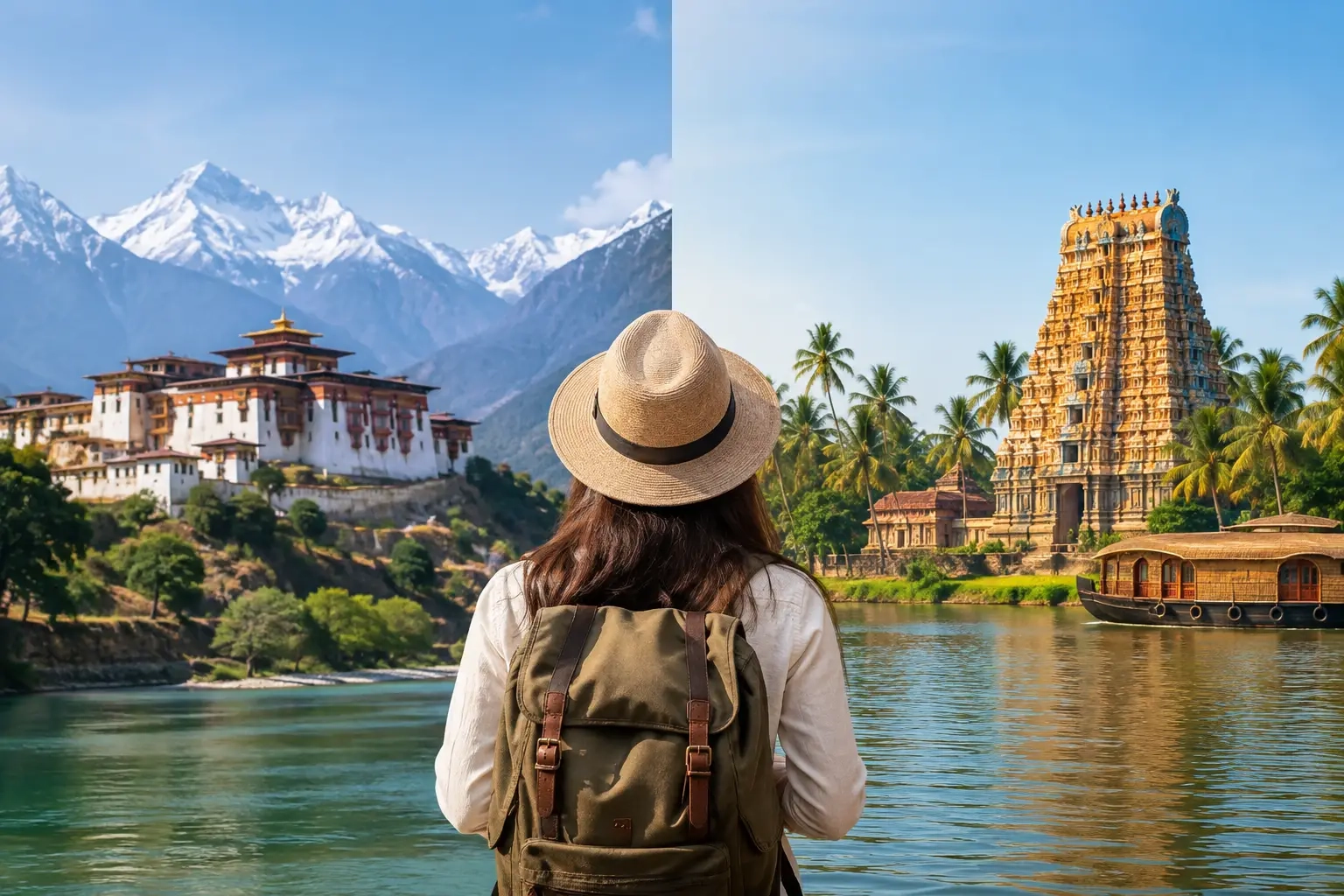
Most first-time visitors to India go north, and for a good reason: that is where the monuments they already have in mind actually are. The Taj Mahal, Jaipur's forts, the ghats at Varanasi, the Himalaya behind it all.
But a fair number of travellers would have preferred the south, and they only find that out afterwards. So here is the comparison we would actually make on the phone.
The short version
Go north if the famous sights are the point. The Golden Triangle, Rajasthan, Varanasi and a tiger reserve give you a trip with something different in it every day — and a lot of driving between those days.
Go south if you would rather spend three nights somewhere than one night in three places. Temple towns, backwaters, tea country and some of the best food in the country, at a slower tempo and with shorter transfers.
Neither is more authentic. They are different holidays that happen to be in the same country.
What the north gives you
North India is a circuit of landmarks, and the landmarks genuinely deliver. Delhi layers Mughal tombs, colonial avenues and contemporary India within a day's touring. Agra holds the Taj Mahal, which rewards two visits — dawn and late afternoon — more than one long one. Jaipur brings Amber Fort, the observatory, the bazaars and the palaces.
From there it opens up. Udaipur for lakes and the most romantic hotels in India. Jodhpur for the blue city under its fort. Jaisalmer for the desert. Ranthambore if you want a tiger safari folded into a heritage trip. Varanasi if you want the experience people find hardest to describe afterwards.
The honest caveat is distance. Delhi to Agra is three to four hours by road, Agra to Jaipur four to five. Add Rajasthan properly and you are looking at several more half-days in the car. That is manageable and often enjoyable, but it has to be built in. A six-night itinerary that promises the Golden Triangle plus Udaipur is selling you a lot of highway.
Allow ten to fourteen nights for the north to breathe. Six or seven covers the Golden Triangle and nothing more.
What the south gives you
South India is greener, slower and less intense. The driving is shorter, the cities are less overwhelming, and the itinerary tends to cluster rather than spread.
Tamil Nadu is the temple heartland — Madurai's Meenakshi temple, the Chola bronzes at Thanjavur, the shore temples at Mahabalipuram, French-colonial Pondicherry on the coast. For anyone interested in architecture, sculpture or living religious practice, this is the richest part of India and it is not crowded with foreign visitors.
Kerala is the easiest introduction to India we know of: Kochi's layered colonial history, the tea estates above Munnar, the spice country at Thekkady, and a night on the backwaters. Three nights in Kerala beats a week of one-night stops anywhere.
Karnataka adds Mysore's palace and the boulder-strewn ruins of Hampi, which is one of the most extraordinary places in the country and sees a fraction of the visitors it deserves.
Allow seven to eight nights for Kerala done properly, ten to twelve to add Tamil Nadu or Karnataka, two to three weeks for the full south.
Climate: they want different months
This is the practical difference that decides more trips than anything else.
The north's best weeks are October and November, with February and March close behind. December and January are comfortable by day, cold at night, and carry a real fog risk on the northern plains that delays flights and trains. April to June is punishing on the plains — 45°C in Rajasthan in May is normal — though that is exactly when Kashmir and Ladakh open.
The south's main season is October to March, and it is more forgiving at the edges. April and May are hot and humid on the plains but the hill stations stay pleasant. The southwest monsoon from June to September shuts down comfortable temple touring, but it is the traditional season for Ayurvedic treatment in Kerala, when the landscape is at its greenest and prices drop.
So: if you can only travel in the Australian winter, around June to August, neither region is at its peak, but Kerala for wellness or Ladakh for the mountains both work. If you can travel in October or November, you have the pick of both.
Cost
They are closer than people expect. Our North India itineraries run from around AUD $820 per person for seven days on the Golden Triangle to around $2,600 for a sixteen-day grand tour. South India runs from around $1,150 for eight days in Karnataka to around $2,580 for fifteen days across the southern states. Both exclude international flights.
The real variable in India is not the region, it is the standard of accommodation. A heritage palace in Udaipur and a good four-star in the same city are a very different number.
Can you do both?
On a first trip of under two weeks, we would say no — and we say it fairly often. You would spend a day of it in domestic airports and arrive in the second half too tired to notice it.
On three weeks it works well, and the contrast is genuinely lovely: the north's monuments first, then fly south and slow down for a week in Kerala to finish. Begin with the intensity and end with the quiet, not the other way around.
Which one, then?
If you want the Taj Mahal, Rajasthan's forts and the India you have already pictured, start in the north. If you want food, temples, backwaters and time to sit still, start in the south.
Most of our travellers come back. The question is only which half of India should speak to you first — and we are happy to talk it through before you commit to either.
Tell us what you have in mind and we will give you an honest view on which fits your dates, your pace and the trip you are actually hoping for.