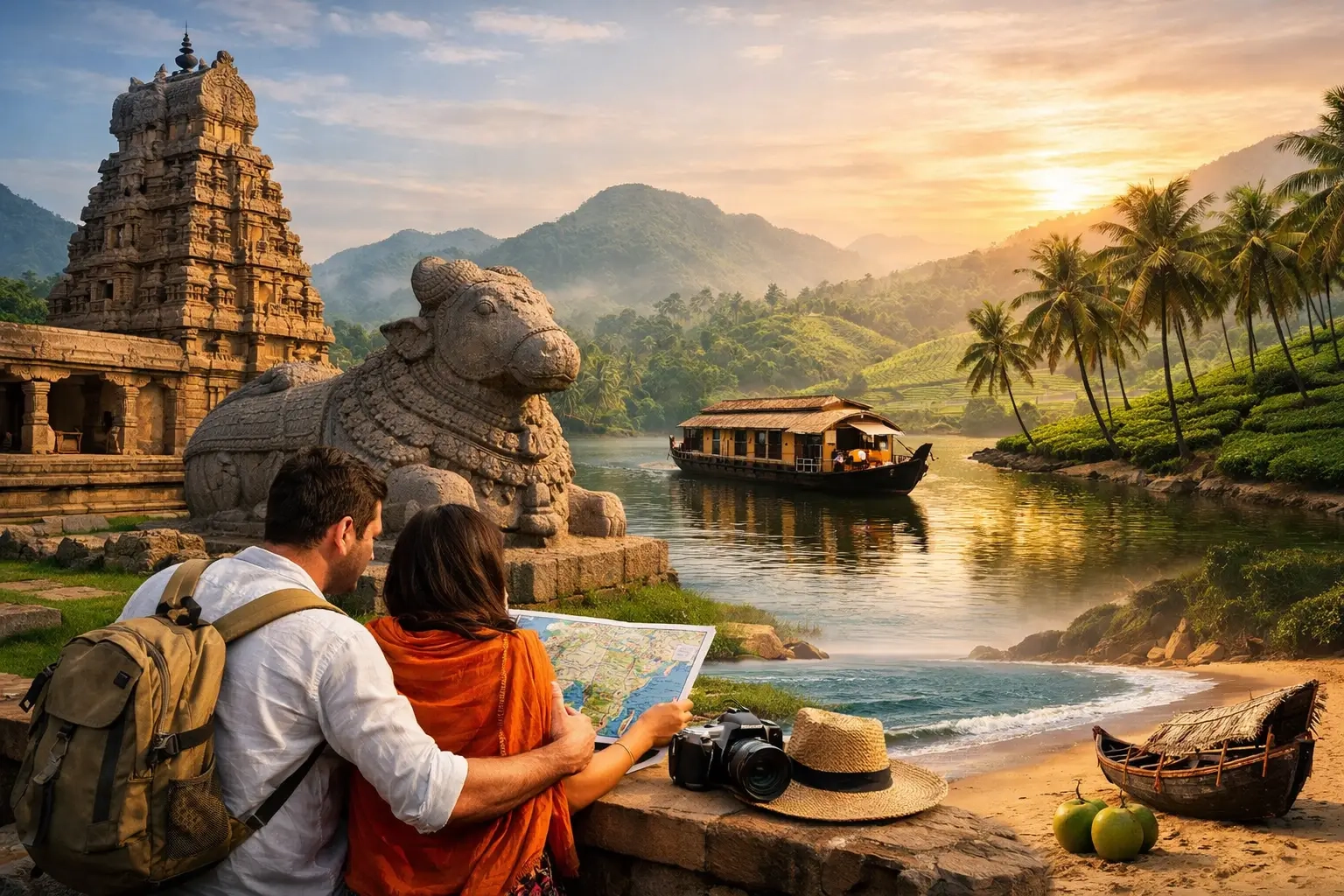
Seven days in Kerala works best when it is treated as a finely paced introduction rather than an attempt to see an entire region at speed. Kerala's coastal heritage, misty hill country, spice-growing interior and waterways sit within manageable reach of one another, which gives you a rich sense of place without constant unpacking.
For Australian travellers arriving after a long-haul flight, the difference lies in the order of the journey. A thoughtfully sequenced route allows time to settle in, includes realistic road transfers, and leaves room for the unplanned pleasures that make Kerala memorable: a lingering breakfast beneath palms, a conversation with a guide, or the changing light across the backwaters at dusk.
Why Kerala suits a seven-day itinerary
Kerala is an excellent choice for a first focused encounter with South India because its experiences are varied but naturally connected. Kochi brings together old trading quarters, contemporary art and a layered maritime history. From there the road climbs into the Western Ghats, where tea estates and forested slopes offer a complete change of atmosphere. Further south, the backwaters provide a gentle finale.
The trade-off is breadth. Seven days is enough to experience Kerala with care, but not enough to combine it properly with the temples of Tamil Nadu and the palaces of Karnataka. Trying to add several states turns a considered holiday into a sequence of airports and long drives. If Dravidian temple architecture is a priority, extend the journey rather than compress it.
A well-designed week generally centres on Kochi, Munnar, Thekkady or Periyar, and the backwaters. Each stop has a distinct character, and each earns its place.
The route, day by day
Days 1 and 2: Kochi and the Malabar Coast
Begin in Kochi, where the pace is forgiving after an international arrival. The historic precinct of Fort Kochi rewards exploring with context — its streets reflect centuries of Arab, Chinese, Portuguese, Dutch and British trade, and the cantilevered Chinese fishing nets along the shore remain the city's most recognisable scene.
A private guide makes the first afternoon purposeful without being demanding, connecting the sights to the people and trade routes that shaped this port. You might visit the Church of St Francis, wander past colonial-era warehouses and galleries, and pause for Kerala cooking built on coconut, pepper, curry leaf and the day's catch.
A slower second morning leaves room for the city's finer details — a heritage walk, an introduction to the traditions behind Kathakali, or the neighbourhoods beyond Fort Kochi. An evening Kathakali performance is far more rewarding when it is preceded by an explanation of the make-up, the gesture language and the music. It stops being a colourful spectacle and becomes something you can actually read.
Days 3 and 4: Munnar's tea-clad hills
The drive from Kochi to Munnar is one of the longer transfers of the week, so treat it as part of the experience rather than dead time. The landscape shifts gradually from humid lowlands to waterfalls, cardamom country and tea gardens. Leaving at a sensible hour, with well-chosen stops, makes the ascent feel relaxed rather than endured.
Munnar sits high in the Western Ghats and its cooler air is a welcome contrast to the coast. The tea estates are striking, but the most satisfying visit goes beyond the photographs: a knowledgeable local host can explain how elevation, rainfall and processing shape the leaf, and how the plantation communities have shaped the area.
The following day allows Munnar at its best — unhurried and outdoors. Gentle walks through tea country, a tea factory visit, and drives to the lookouts can all be matched to your energy. Those who prefer a quieter rhythm might take a long lunch over the hills and an afternoon at the hotel. The value of two nights here isn't the scenery alone; it's having time enough to absorb it.
Day 5: Spice country and Periyar
From Munnar, continue towards Thekkady, the gateway to Periyar's spice hills and forest. This stage is gentler than the Munnar ascent, though road conditions and seasonal weather always affect journey times, so build in some flexibility.
Thekkady is a genuine contrast to Munnar's ordered tea estates. Pepper vines, cardamom, clove, nutmeg and cinnamon all thrive here, and a guided plantation walk gives real meaning to flavours you have been eating all week. It is a sensory experience, but also an insight into the agricultural knowledge behind Kerala's cooking.
Periyar is usually associated with wildlife, and sightings depend entirely on season and luck. It is better to think of it as time in a remarkable forest environment with the possibility of wildlife, rather than an expectation of it. A well-chosen nature activity, on the water or on foot, brings a quieter perspective on the landscape.
Day 6: The backwaters, unhurried
The descent from the hills to the waterways is the journey's most satisfying transition. By afternoon the terrain has softened into canals, paddy fields and coconut groves. The backwaters are not one attraction but a living network of villages, working boats, small churches, temples, farms and family homes.
An overnight private houseboat suits travellers who value being on the water, particularly when the vessel has been chosen for its service and a quieter route. It isn't the only option, though. A waterside resort near Kumarakom or Alleppey may suit those who want more space, a pool and the chance to explore by smaller boat during the day. The question is whether you want the accommodation to be the experience, or a comfortable base beside it.
As the day slows, watch daily life pass along the banks — schoolchildren heading home, fishers at work, boats moving between villages. This is the point in the itinerary where a full schedule is least useful.
Day 7: A coastal finish, or onward
Your final day can go two ways. If flight timings allow, return to Kochi for a leisurely departure and one last coastal meal. Alternatively, add a beach stay at Marari or another carefully chosen stretch of coast — extending the holiday by a few nights rather than squeezing it into the seven.
That extension is particularly appealing after the hills and the water. Kerala's coast offers an easy change of tempo, but it deserves more than a rushed overnight.
The details that make it feel effortless
Kerala rewards considered logistics. Distances that look modest on a map can mean winding mountain roads, local traffic and changing weather. The most comfortable itinerary is rarely the one with the most stops — it is the one with sensible departure times, dependable vehicles, experienced drivers, and accommodation chosen for location as much as character, all of which we settle when you speak with a Kerala specialist.
Season shapes the experience too. The cooler, drier months are popular for combining coast and hills, while the monsoon brings vivid green and a different atmosphere entirely. Neither is automatically better; it depends on your tolerance for humidity and whether Ayurveda, wildlife or photography is driving the trip.
Seven days in Kerala can leave you with tea-scented hill air, spice-laden meals and the quiet movement of a backwater boat still in mind. Give each place the time it asks for, and the week feels not abbreviated but beautifully introduced.