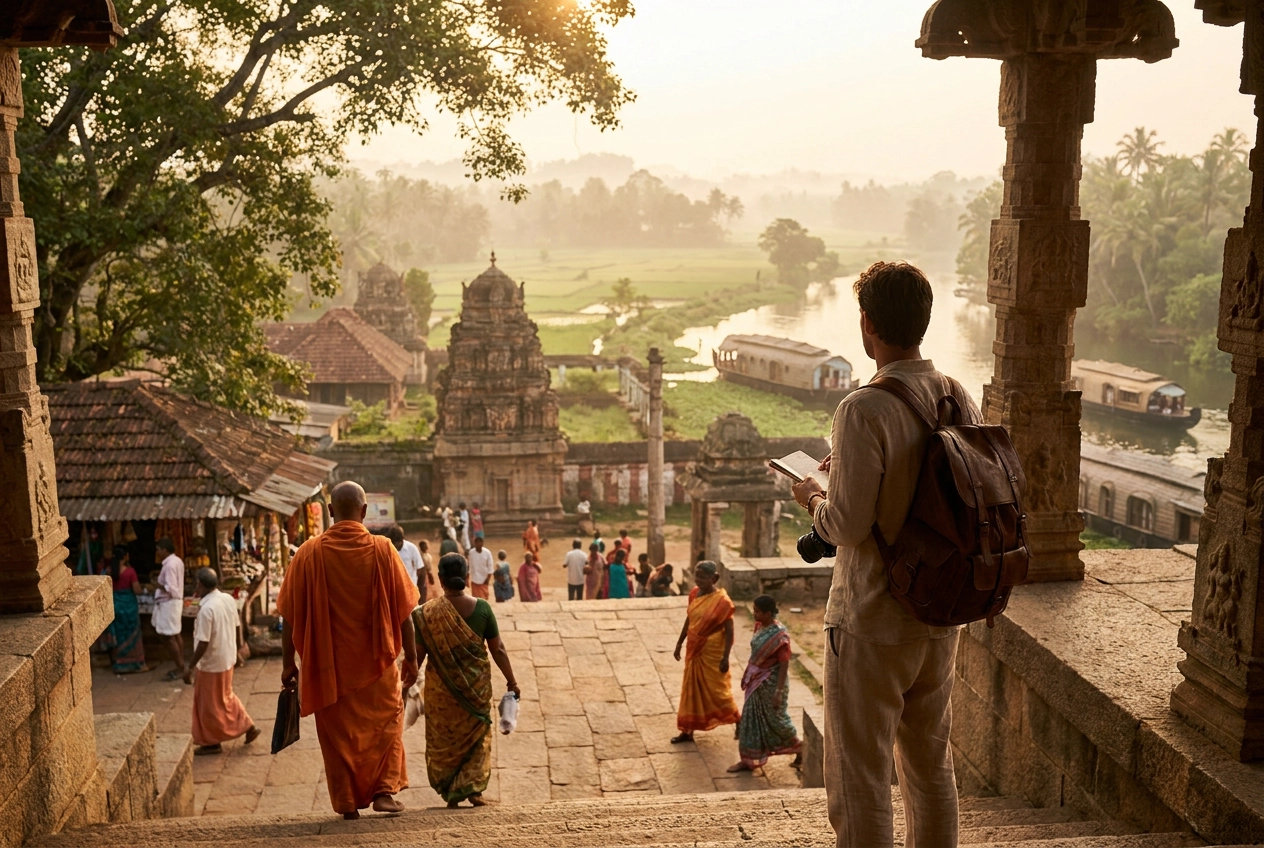
Imagine swapping Sydney's harbour views for the misty peaks of the Western Ghats, or trading Melbourne's café culture for a steaming cup of authentic filter coffee on a Kerala houseboat. South India offers a travel experience unlike anywhere else on earth, and Australian travellers are discovering it in record numbers.
Navigating South India tour packages can feel overwhelming at first. With five states, thousands of temples, and dozens of distinct cultural experiences on offer, knowing where to start is half the battle. That is exactly why this guide exists.
Whether you are drawn to Tamil Nadu's ancient Dravidian architecture, Karnataka's royal palaces, Kerala's tranquil backwaters, or Telangana's vibrant food scene, the right package can transform a complicated itinerary into a seamless adventure. In this guide, you will discover the top tour packages worth considering, what each region genuinely offers Australian visitors, the best times to travel, and the practical details that make the difference between a good trip and an extraordinary one. Let's get into it.
Why South India Is Different from the India You Already Know
Most travellers who have experienced the Taj Mahal, the palaces of Rajasthan or the ghats of Varanasi assume they have a working understanding of India. South India will gently, then emphatically, prove otherwise. This is not a variation on a familiar theme. It is an entirely separate civilisational story, told across five linguistically and culturally distinct states: Kerala, Tamil Nadu, Karnataka, Andhra Pradesh and Telangana. Each carries its own cuisine, its own classical arts tradition, its own architectural vocabulary and its own festival calendar. Treating South India as an afterthought to a northern itinerary does justice to neither region.
Where North India's identity was shaped by Mughal conquest and Rajput courts, South India's roots run through Dravidian civilisation: a culture older than the Mughal era and expressed with extraordinary force in the towering gopuram-topped temples that dominate city skylines from Madurai to Thanjavur. The Meenakshi Amman Temple in Madurai and the UNESCO-listed Brihadeeswarar Temple are not relics; they are living ritual centres still drawing thousands of worshippers daily. The classical arts here are equally alive. Carnatic music, Bharatanatyam dance and Kathakali performance are not museum exhibits but practised traditions embedded in community life. Culinarily, South India bears no resemblance to the tandoor-and-cream tradition of the north. Instead, coconut, tamarind, curry leaf and spice define a coastal culinary world that shifts dramatically across sub-regions, from the complex, fiery profiles of Chettinad cooking to the lighter, coconut-rich dishes of Malabar and the vegetarian simplicity of Udupi cuisine.
The geography reinforces the case for a dedicated journey. Kerala's backwater canals and Munnar's tea-covered hills occupy one register entirely. Karnataka's boulder-strewn ruins at Hampi, the former capital of the Vijayanagara Empire, occupy another. Tamil Nadu's Coromandel coastline, with its seventh-century Shore Temples at Mahabalipuram overlooking the Bay of Bengal, adds a further dimension. Threading through multiple states, the Western Ghats represent a UNESCO World Heritage biodiversity corridor sheltering tiger reserves at Bandipur, Mudumalai and Nagarhole. This geographic range simply cannot be absorbed in the two or three days a traveller might tack onto a longer northern circuit. A dedicated, multi-state South India journey rewards the depth of planning it requires.
For Australian travellers who have already completed the Golden Triangle or explored Rajasthan's desert forts, South India is not more of the same India. It is a second, entirely distinct chapter that rewards a completely fresh itinerary. The 2026 travel sentiment shift, moving decisively away from box-ticking toward meaningful, culturally immersive experiences, positions South India particularly well. Its living traditions, from temple ritual and spice plantation visits to Kathakali performances and overnight houseboat stays on Kerala's backwaters, deliver precisely the kind of authentic cultural depth that increasingly motivates serious travellers. South India's cultural highlights consistently reward itineraries built around absorption rather than speed. A specialist-designed, dedicated South India journey is not a luxury; for the region's complexity, it is simply the most intelligent way to travel.
The Most Popular South India Tour Package Formats Compared
Not every South India tour package is built the same way, and choosing the right format before you commit to dates and flights will determine whether your trip feels immersive or rushed. Here are the five principal formats currently operating in the market, from the most compact to the most expansive.
1. The Six-Day Kerala Focus Package
This is the entry point to South India and the most widely available format on the market. It centres on three anchor destinations: Kochi's colonial Fort area and spice markets, the Alleppey backwaters explored by houseboat, and the cooler tea-carpeted hills of Munnar. For Australian travellers working within a standard annual leave allocation, six to seven days in a single state delivers genuine depth without the fatigue of crossing multiple regional borders. First-time visitors to India particularly benefit from this format; a coherent single-state narrative is far less overwhelming than a multi-state circuit where cultural registers shift every two days.
2. The Nine-Day Luxury Kerala Package
This is the format most closely aligned with how Taj Voyages designs South India travel for its clients. It builds on the core Kerala circuit by adding boutique heritage accommodation, a private houseboat charter rather than a shared vessel, a day or two at Thekkady for wildlife at Periyar Tiger Reserve, and a structured Ayurvedic spa stay. The nine-day window is long enough to absorb Kerala properly without requiring extended leave. Travellers consistently summarise this format's appeal in the same way: hotel, transport, houseboat and food all functioning seamlessly as a single coordinated experience rather than separately booked components.
3. The Ten-Day Cultural Wellness Itinerary
This format crosses the state border into Tamil Nadu, pairing Kerala's Ayurvedic retreats with Madurai's Meenakshi Amman temple complex and, for travellers with a culinary focus, a Chettinad region detour for its distinctive peppercorn-heavy cuisine. The combination targets travellers who want physical restoration and cultural immersion within one trip rather than treating wellness and sightseeing as competing priorities. The 2026 travel landscape has reinforced demand for exactly this kind of experience; what the industry is calling "calmcations" and "glow-cations" map directly onto Kerala's established spa tradition, while Tamil Nadu's living temple culture adds the cultural weight that prevents the itinerary from feeling like a resort holiday with a day trip attached.
4. The Multi-State Grand Tour (14 to 21 Days)
For retirees or professionals travelling during an extended break, the Grand Tour format unlocks South India's full geographic and cultural range. A well-structured version moves through Kerala, across Tamil Nadu's temple cities, and into Karnataka for Mysore's Amba Vilas Palace, the UNESCO-listed ruins of Hampi, and the cool, coffee-scented hills of Coorg. The South India Grand Tour has moved well beyond a niche itinerary into mainstream demand. Sixteen to eighteen days represents the practical sweet spot; fourteen days is achievable but tight, while anything beyond twenty-one days is typically reserved for travellers combining South India with a separate northern circuit.
5. The South India and Sri Lanka Combined Format
This is the most compelling emerging format for premium travellers who want to maximise a long-haul flight from Australia. After completing a South India circuit, three to five days in Sri Lanka add a genuinely distinct cultural layer: Colombo's colonial architecture, Kandy's sacred Temple of the Tooth, and the southern beaches around Mirissa or Galle. The Tamil cultural connection between southern India and Sri Lanka's north gives the combined itinerary a coherent narrative thread, and Buddhist pilgrimage sites in Sri Lanka extend the spiritual geography that many travellers begin exploring at Tamil Nadu's great temples. Visa logistics require advance planning since India and Sri Lanka operate separate entry requirements, but the geographic proximity makes the transition straightforward when coordinated by a specialist.
Kerala Packages: Backwaters, Hills and Ayurvedic Retreats
Kerala, on the southwestern coast of South India, stands apart from every other destination in the region in one critical respect: it asks you to slow down, and rewards you handsomely for doing so. Bordered by the Arabian Sea and the tea-covered Western Ghats, Kerala is the South India state most travellers fall for first — and our full Kerala travel guide goes deeper into where to go and when. The five experiences below represent the most compelling reasons to place Kerala at the centre of your South India itinerary.
1. Private Houseboat Charter on the Backwaters
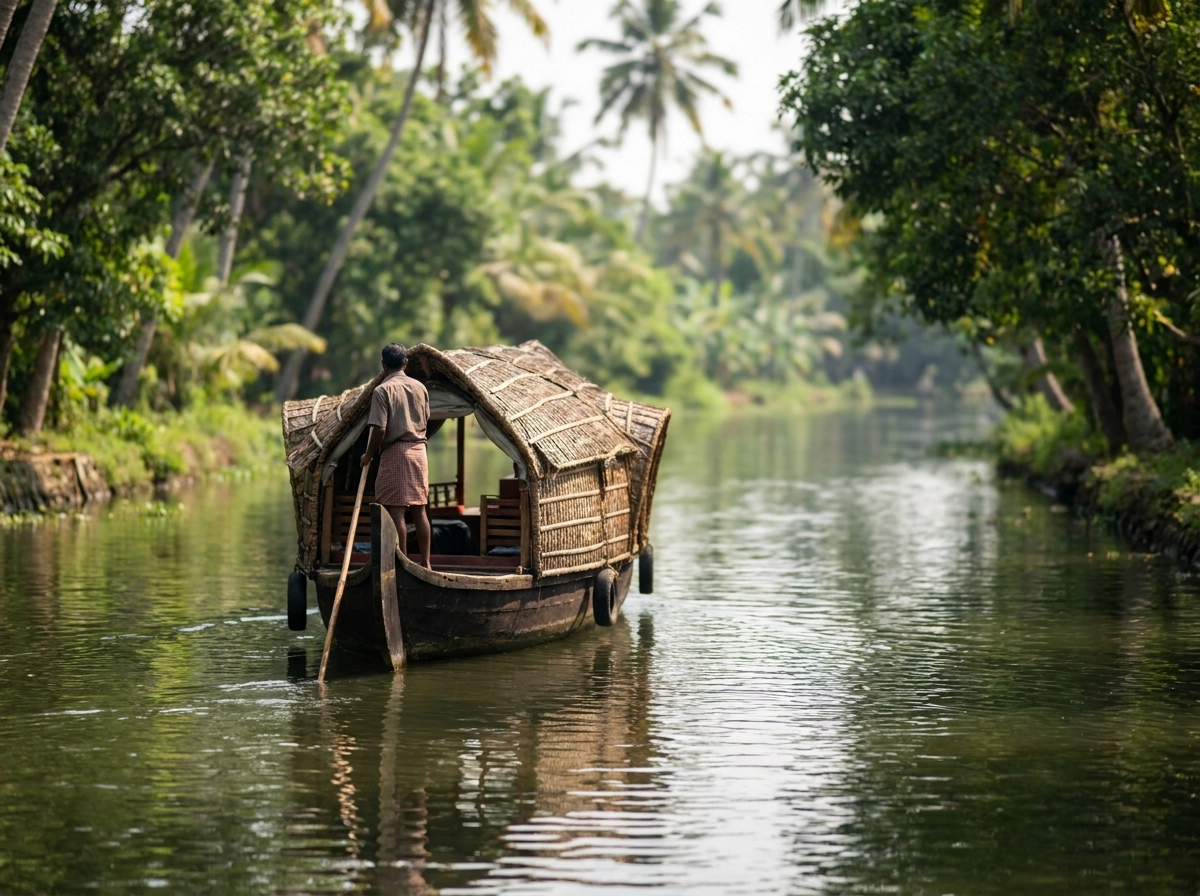
The backwater network threading through Kerala's coastal lowlands connects an extraordinary system of canals, lakes and rivers that stretches across hundreds of kilometres. The traditional kettuvallam, a rice boat converted into a floating residence, is the only way to experience this landscape properly. A private charter for two to four guests delivers something no group tour replicates: the ability to drift at your own pace, moor beside a village for an evening, and watch the light change over the paddy fields without a schedule imposed on the moment. This format sits squarely within 2026's 'calmcation' travel trend, where restorative, unhurried experiences are displacing activity-dense itineraries. For Australian visitors, the logistics are also straightforward; Alleppey (Alappuzha) is the primary departure hub, and Kerala houseboat charters can be arranged across a range of durations and specifications to suit different preferences.
2. Two Nights in Munnar's Tea Highlands
Munnar sits at approximately 1,600 metres above sea level in the Western Ghats, and the temperature difference from the coastal plains is immediately noticeable. A single day trip from Kochi fails to do justice to the landscape; a two-night stay allows for an early-morning estate walk through the tea rows before the mist lifts, a private plantation tour explaining the full production cycle, and an unhurried sunset over the ridgeline. The combination of cool air, dramatic scenery and genuine agricultural heritage makes Munnar a satisfying contrast to the humidity and bustle of Kochi.
3. A Structured Ayurvedic Retreat
Kerala's Ayurvedic tradition draws on a healing system that practitioners describe as more than 5,000 years old, and the experience available at certified retreats in Kumarakom or Varkala is medically grounded in a way that generic spa tourism is not. A structured seven-night Panchakarma programme includes daily consultations with qualified Ayurvedic physicians, personalised treatment schedules addressing your specific constitution, and prescribed dietary protocols maintained throughout your stay. This is a genuine therapeutic intervention, not a massage-and-facemask weekend, and it represents the single most compelling wellness offering available to time-pressed Australian professionals travelling in the region.
4. The January Travel Window
For Australians departing Sydney or Melbourne, a January departure aligns post-Christmas leave patterns with Kerala's optimal travel season; October through March brings dry weather, manageable temperatures and clear skies across the state. This timing also corresponds with 2026's broader 'glow-cation' wellness travel trend, where travellers are deliberately building health and restoration into their annual leave rather than recovering from their holiday afterward. Flights connect through Singapore or Kuala Lumpur into Kochi International Airport, making the routing efficient for eastern-seaboard travellers.
5. Two Opening Nights in Kochi
Kochi functions as Kerala's gateway and deserves more than a transit stop. Fort Kochi's Portuguese-era streetscapes, the iconic Chinese fishing nets along the harbour, the Jewish Quarter of Mattancherry with its 16th-century synagogue, and a genuinely active contemporary arts scene combine to create a layered urban experience that sets the cultural tone for the days ahead. Two nights here, before heading south toward Alleppey or east into the hills, is the standard opening structure recommended across well-designed Kerala itineraries for good reason.
Tamil Nadu Temple Circuit Packages: Ancient Cities and Living Traditions
Tamil Nadu offers something that no other South India destination quite replicates: a living, breathing civilisation of stone, ritual and sound that has functioned without meaningful interruption for more than a millennium. The state's temple circuits are anchored by three architecturally distinct flagship sites, each representing a different era of Dravidian achievement. The Brihadeeswarar Temple in Thanjavur, a UNESCO World Heritage Site completed in 1010 CE, demonstrates the engineering confidence of the Chola empire at its height. The Meenakshi Amman Temple in Madurai evolved across several centuries into one of the most elaborate religious complexes in Asia. The Shore Temple at Mahabalipuram, carved directly from coastal granite in the 7th and 8th centuries, predates both. Together, these three sites constitute a coherent curriculum in Dravidian history that no museum could replicate.
Madurai and the Alangaram Ceremony
Madurai is not simply a city with a famous temple; the temple is, in practical terms, the city. Approximately 33,000 worshippers pass through the Meenakshi Amman Temple each day, and the complex operates its own internal logic of corridors, shrines, flower markets and ritual schedules that runs parallel to the city outside its walls. The single most compelling experience a premium Tamil Nadu package can include is a privately guided visit to the Alangaram ceremony, conducted each evening as the deity is ritually prepared for rest. This ceremony is rarely arranged for group-tour participants, partly because of timing constraints and partly because it requires knowledgeable local access to navigate properly. For culturally motivated Australian travellers, it represents the kind of unrepeatable, deeply personal encounter that justifies the entire journey.
Chettinad: Mansions and Masalas
Set in the Sivaganga district, Chettinad delivers two experiences in a single detour that would each justify a visit independently. The Nattukotai Chettiar merchant mansions, built during a period of extraordinary commercial prosperity in the 19th and early 20th centuries, are among the most distinctive heritage structures in India, combining local granite, Burmese teak, Italian marble and hand-painted tiles within a single floor plan. The regional cooking tradition is equally remarkable; Chettinad cuisine is built on stone-ground masalas and spice combinations that have remained largely unchanged for generations, producing a complexity of flavour that is quite unlike anything elsewhere in South India. A private cooking class with a local family, arranged as part of a tailor-made itinerary, grounds the culinary experience in genuine domestic context rather than a restaurant demonstration.
Timing, Music and the Coastal Finale
Travellers departing Australia between November and January gain access to a significant cultural bonus: the Chennai Music Season, widely regarded as the largest classical music festival in the world by number of performances, running through December and into January. Carnatic vocal concerts and Bharatanatyam recitals fill venues across the city during this period, offering a level of access to South India's classical arts that is simply unavailable at other times of year. The itinerary then concludes naturally at Mahabalipuram, located 60 kilometres south of Chennai on the Coromandel Coast. The site combines UNESCO-listed rock-cut temples and bas-relief panels with a long beach and active sculpture workshops where the stone-carving tradition continues in working family studios. As a final stop before a Chennai departure flight, it balances cultural weight with the ease of a coastal setting.
Karnataka, Goa and the Golden Chariot Luxury Rail Journey
Karnataka stands apart as the most architecturally and ecologically layered destination in South India. Mysore Palace, a masterpiece of Indo-Saracenic design, draws visitors every Sunday evening when its facade is illuminated by approximately 97,000 lightbulbs, transforming it into one of the subcontinent's most theatrical spectacles. Northwest of Mysore, the UNESCO-listed ruins of the Vijayanagara Empire at Hampi scatter across a surreal boulder landscape that rewards a full day of exploration at minimum. Add the coffee and spice estates of Coorg, the tiger reserves of Nagarhole, and the 12th-century Hoysala temple complexes at Belur and Halebidu, and Karnataka alone contains enough material for a compelling standalone seven-day itinerary.
The Golden Chariot: Karnataka's Definitive Premium Experience
The most elegant way to absorb this breadth of heritage is aboard the Golden Chariot, a luxury train that threads together Karnataka's landmark sites and concludes in Goa. The flagship Pride of Karnataka itinerary departs Bengaluru on Saturday mornings and calls at Bandipur, Mysore, Hassan (the gateway to Halebidu), Hampi, Pattadakal and Aihole before reaching Goa. The train's 18 purple and gold coaches include two on-board restaurants named Ruchi and Nalapaka, a dedicated spa carriage called Arogya, a fitness centre, and a bar named Madira. Private cabins handle luggage throughout, eliminating the coordination effort of a self-assembled road journey across the same circuit. Boarding at Bengaluru involves a red carpet welcome, live Indian classical music and flower garlands; the interiors of the dining cars draw their design language from Hoysala and Vijayanagara imperial architecture, sustaining the heritage narrative even while the train is in motion.
For Australian travellers, the Golden Chariot offers something genuinely distinctive: it is one of only four luxury rail journeys operating in India, alongside the Palace on Wheels, the Maharaja Express and the Deccan Odyssey, and the only one dedicated exclusively to South India's heritage corridor. The train has won Asia's Leading Luxury Train at the World Travel Awards and is the natural premium centrepiece for any Karnataka-focused South India itinerary. The Pride of Karnataka departs on Saturdays from October through March, and our specialists can share current scheduling, cabin categories and tariffs when you enquire. You can also explore the Golden Chariot journey in more detail before confirming your itinerary.
Goa Beyond the Beach, and How to Structure the Full Circuit
The Golden Chariot's Goa segment introduces a destination that most Australian travellers associate primarily with beach resorts. A more considered approach reveals Old Goa's Baroque Portuguese churches, collectively recognised as a UNESCO World Heritage Site, alongside spice plantations in the hinterland and boutique heritage properties scattered through the villages of North Goa. These experiences pair naturally with the heritage tone established across the Karnataka stages of the journey.
The recommended structure for a complete premium package is to precede the Golden Chariot departure with two nights in Bengaluru. This allows time for Bangalore Palace, the city's contemporary restaurant scene, and a day trip to Mysore before boarding the train for the main circuit. The result is a nine-night Karnataka and Goa experience that moves from urban culture to imperial heritage to coastal history in a single, cohesive arc.
The South India and Sri Lanka Combination: A Natural Pairing
Few itinerary combinations in this part of the world make as much cultural sense as South India paired with Sri Lanka. The connection between these two destinations runs far deeper than proximity. The Tamil-speaking communities of northern Sri Lanka share ethnic, linguistic and religious roots with Tamil Nadu, creating a civilisational continuum that stretches across the Palk Strait. The Ramayana's geography places Ravana's kingdom firmly in Sri Lanka, and several sites on the island are revered as part of that epic's landscape by Hindu pilgrims travelling from South India. Add the shared Indian Ocean coastline and centuries of maritime trade, and you have a pairing that feels culturally coherent rather than simply logistically convenient.
A Practical Format for Australian Travellers
The market-tested duration for this combination sits between 16 and 19 days. A well-structured itinerary dedicates 10 to 12 days to Kerala and Tamil Nadu, covering the backwaters, Munnar, the Meenakshi Temple in Madurai and the Shore Temple at Mahabalipuram, before a short SriLankan Airlines or IndiGo connection from Chennai bridges into Colombo. The Sri Lanka segment then builds through Kandy's Temple of the Tooth, the tea highlands around Nuwara Eliya, the scenic rail journey toward Ella, and the southern beach town of Mirissa before a Colombo departure home. Australian travellers require an Indian e-Visa and Sri Lanka's Electronic Travel Authorisation; having one operator coordinate both removes a layer of administrative friction that catches self-planners by surprise.
The Multi-Faith Cultural Arc
What makes this combination particularly rewarding for first-time visitors to the subregion is the cultural counterpoint it creates. South India's Dravidian Hindu temple tradition, expressed through the soaring gopurams of Tamil Nadu and the rituals of living temple cities, finds its complement in Sri Lanka's Theravada Buddhist heritage circuit. Sigiriya's fifth-century rock fortress, the ancient capital of Anuradhapura and the Dambulla cave temples represent a distinct civilisational chapter. Together, the two countries compose a multi-faith narrative that no single-country itinerary can replicate.
Taj Voyages manages both the India and Sri Lanka legs as a single coordinated package, which eliminates the continuity risk of booking two separate operators. Accommodation quality, ground transport standards and itinerary pacing remain consistent across both countries, and any schedule adjustment in one country flows through to the other without the friction of separate supplier relationships. For Australian travellers investing three weeks in this part of the world, that single point of accountability matters considerably.
Best Time to Visit South India From Australia
The optimal window for visiting South India is October through March, and understanding why requires a brief look at how two separate monsoon systems shape the region's climate. The southwest monsoon clears the Kerala coast by late September to early October, delivering dry, warm conditions across the Western Ghats, backwaters and beach stretches. Tamil Nadu, however, is governed by the northeast monsoon, which peaks in November before winding down through December. This means a November or December departure from Australia is the single most reliable timing choice for a multi-state itinerary, catching Kerala at its clearest while Tamil Nadu transitions into its own dry season. Temperatures across the region during this window typically range from 15°C to 25°C in the highlands and 25°C to 30°C along the Kerala coast, making sightseeing, temple walks and outdoor excursions genuinely comfortable rather than an endurance test.
For Australian travellers specifically, this window carries a practical advantage that few long-haul destinations can match. October through March aligns almost precisely with Australian summer and the Christmas-New Year leave period, meaning South India fits naturally into the Australian calendar without requiring creative leave planning or sacrificing ideal in-destination conditions. Most long-haul destinations that offer peak conditions in this period are either already extremely crowded or present logistical complications; South India rewards the timing with cultural richness and manageable weather simultaneously.
Festival timing adds measurable value to specific departure months within this window. Pongal, Tamil Nadu's harvest festival celebrated in January, falls squarely within the prime period and brings vivid street-level ceremony to any itinerary anchored in Chennai, Madurai or Thanjavur. December departures carry a further distinction: the Chennai Music Season, running December through January, is widely regarded as the largest classical music festival in the world by performance volume, with over 4,000 Carnatic and Bharatanatyam performances staged across approximately 400 venues. For travellers drawn to living cultural traditions rather than monuments alone, a December departure from Sydney or Melbourne places them at the centre of an extraordinary event that most international visitors never encounter. This seasonal logic holds up across every detailed regional breakdown of the best time to visit South India.
One practical consideration that shapes timing decisions more than most travellers anticipate is advance booking lead time. Australian school holiday periods from late December through late January coincide precisely with South India's peak season, and boutique heritage properties, private houseboat charters and specialist experiences fill months ahead of these dates. Taj Voyages recommends beginning enquiries at least six to nine months before a peak-season departure to secure preferred properties and build a coherent itinerary rather than assembling from whatever remains available. In 2026, earlier booking behaviour has become the norm across premium travel, and South India is no exception to this trend.
Practical Guide for Australians: Flights, Visas and Trip Duration
Getting to South India from Australia
There are currently no nonstop services from Australia to South India, so your choice of connection hub is a genuine planning decision, not just a booking formality. From Sydney or Melbourne, the three primary routing options are via Singapore (with onward connections to Kochi, Chennai or Bangalore), via Kuala Lumpur, or via Dubai. Total journey times typically fall between 13 and 17 hours depending on your hub and layover duration. Kochi (COK) is the natural gateway for Kerala-focused itineraries; Chennai (MAA) suits Tamil Nadu and temple circuit trips; Bangalore (BLR) serves Karnataka and works well as a departure point for multi-state tours. Taj Voyages evaluates connection quality, not just headline flight prices, when building South India routing for Australian clients, because a poorly timed six-hour layover at either end of your trip represents meaningful lost touring time.
Indian e-Visa: Straightforward but Plan Ahead
Australian passport holders are eligible for the Indian e-Tourist Visa, applied for online through the Indian government's official portal. Processing may take 72 hours or more, and the one-year e-Tourist Visa is valid for multiple entries across 365 days from the date it is granted. This makes South India genuinely accessible from a visa administration perspective. That said, Taj Voyages recommends applying at least two weeks before departure, giving adequate buffer if the portal experiences processing delays, which do occur periodically. For South India tours that include a Sri Lanka extension, there is a second application to make: Australian passport holders need a Sri Lankan Electronic Travel Authorisation (ETA), applied for online before departure and free of charge for 30-day tourist stays since 25 May 2026, so the extra step costs paperwork rather than money.
Matching Trip Length to Your Leave Entitlements
Australian leave patterns shape South India itineraries in specific ways, and Taj Voyages calibrates trip lengths accordingly. A ten-day trip works well for a single-state focus on Kerala or Tamil Nadu, covering the headline experiences without feeling rushed. Fourteen to sixteen days opens up a genuine two-state circuit, such as Kerala combined with Tamil Nadu's temple cities, or Kerala paired with Karnataka's palaces and wildlife. For a three-state Grand Tour or a South India plus Sri Lanka combination, 19 to 22 days is the minimum comfortable duration once travel days at each end are factored in.
One practical design principle Taj Voyages applies as standard is open-jaw routing: flying into one gateway city and departing from another. Flying into Kochi and out of Chennai or Bangalore, for example, eliminates substantial backtracking and converts that saved time into additional experiences. This approach is particularly valuable for travellers working within fixed leave windows, where every day on the ground counts. Explore our tailor-made South India tours to see how a private itinerary can adapt multi-state logic to your specific timeframe and interests.
What Separates a Tailor-Made South India Package from a Group Tour
The format of your South India tour package determines the quality of your experience more than any single destination choice. Understanding the structural difference between group and private travel is worth doing before you commit to any itinerary.
1. Group tours deliver coverage, not depth. Group-based South India tours typically operate on fixed departure dates, with pre-set itineraries shared among ten to twenty strangers, accommodation contracted in bulk at mid-market properties, and a daily pace calibrated to the most cautious traveller in the group. You will visit the primary sites. You will move when the group moves, eat where the group eats, and wait while others finish shopping. The format is not broken; it simply cannot prioritise your experience over the group's logistics. For a destination as texturally rich as South India, that trade-off costs considerably more than it appears to on the brochure.
2. A tailor-made package is built around you, not around a roster. Departure dates are set around Australian leave calendars and festival timing. Accommodation is selected to match your preference for heritage properties rather than international chain hotels filling beds at volume. Your vehicle and guide are private across all ground transport and excursions. If you want to spend an extra afternoon in Hampi or leave Kochi a day early, no negotiation is required. That flexibility is not a luxury; for a two-week trip covering multiple states, it is the difference between a coherent journey and a series of rushed checkpoints.
3. Certain experiences are structurally incompatible with group tours. Private evening puja ceremonies at Tamil Nadu temples, cooking classes hosted in local family homes, chartered Kerala houseboats without shared berths, and Golden Chariot cabin upgrades are all bookable for private travelling parties. They are not available to group tours because the logistics and per-person economics make them unworkable at scale. These are precisely the experiences that remain vivid years after the trip.
4. The cost gap is narrower than most travellers assume. For couples or small groups of three to four, per-person accommodation costs are shared across a private itinerary just as they are on a group tour. The headline price difference between a well-designed tailor-made package and a premium group tour often shrinks to less than travellers expect, while the quality difference is substantial.
5. Choice volume on aggregator platforms creates its own burden. With hundreds of South India tour options listed across major platforms and thousands of traveller reviews to parse, the research process itself becomes a significant time cost. A specialist consultant replaces that process with a single briefing call, converting a sprawling field of options into a coordinated, personalised itinerary without the hours of cross-referencing.
Planning Your South India Package with Taj Voyages
Taj Voyages operates from Australia, which means every stage of your South India journey, from the first planning conversation through to in-destination support, runs on Australian time. Your consultant understands the realities of Australian leave calendars, public holiday windows, and the routing logic of long-haul travel from Sydney, Melbourne, Brisbane or Perth to South Indian gateway cities such as Kochi, Chennai and Bengaluru. That structural alignment removes a layer of friction that typically comes with booking complex international travel through operators based overseas.
The process itself begins with a single briefing conversation. Rather than sending you a brochure and asking which fixed departure best fits your schedule, Taj Voyages uses that initial discussion to understand your travel dates, interests, group composition, travel style and budget. From there, a custom proposal is prepared covering a day-by-day itinerary, curated accommodation recommendations, internal transport design and a transparent cost summary. The result is a programme built around your trip, not the other way around.
South India does not need to stand alone. If your broader interest includes North India, a Rajasthan heritage circuit or a luxury rail journey such as the Palace on Wheels or the Maharaja Express, Taj Voyages can integrate all of it into a single extended itinerary. Clients regularly combine a Kerala and Tamil Nadu circuit with a Rajasthan extension, completing India's full cultural spectrum in one carefully sequenced journey rather than making two separate long-haul trips.
For travellers drawn specifically to the Golden Chariot, Taj Voyages manages the full reservation: cabin selection, pre-booking of shore excursions and the design of pre-train and post-train accommodation in Karnataka so the rail experience connects seamlessly with the wider itinerary.
The recommended first step is to enquire at least six months before your intended departure date. October through March is peak season across South India, and availability of preferred heritage properties, private houseboat charters and Golden Chariot cabins fills quickly. Enquiring early gives your consultant the scope to design without compromise.
South India Is Worth Getting Right: Key Takeaways for Australian Travellers
South India's five states represent enough cultural, culinary and landscape range to sustain multiple dedicated trips. The most important planning decision is not which highlights to photograph but which states to combine based on your available time and genuine interests. Trying to cover everything in a single visit produces a journey that moves too fast to absorb what makes this region exceptional.
The October to March travel window remains the clear choice for Australian visitors. It aligns seasonal conditions with Australian leave periods and places you in South India during key cultural moments including Pongal and the Chennai Music Season, experiences that reward travellers who have planned specifically around them.
For premium Australian travellers, the defining distinction is not destination choice but itinerary design. A tailor-made private package delivers access, flexibility and cultural depth that group-format and aggregator-assembled tours structurally cannot match. The experience you have in a Chettinad heritage property or on a private temple tour is determined entirely by how the trip was built.
The Golden Chariot luxury rail journey and the South India plus Sri Lanka combination represent the two highest-value differentiators in this market. Both are best managed through a single specialist operator with expertise across both destinations, ensuring consistent quality and seamless logistics throughout.
Begin planning conversations at least six months before your intended travel date. The properties, Golden Chariot departures and private cultural experiences that elevate a South India trip from good to exceptional have limited availability and reward those who move early.
Frequently Asked Questions
When is the best time to visit South India from Australia?
October to March, which aligns neatly with Australian summer and the Christmas–New Year break. Kerala clears after the southwest monsoon by October, while Tamil Nadu settles after the northeast monsoon by December, making November–December especially reliable for a multi-state trip.
How many days do you need for South India?
Ten days suits a single state such as Kerala or Tamil Nadu. Fourteen to sixteen days allows a genuine two-state circuit, and nineteen to twenty-two days is the comfortable minimum for a three-state Grand Tour or a South India and Sri Lanka combination.
Do Australians need a visa for South India?
Yes. Australian passport holders apply online for the Indian e-Tourist Visa, typically processed within a few days and valid for a year with multiple entries. Applying at least two weeks before departure is sensible.
Can you combine South India with Sri Lanka?
Yes, and it's one of the most rewarding pairings — a short flight from Chennai links the two, and the shared Tamil cultural heritage gives the combined journey a coherent thread. Sixteen to nineteen days works well, coordinated as a single itinerary.
Where is Kerala, and is it part of South India?
Yes. Kerala is a state on the southwestern coast of South India, bordered by the Arabian Sea and the Western Ghats. It is one of the five South India states — alongside Tamil Nadu, Karnataka, Andhra Pradesh and Telangana — and is best known for its tranquil backwaters, Munnar's tea hills and its centuries-old Ayurvedic tradition.
Conclusion
South India is not just a destination; it is a complete sensory transformation waiting to happen. The key takeaways from this guide are straightforward: choose a package that matches your travel style, time your visit between October and March for the best weather, prioritise at least two or three regions to appreciate the cultural diversity, and work with a reputable operator familiar with Australian travellers.
The right South India tour package removes the guesswork and replaces it with genuine discovery, from temple corridors that have stood for centuries to backwaters that move at a beautifully unhurried pace.
You have done the reading. Now it is time to do the travelling. Request a customised itinerary and take the first step toward a journey that will genuinely change how you see the world.