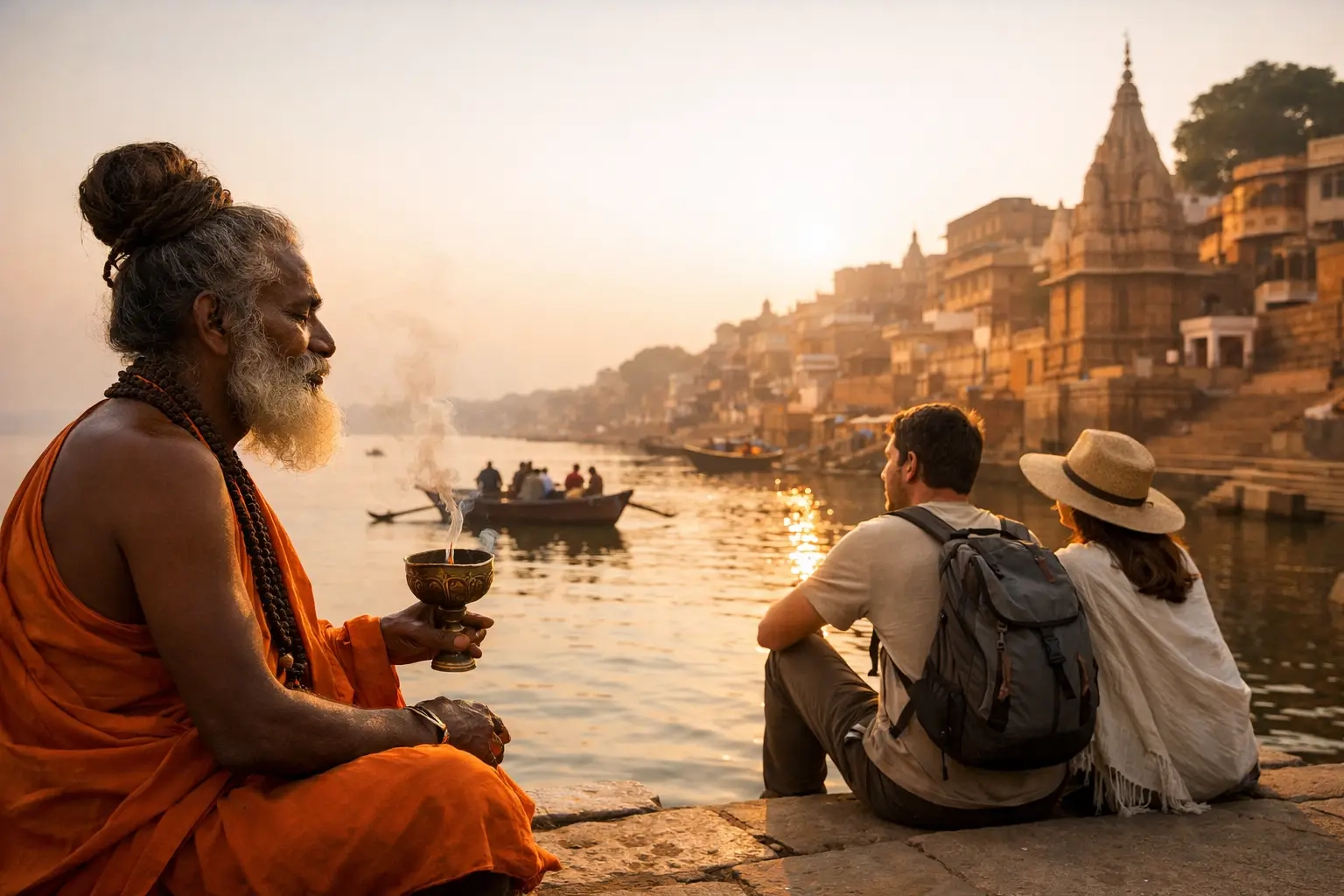
Varanasi is the trip people find hardest to describe when they get home. Not because it's indescribable, but because the honest description sounds either overblown or morbid, and neither does it justice.
So here is the plain version, including the parts most itineraries leave out.
What Varanasi actually is
One of the oldest continuously inhabited cities on earth, and the holiest place in Hinduism. Hindus believe that dying in Varanasi, or being cremated on its ghats and having the ashes committed to the Ganges, releases the soul from the cycle of rebirth.
Which means this is not a city that performs its religion for visitors. It is a working pilgrimage site where people come to pray, to bathe, to grieve, and to die. You are a guest in the middle of that, and the experience lands differently depending on whether you've understood it beforehand.
The dawn boat
Everyone tells you to do this, and they're right.
You leave the hotel in the dark, walk down through lanes that are already waking, and get into a rowing boat as the sky starts to lighten. From the water you watch the entire riverfront come alive: pilgrims descending the steps to bathe, priests performing surya namaskar, washing laid out on the stones, the light moving up the buildings as the sun rises behind you.
It is genuinely one of the great experiences in travel, and it is best done early in your stay rather than as a finale — it gives you the map of the place before you walk it.
Take a rowing boat, not a motorboat. The quiet is part of it.
The cremation ghats, and how to handle them
Manikarnika is the main cremation ground, and it burns around the clock. You will see funeral pyres, and you will see them close.
This is the part to think about before you arrive rather than in the moment. Most travellers find it moving rather than distressing — it is conducted openly, matter-of-factly, as a normal part of life, and there's something clarifying in that. But it is real grief and real bodies, and if that's not something you want to witness, say so and we'll build the itinerary around it.
Three rules if you do go:
No photographs. Not discreetly, not from a distance, not from a boat. This is a funeral.
Ignore anyone who approaches you offering a viewing spot, a guided explanation, or a donation for firewood for a poor family. It is a well-established scam and it operates on exactly the kind of guilt the setting produces. Your own guide will keep you clear of it.
Dress and behave as you would at a funeral at home, because that's what it is.
Ganga Aarti
Each evening at Dashashwamedh ghat, priests perform a fire ceremony to the river — brass lamps, bells, incense, chanting, enormous crowds.
It's spectacular and worth seeing. Two practical notes: it's genuinely crowded, so it's better watched from a boat on the river than from the steps, and the energy is more festival than contemplative. If you want the quieter version, Assi ghat holds a smaller morning aarti with a fraction of the people.
How long to stay
Two nights, three if you can.
One night is the standard allocation and it is not enough — you arrive, you do the dawn boat, you leave. You need a full day in the middle for the city to stop being a sequence of sights.
Beyond three nights, most travellers are ready to move on. Varanasi is intense in a way that is hard to sustain, and that's not a criticism of it.
Sarnath, which most people skip
Ten kilometres from the centre is Sarnath, where the Buddha gave his first sermon after attaining enlightenment. One of the four principal Buddhist pilgrimage sites in the world, with a very good archaeological museum.
It is calm in a way Varanasi is not, and half a day there in the middle of your stay changes the rhythm of the trip considerably. Almost nobody includes it. We usually suggest it.
The rest of the sacred north
Varanasi is the intense end of a spectrum, not the whole of it.
Rishikesh, in the Himalayan foothills, is where the Ganges leaves the mountains — green, cool, and the centre of India's yoga tradition. Evening aarti there is smaller and gentler than Varanasi's.
Haridwar, just downstream, is a major pilgrimage town with a huge evening ceremony of its own.
Bodh Gaya, in Bihar, is where the Buddha attained enlightenment, and the Mahabodhi Temple complex draws pilgrims from across the Buddhist world.
These pair naturally with Varanasi on a longer journey through North India, and they give the trip a range beyond a single overwhelming city.
When to go
October to March. November and February are ideal — cool mornings on the water, comfortable days.
Avoid May and June, when the plains are brutally hot and the ghats offer no shade. Avoid the monsoon, July to September, when the river runs high and boat access is restricted or stopped entirely.
Dev Deepawali, in November, is Varanasi at its most extraordinary — the entire riverfront lit with oil lamps. It is also the single busiest night of the year, and needs booking many months out.
Practical things that matter here more than elsewhere
Dress modestly. Shoulders and knees covered, for everyone. You'll remove shoes at temples.
The old city lanes are narrow and unmarked, motorbikes come through them, and getting lost is the default state. A local guide is not a luxury in Varanasi; it's the difference between a good day and a stressful one.
The hotel matters more than usual. A quiet, well-run place to return to is what makes the intensity enjoyable rather than exhausting. River-facing is worth paying for.
Expect to be approached — by boatmen, guides, silk sellers. Mostly harmless, occasionally persistent. A guide handles it for you.
Who this suits, and who it doesn't
Varanasi rewards travellers who are curious about how other people live and die, and who can hold a thing that is both beautiful and confronting without needing it resolved.
It is not a relaxing stop and it is not a good place to put at the start of a first trip to India. We usually place it after Rajasthan, when people have found their feet.
If you are travelling with young children, or if you want a holiday rather than an experience, we would say so and suggest something else. We'd rather tell you that in advance than have you spend two nights somewhere you didn't want to be.
If it does appeal, it will probably be the part of India you think about longest. Tell us what you have in mind and we'll build it in properly, with the time it needs.