
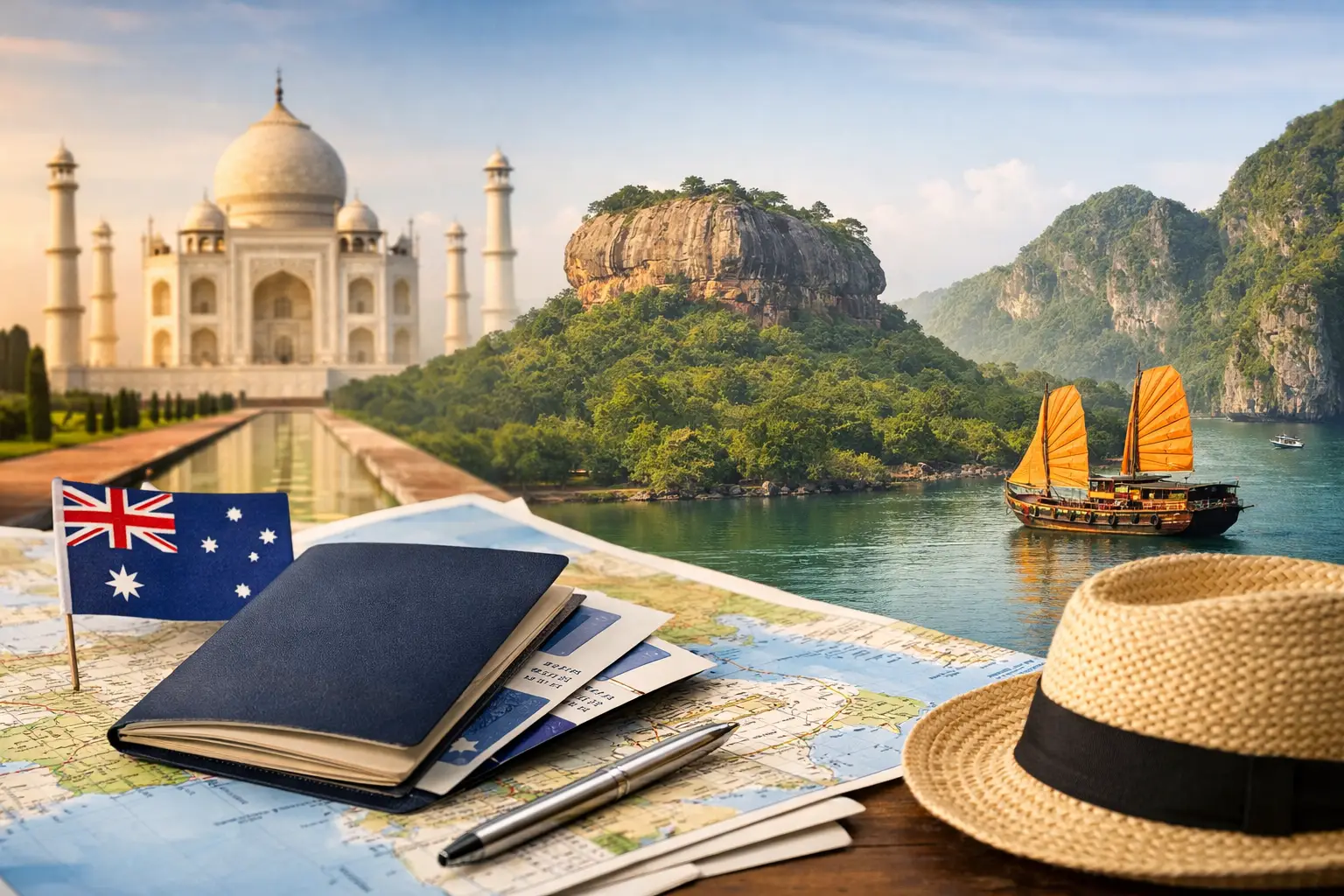
If you are asking, “Do Australians need a visa for India, Sri Lanka or Vietnam?”, the practical answer is yes: Australian passport holders generally need to arrange travel authority before visiting all three countries. The process and terminology differ, however, and that distinction matters when you are coordinating international flights, hotel stays, private touring and onward travel across more than one destination.
For a considered journey, visas should sit alongside the itinerary from the outset rather than being treated as a last-minute formality. Entry policies can change, individual circumstances vary, and an approved visa or travel authority does not replace the usual border checks on arrival.
Do Australians need a visa for India, Sri Lanka or Vietnam?
Australian citizens travelling on an ordinary Australian passport will usually need the following for tourism:
- India: A visa is required before travel. For many leisure visits, an electronic visa is the usual route.
- Sri Lanka: An electronic travel authorisation is generally required for tourism, subject to the entry process in place at the time of travel.
- Vietnam: A visa is required. The electronic visa system is commonly used by Australian visitors, where eligible.
There are exceptions. For example, holders of an Overseas Citizen of India card may have different entry arrangements for India. Diplomatic passports, dual nationality, long-stay travel, business activity, media work and certain specialised purposes can also call for a different visa category. Your passport type and the reason for travel should always guide the application.
India: arranging the right visa for a richly varied itinerary
India requires Australian visitors to hold valid visa permission before arrival. The e-Visa is commonly suitable for tourism, but its eligibility, validity period, permitted entries and authorised arrival points must match your plans. This becomes especially relevant for a journey that combines several regions, such as Rajasthan and the Golden Triangle, Kerala and the south, or a luxury rail experience followed by a beach stay.
Your passport should normally have at least six months’ validity from your date of arrival and sufficient blank pages for immigration requirements. Details in the application must precisely match the passport you will carry, including full name, passport number, date of birth and nationality. Even a small discrepancy can create unnecessary delays.
India’s entry requirements are also closely tied to how and where you arrive. If you are flying into a major international airport, the arrangement may be straightforward. If your itinerary includes a land crossing, a less common airport, or a carefully timed connection from Nepal or Sri Lanka, the permitted entry point deserves particular attention. A visa should support the itinerary, not force a change to it.
For families, every traveller needs their own appropriate documentation, including children travelling on their own passports. Travellers with previous Indian visas, an OCI card or a history of passport changes should allow additional time for their details to be reviewed carefully.
Sri Lanka: electronic travel authority and arrival details
For Australian holidaymakers, Sri Lanka generally requires an electronic travel authorisation, often known as an ETA, before departure. The name of the system, application channel and conditions can be updated from time to time, so it is wise to confirm the current requirements well before travel.
As with other destinations, your passport will generally need adequate validity beyond your stay. Immigration may also ask for evidence of onward or return travel and details of your accommodation. For an itinerary that moves from Colombo to the Cultural Triangle, hill country, Yala and the coast, having a clear and coherent travel plan helps ensure every detail is readily available if requested.
Sri Lanka is particularly well suited to combining experiences at a relaxed pace, but its journeys can involve several hotels, scenic rail sectors and private road transfers. That makes accurate arrival dates, passport details and booking records all the more valuable. If you are arriving from India or continuing to Vietnam, ensure each country’s visa timing is considered separately rather than assuming a regional itinerary has one shared entry process.
Vietnam: e-Visas, dates and points of entry
Australians ordinarily need a visa to visit Vietnam, and an e-Visa is frequently the appropriate option for tourism. The application should reflect the intended length of stay, whether you need a single or multiple entry arrangement, and your exact point of arrival.
This last detail matters more than many travellers expect. A Vietnam e-Visa is issued against the information supplied in the application. If your itinerary changes from arriving in Ho Chi Minh City to arriving in Hanoi, or if an internal routing changes the international arrival airport, check whether the visa remains suitable before you travel.
Passport validity is usually expected to extend for at least six months beyond arrival. Keep a copy of your visa approval accessible during travel, along with your accommodation and onward journey details. It is also sensible to ensure that the name on your flights, hotel reservations and visa documents is presented consistently, especially where a passport has a middle name or a recently updated surname.
Vietnam rewards thoughtful routing. A private journey might pair Hanoi and Ha Long Bay with central Vietnam’s heritage cities, then continue south to Ho Chi Minh City and the Mekong Delta. Because these itineraries often use domestic flights, rail or private drivers, your international entry and exit dates should be settled early enough for visa planning to proceed with confidence.
Passport and visa details worth checking early
Visa applications are only one part of preparing for India, Sri Lanka or Vietnam. A little early attention to the operational detail gives you more freedom to focus on the journey itself.
First, check passport validity for every member of your party, including children. Six months beyond arrival is a common benchmark, although the relevant authority’s current rule should be confirmed for your destination and visa type. Also review whether the passport has the required blank pages and is in good physical condition.
Next, make sure your proposed dates are realistic. Visa validity, permitted duration of stay and entry windows are not interchangeable. An approval issued for a particular travel period may not accommodate a postponed departure or an added stop in another country.
Finally, consider the full sequence of the trip. A multi-country itinerary may require three separate applications, each with its own timing, photographs, supporting information and conditions. If you are travelling on an escorted departure, a private itinerary, or a combination of both, the relevant documentation should be checked against the confirmed routing.
Why visa support is useful on a multi-country journey
Visa processes are manageable, but they are not identical across India, Sri Lanka and Vietnam. The challenge is often not completing one application. It is ensuring that passport validity, travel dates, arrival airports, accommodation records and any onward plans all align across a more complex holiday.
A specialist can help you identify the likely visa pathway, flag the documents and information required, and coordinate the timing around your itinerary. At Taj Voyages, visa support forms part of the wider planning process for tailored journeys, helping travellers move from confirmed route to departure with the details properly organised. Final decisions always remain with the relevant immigration authorities, but careful preparation removes avoidable uncertainty.
Can Australians get a visa on arrival?
Do not assume that a visa on arrival will be available or appropriate. India, Sri Lanka and Vietnam have different systems and policies can change. Arrange the required authority in advance unless the current official guidance clearly confirms another option for your circumstances.
How far ahead should visa applications be prepared?
Begin reviewing requirements once your itinerary is taking shape, rather than waiting until the final days before departure. Application processing can vary, and extra time is helpful if a passport needs renewal, travel dates change or additional information is requested.
Do transit stops need a separate visa?
It depends on the country, airport, length of connection and whether you remain airside. A planned overnight stay, a change of airports or a desire to leave the terminal may alter the requirements. This should be reviewed as part of the complete flight itinerary.
The most reassuring approach is to treat visas as part of the design of your holiday, alongside the places you will stay and the experiences you will share. With the entry arrangements checked early and your route carefully coordinated, you can arrive ready to enjoy India, Sri Lanka and Vietnam with your attention where it belongs.