
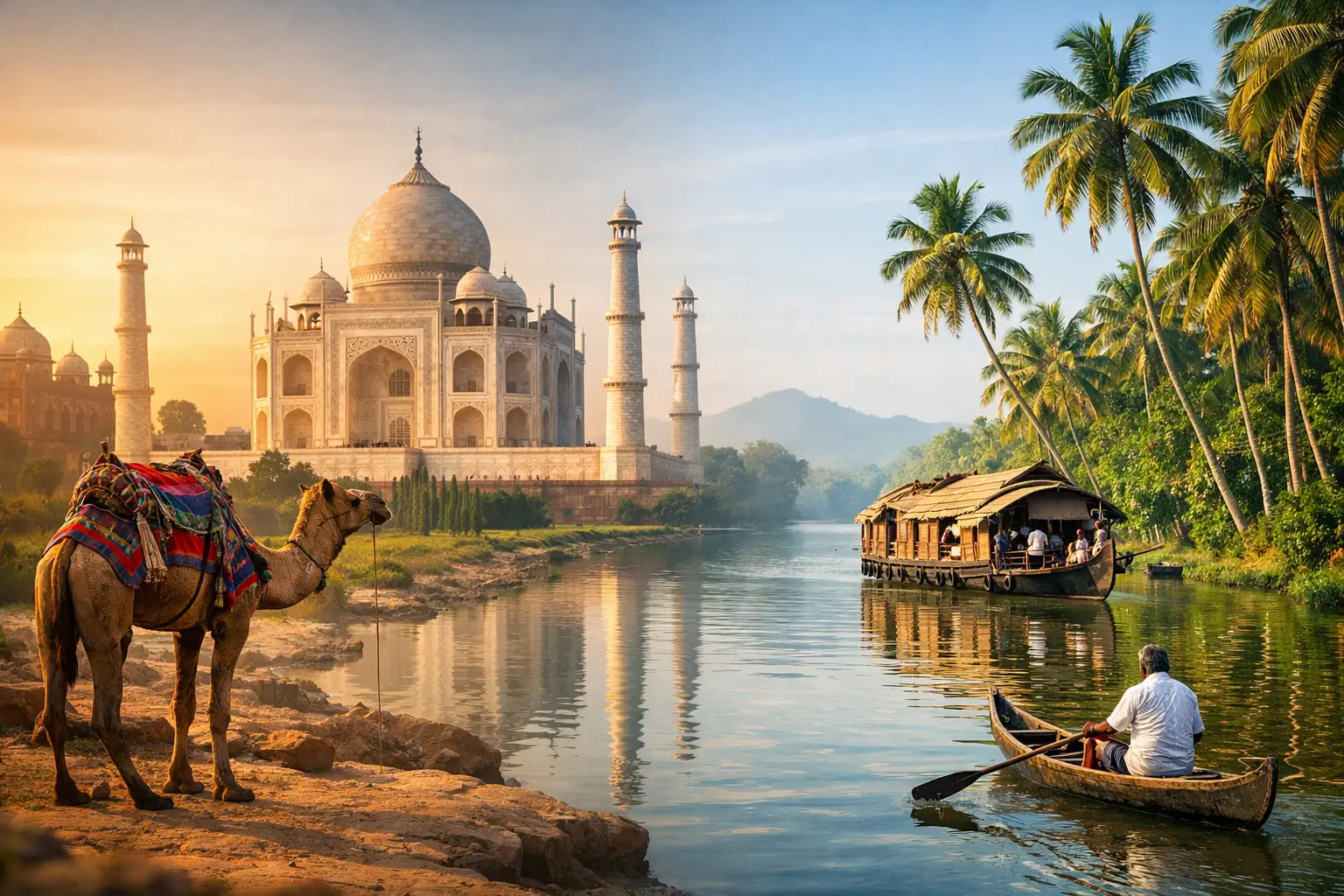
The moment you leave Jaipur's rose-hued palaces and arrive among Kerala's palms, the contrast feels deliberate rather than abrupt. A Golden Triangle + Kerala combo (north highlights + south relaxation) brings together two distinctly different expressions of India: the grand architecture, living history and energetic streets of the north, followed by the slower rhythms, waterways and coastal flavours of the south.
For Australian travellers covering a considerable distance to reach India, this combination makes excellent use of time. It offers the essential northern landmarks without asking you to remain in busy cities for the entire journey, then creates space to rest, reflect and experience Kerala at a gentler pace.
Why the Golden Triangle and Kerala combo works so well
Delhi, Agra and Jaipur provide a rich introduction to northern India. In Delhi, Mughal monuments, colonial-era avenues and contemporary neighbourhoods sit side by side. Agra centres on the Taj Mahal, whose scale and detail are best appreciated with time set aside for a well-paced visit. Jaipur adds royal residences, crafts and the distinctive landscapes of Rajasthan.
These places are visually compelling, but they are also full days. There are early starts to make the most of major sites, road transfers between cities, and a great deal to absorb. Kerala is a natural counterpoint. Its experience is shaped less by monument-hopping and more by the movement of water, the scent of spice gardens, unhurried meals and the changing view from a quiet retreat.
The appeal is not simply that one region is active and the other restful. Together, they give context to one another. The imperial ambition visible in northern forts and mausoleums is balanced by Kerala's long maritime history, layered traditions and close relationship with the natural landscape.
A considered route from north to south
A well-designed itinerary generally begins in Delhi, where an arrival night allows you to settle before sightseeing begins. From there, private road travel links Delhi, Agra and Jaipur in a logical sequence, with carefully selected stops and stays that prevent the journey from becoming a checklist.
The northern highlights
In Old Delhi, a guided walk or rickshaw ride can reveal the texture of markets, historic lanes and food traditions in a way that passing through by vehicle cannot. New Delhi offers a different perspective, from ceremonial boulevards to elegant garden precincts. The right guide helps turn these contrasts into a coherent story rather than a series of separate sights.
Agra deserves more than a rushed Taj Mahal photograph. An early morning or late afternoon visit often gives the monument a quieter, more atmospheric quality, while time at Agra Fort deepens the Mughal context. Depending on your interests, the itinerary may also include local artisan traditions or the beautifully preserved abandoned city of Fatehpur Sikri en route to Jaipur.
Jaipur is particularly rewarding when its headline attractions are paired with smaller experiences. Amber Fort, City Palace and Jantar Mantar are deservedly well known, yet a private visit with a textile specialist, a cookery experience or time with local craftspeople can lend the city greater depth. Your accommodation matters here too: a heritage-style stay can extend the sense of place after the day's touring has finished.
A flight then connects Jaipur or Delhi with Kochi, avoiding an unnecessarily long overland journey and allowing Kerala to feel like the change of scene it should be.
Kerala's slower, more sensory rhythm
Kochi is an appealing first stop in the south. Its historic harbour district reflects centuries of trade and cultural exchange, with Chinese fishing nets, synagogue precincts, churches and colonial buildings all within reach. A private guide can shape the day around your interests, whether that means art, architecture, food or simply a relaxed walk through Fort Kochi.
From Kochi, most journeys continue into the backwaters around Kumarakom or Alleppey. Here, time on a private houseboat is often a highlight, particularly when it is treated as an overnight experience rather than a brief cruise. Gliding past coconut groves, village jetties and rice paddies provides a welcome change from the pace of the north. The quality of the vessel, crew and mooring arrangements makes a meaningful difference, so this is an area where specialist planning is valuable.
The final Kerala stay may be in the cooler hills of Munnar, among tea estates and forested slopes, or along the coast near Marari, where the emphasis is on beachside calm and restorative days. Munnar suits travellers who enjoy scenery, gentle walks and tea country; the coast is better for those who would prefer fewer transfers and more uninterrupted time at their resort. There is no single correct choice.
How long should you allow?
Twelve to fourteen nights is an ideal starting point for a Golden Triangle and Kerala combination. This allows three or four nights across Delhi, Agra and Jaipur, depending on arrival timing and sightseeing preferences, followed by seven or more nights in Kerala. It is enough time to include the key northern sights while preserving the unhurried quality that makes the southern portion so rewarding.
A shorter itinerary can work if your time is fixed, but it involves trade-offs. You may choose just one Kerala base, or spend fewer nights in Delhi and Jaipur. For travellers who value immersion, adding nights is usually more satisfying than adding destinations. India reveals itself through the moments between the famous places: a morning chai, a conversation with a guide, a meal that lingers, or a view from your room after the day visitors have left.
Those with more time might add Ranthambore National Park after Jaipur for the possibility of wildlife viewing, or extend Kerala with a stay in the hills. These additions need thoughtful sequencing, particularly around domestic flight schedules and the preferred pace of the journey.
The details that make the journey feel effortless
India rewards careful coordination. The distances between northern cities, the timing of Taj Mahal visits, flight connections to Kerala, hotel check-in windows and luggage arrangements all influence how the holiday feels on the ground. A polished itinerary does not fill every hour. It leaves enough room for a late breakfast, a swim, an impromptu browse through a gallery or a quiet afternoon when the climate calls for it.
Accommodation should also change with the destination. Delhi may call for a calm city sanctuary with easy access to key districts. In Jaipur, character and heritage can be as important as location. On the backwaters, privacy and attentive service are often more valuable than a long list of facilities. Kerala's hill country and coast each invite a different style of stay, from plantation-inspired retreats to refined beachfront resorts.
Private drivers and knowledgeable local guides are equally important. They provide continuity across a multi-stop itinerary and let you focus on the experience rather than the practicalities. For Australian travellers, professional assistance with visas, pre-departure information and tour management also brings welcome reassurance before and throughout a journey with several moving parts.
Who will enjoy this combination most?
This itinerary is particularly well suited to couples and small private groups who want India's landmark experiences without sacrificing time to slow down. It works beautifully for first-time visitors because it includes recognisable icons, yet it has enough variety to feel personal rather than prescribed.
It is also a strong choice for return visitors who have seen parts of the north and want to experience India through a different lens. Kerala's food, wellness traditions, waterways and landscape offer a restorative dimension that complements, rather than competes with, Rajasthan's colour and grandeur.
Taj Voyages can tailor the balance around what matters most to you: more heritage interpretation in the north, an extra night on the backwaters, a quieter coastal finish, or a pace that leaves room to simply be present. The most memorable version of this journey is not the one that fits the most into each day, but the one that gives each place the time it deserves.