
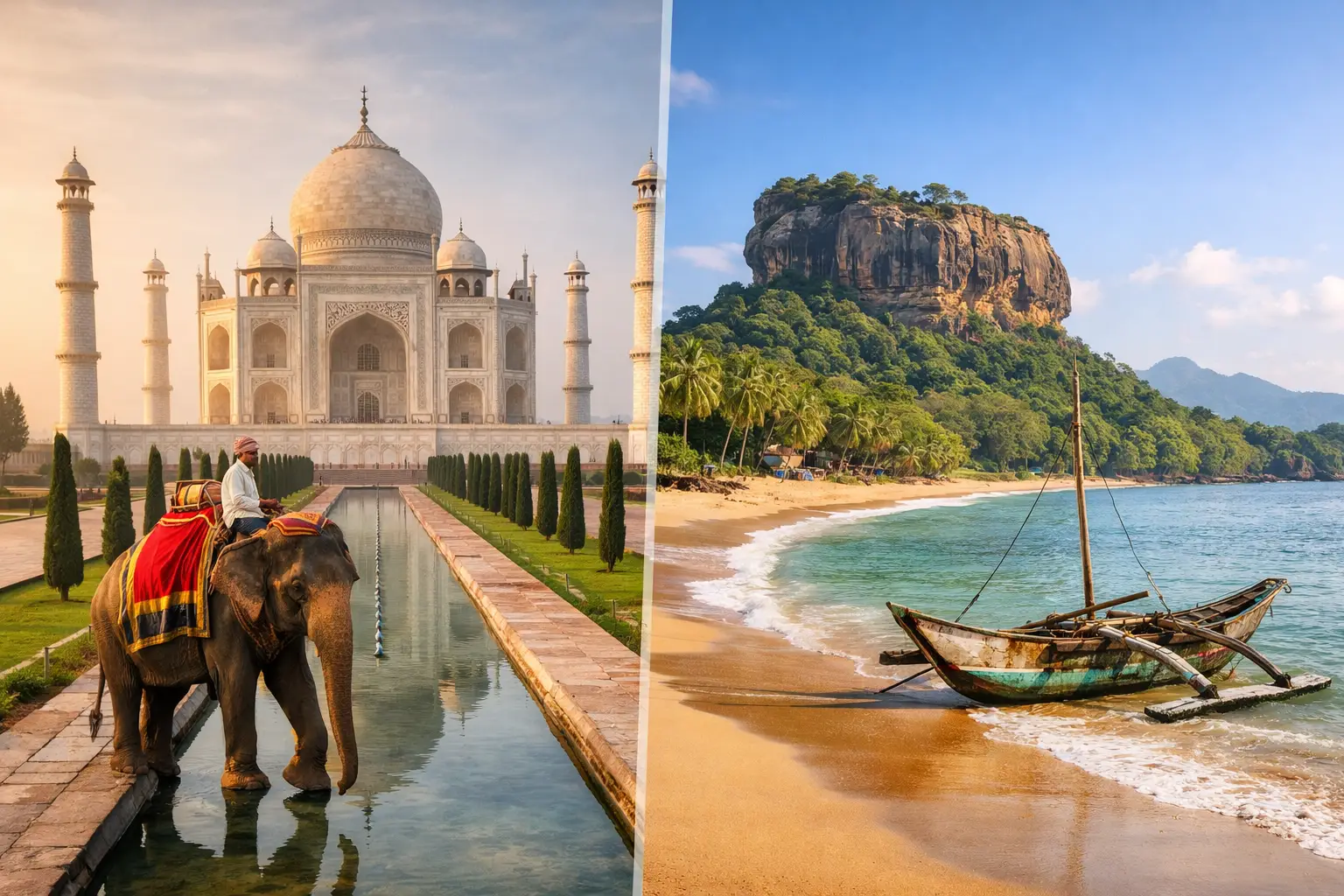
A dawn prayer drifting across Varanasi’s ghats, a leopard moving through Sri Lanka’s dry-zone bush, tea served on a cool hillside, or a private dinner in a restored palace: the decision between these two countries is rarely about finding a better destination. For travellers asking india vs sri lanka: which to visit first, it is really a question of pace, scale and the kind of memories you want to make on your first journey through South Asia.
Both reward thoughtful planning. India offers extraordinary breadth, from regal Rajasthan and the Himalayan foothills to Kerala’s waterways and Tamil Nadu’s temple towns. Sri Lanka presents a more compact, richly varied island where ancient cities, high-country tea estates, wildlife reserves and the coast can sit comfortably within one carefully paced itinerary. Neither needs to be rushed, and each can be deeply rewarding when shaped around your interests.
India vs Sri Lanka: which to visit first?
Choose India first if you are drawn to intensity, variety and a journey with many layers. Its scale is part of the experience. A well-designed itinerary can move from Delhi’s Mughal and colonial architecture to Agra’s marble monuments, Jaipur’s royal heritage and Udaipur’s lakeside calm, with each stop revealing a different rhythm of life, cuisine and craftsmanship.
Choose Sri Lanka first if you prefer a gentler introduction to the region without sacrificing cultural depth. Distances are shorter, the landscapes change quickly, and a two-week journey can comfortably combine the Cultural Triangle, Kandy, tea country, a safari and time by the Indian Ocean. It is an appealing choice for couples and families who want variety with less time spent in transit.
The right first destination also depends on what you hope travel will leave you with. India can feel expansive and transformative, particularly for travellers with a strong interest in history, spirituality, textiles, architecture or regional food. Sri Lanka often feels restorative as well as culturally rich, balancing active days of sightseeing with space to slow down beside the sea or among the hills.
Choose India for depth, spectacle and regional variety
India is not one experience, and treating it as one is the quickest way to underestimate it. North India alone can fill a wonderfully considered first visit, while South India offers a distinct world of temple architecture, coastal cooking, lush landscapes and classical arts. For return visitors, the central and north-eastern regions open up further possibilities through wildlife, tribal heritage, Buddhist sites and mountain scenery.
For a first visit, the Golden Triangle remains compelling when it is allowed room to breathe. Delhi gives context to the country’s many eras; Agra rewards an early, unhurried visit to the Taj Mahal; and Jaipur reveals the craft and courtly culture of Rajasthan. Add Ranthambore for wildlife, Udaipur for a lakeside pause, or Jodhpur for its blue-hued old city, and the route begins to feel personal rather than standard.
India is particularly suited to travellers who enjoy a journey built around meaningful contrasts. You might begin the day with a private guide at a centuries-old fort, spend an afternoon meeting artisans in their workshop, and end it in a heritage hotel where the setting carries its own story. Food is another reason to choose India first. Each region has its own vocabulary of spices, breads, sweets and seasonal dishes, and dining becomes part of understanding place.
There is more movement involved than in Sri Lanka, especially on a multi-region itinerary. That need not mean a tiring holiday. Carefully selected flights, private road transfers, well-located hotels and, where appropriate, luxury rail journeys can turn the travel between destinations into part of the pleasure. Experiences such as the Maharaja Express, Palace on Wheels, Deccan Odyssey and Golden Chariot offer a distinctive way to see India while retaining a high level of comfort and continuity.
India is best for you if you have at least two weeks available, enjoy cities as much as landscapes, and want a destination you can return to many times without repeating the same journey.
Choose Sri Lanka for an elegant, varied island journey
Sri Lanka has an ease of flow that makes it exceptionally satisfying as a first South Asian holiday. Within a relatively small area, you can encounter sacred cities, remarkable archaeology, misty tea estates, national parks and palm-fringed beaches. The transitions are swift but never monotonous.
A classic route might begin in Colombo or the coast before continuing to Sigiriya and the ancient capitals of the Cultural Triangle. From there, Kandy brings temple traditions, Kandyan arts and a greener landscape, while the journey into the hill country reveals tea plantations, walking trails and cool air. The southern coast and nearby national parks then provide a graceful final chapter, with time for wildlife viewing and oceanfront relaxation.
Sri Lanka is a fine choice for travellers who want culture and nature in close conversation. One day might involve the rock fortress at Sigiriya and a village-style lunch; the next, a scenic rail journey through tea country or an early morning safari. Elephants, birdlife and, in the right parks and seasons, leopards add a memorable wildlife element without requiring an entirely separate expedition.
The island also suits travellers who value a more measured daily pace. There are still early starts for wildlife and worthwhile cultural visits, but the itinerary can include longer stays in a few carefully chosen properties. This is especially appealing after a busy year, or when travelling with different generations who want shared experiences without constant packing and unpacking.
Sri Lanka is best for you if you have around 10 to 14 days, would like a balance of heritage, scenery and time to unwind, or prefer a first encounter with South Asia that feels compact and cohesive.
Consider the season, not just the map
Weather should shape the decision, particularly if beach time is important. India’s climatic patterns vary significantly by region, so a Rajasthan and North India journey is planned differently from Kerala, the Himalayas or the southern states. Sri Lanka has two monsoon systems, meaning conditions can differ notably between the west and south coasts and the east coast at the same time of year.
This does not make either country a poor choice at a particular time. It means the itinerary should be designed around the seasons. A specialist can recommend the regions, national parks and coastal stays that make sense for your travel dates, rather than applying a single template to an entire country.
Festivals can also influence the feel of a journey. India’s calendar offers vivid celebrations across many faiths and regions, while Sri Lanka’s cultural and Buddhist festivals bring their own processions, rituals and public occasions. Travelling at these times can be deeply memorable, but it also calls for early planning and considered routing.
Which destination feels easier for a first long-haul journey?
Sri Lanka is generally simpler to cover in one holiday because of its size. It can be an excellent first choice if you are new to the subcontinent or want to keep the journey focused on a handful of destinations. The country’s diversity arrives in an accessible sequence: heritage, hills, wildlife and coast.
India asks more of your curiosity and rewards it generously. Its major cities are lively, its distances are greater and its possibilities are almost limitless. The answer is not to see everything. It is to choose one region or a clear route, allow time for unplanned moments, and have the practical details managed thoughtfully around you.
For Australian travellers, long-haul comfort matters from the first flight through to the final transfer. Coordinating suitable flight timings, accommodation styles, internal transport, guides, visa support and realistic sightseeing days makes a considerable difference to how the journey feels. Taj Voyages designs each itinerary around those details, so the destination remains the focus rather than the administration behind it.
The case for visiting both, just not at once
India and Sri Lanka complement one another beautifully, but combining them is not always the best answer for a first trip. If you have three weeks or more and are comfortable with a fuller itinerary, a northern India journey followed by Sri Lanka’s hill country and coast can create a rewarding contrast. If time is shorter, choosing one country gives it the attention it deserves.
There is also something to be said for leaving room to return. Begin with Sri Lanka if you want an island journey that blends easily from culture to coast. Begin with India if its great cities, royal heritage, sacred places and regional variety are already calling to you. Whichever comes first, let the itinerary be paced with care - the most memorable South Asian journeys are the ones that leave you wanting to understand more.