
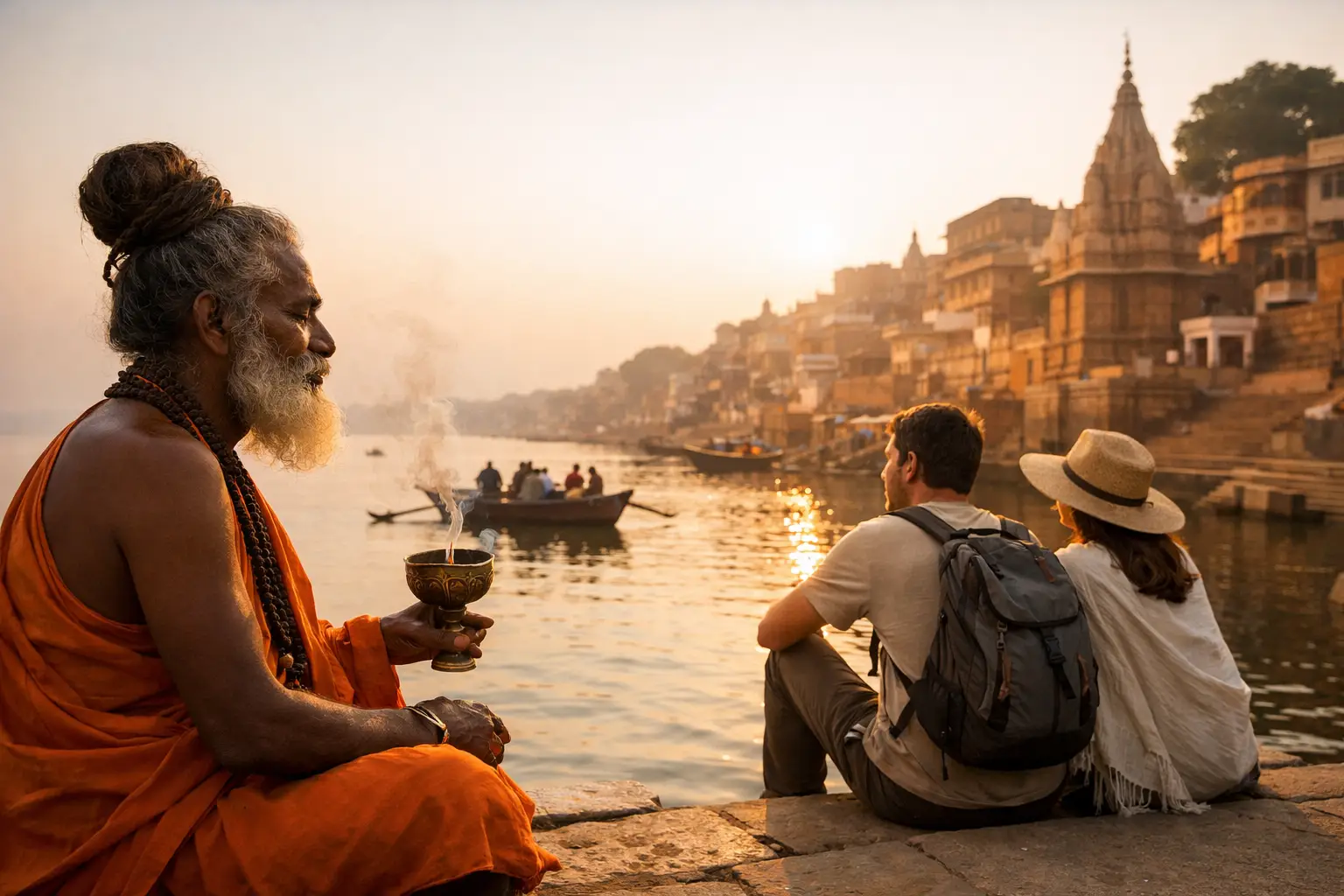
Before dawn, Varanasi is already awake. Lamps move across the Ganges, temple bells carry through narrow lanes, and boats slip quietly from the ghats as the sky begins to change colour. For travellers drawn to Varanasi and spiritual India, this is not simply sightseeing. It is an encounter with living tradition, best experienced with time, context and a thoughtfully paced itinerary.
Varanasi can feel intense because it is so immediate. Everyday life, devotion, trade, music and ceremony share the same small streets and riverfront steps. The reward for approaching it with an open mind is profound: a city that offers not a polished version of spirituality, but a deeply human one.
Why Varanasi Holds Such a Special Place
Also known as Kashi or Banaras, Varanasi is among the world’s oldest continually inhabited cities and one of Hinduism’s most significant places of pilgrimage. Its position on the Ganges gives the city both its visual identity and its spiritual rhythm. For many visitors, the river becomes the clearest way to understand the place: people come to bathe, pray, reflect, celebrate milestones and honour loved ones.
You do not need to share a particular faith to appreciate what is happening around you. Respectful observation is enough. A well-planned visit creates room to witness rituals without treating them as a performance, and a knowledgeable local guide can explain the customs, symbolism and etiquette that might otherwise pass unnoticed.
Varanasi is also a city of scholarship, classical music, silk weaving and food. Between temples and ghats, there are workshops where Banarasi textiles are created, modest cafés serving fragrant chai, and lanes where the scent of marigolds gives way to cardamom, incense and warm milk sweets. Its spiritual importance is inseparable from these ordinary, sustaining details.
Varanasi and Spiritual India Beyond the River
The Ganges is Varanasi’s focal point, yet the experience should not be reduced to one ceremony or one photograph. A meaningful stay usually unfolds across several moments, each showing a different aspect of the city.
Begin on the water
An early-morning private boat ride is often the most peaceful introduction. The air is cooler, the riverfront is softened by morning light, and the ghats gradually come into focus. You may see devotees offering water to the rising sun, people preparing for the day, and pilgrims arriving from other parts of India. The value lies in watching quietly rather than rushing from one landmark to the next.
A sunset cruise offers a different perspective. As the city’s lights appear, the river becomes a calm vantage point from which to take in the energy of the waterfront. Depending on the season and local conditions, your itinerary can be arranged around the evening Ganga Aarti, a devotional ceremony of fire, chanting and music held at Dashashwamedh Ghat.
Walk the lanes with context
Varanasi’s old city is compact, intricate and full of surprises. Its lanes are best explored on foot with someone who knows their rhythm. A guided walk can bring together small shrines, historic neighbourhoods, traditional wrestling grounds, flower markets and food stalls in a way that feels coherent rather than overwhelming.
The precise route matters less than the pace. There is value in allowing time to pause at a doorway, listen to a musician practising, or observe artisans at work. For travellers who prefer greater privacy and comfort, arrangements can be tailored to include considered transfer points, a suitable guide and well-timed breaks away from the busiest areas.
Experience the city’s craft traditions
Varanasi’s celebrated silk is part of its cultural story. Visiting a weaving atelier offers a close view of the skill behind Banarasi brocades, from hand-drawn patterns to the patient work of the loom. It is a worthwhile counterpoint to the city’s religious sites because it reveals another kind of devotion: concentration, inherited knowledge and pride in craft.
Music also has a long association with Varanasi. Where suitable, a small classical music performance or a conversation with a local practitioner can add depth to an evening. These encounters should feel personal and well matched to your interests, not added merely to fill a programme.
A Considered Way to Visit Sacred Places
The most memorable spiritual journeys tend to be unhurried. In Varanasi, that means choosing a small number of meaningful experiences and allowing space between them. A packed schedule can leave little room to absorb the atmosphere of a river dawn or the significance of a temple visit.
Dress should be modest at religious sites, with shoulders and knees covered where appropriate. Shoes are removed before entering many temples, and photography may be restricted. Your guide can advise on local etiquette and help you understand when it is appropriate to observe from a distance. This is especially valuable during ceremonies, when sensitivity matters more than proximity.
It also helps to recognise that Varanasi is not a museum. The ghats and temples are active places used by residents and pilgrims every day. Travelling with care means keeping voices low in contemplative spaces, asking before photographing individuals, and approaching private moments with discretion.
Building Varanasi into a Wider India Journey
Varanasi works beautifully within a broader North India itinerary, particularly when balanced with places that offer a different tempo. Delhi can provide an engaging arrival point, with its layers of imperial history and contemporary energy. Agra adds the architectural refinement of the Taj Mahal, while Jaipur offers palaces, craft and the colour of Rajasthan.
For a stronger spiritual thread, Varanasi can be paired with Bodh Gaya, where the Buddha is traditionally understood to have attained enlightenment. The contrast is meaningful: Varanasi’s river-centred Hindu traditions alongside a place of great importance to Buddhist pilgrims from around the world. Sarnath, a short distance from Varanasi, is another natural addition and is associated with the Buddha’s first sermon.
The right combination depends on your interests and available time. Some travellers want a carefully curated first journey through India’s major cultural centres. Others may prefer to slow down, staying longer in Varanasi and including quieter heritage properties or a gentle rail sector. Taj Voyages can coordinate the flights, road transfers, guides, accommodation and timing so the route feels connected from arrival to departure, rather than like a series of separate bookings.
The Importance of Timing and Comfortable Pacing
Cooler months are generally more comfortable for walking tours, river experiences and outdoor exploration. Festival periods can bring extraordinary colour and devotion, but they also require particularly careful planning around accommodation, access and crowd levels. If a festival is central to your journey, the itinerary should be designed around it from the outset.
A two-night stay gives many travellers a satisfying introduction, allowing for both a dawn boat ride and an evening on the river. Three nights can be preferable if you wish to include Sarnath, a weaving visit, a longer guided walk or simply time to rest between experiences. The best choice is not always the fastest route. In a city with this much to take in, breathing room is part of the experience.
Accommodation also shapes how Varanasi feels. A carefully selected hotel provides a calm return after the sensory richness of the old city, while considered transport arrangements remove the need to manage unfamiliar logistics at the busiest times of day. These details may seem modest, yet they make it easier to be fully present when it matters.
What You May Carry Home
Varanasi does not ask to be neatly explained. You may remember the glow of lamps on the river, a handloom’s rhythmic movement, the scent of flowers at a ghat, or a quiet conversation with your guide. Often, it is the coexistence of all these things that stays with you.
A journey through Varanasi and spiritual India is most rewarding when it is shaped around curiosity rather than expectation. Give the city time, travel with respect, and let its rituals, craft and river life reveal themselves at their own pace.