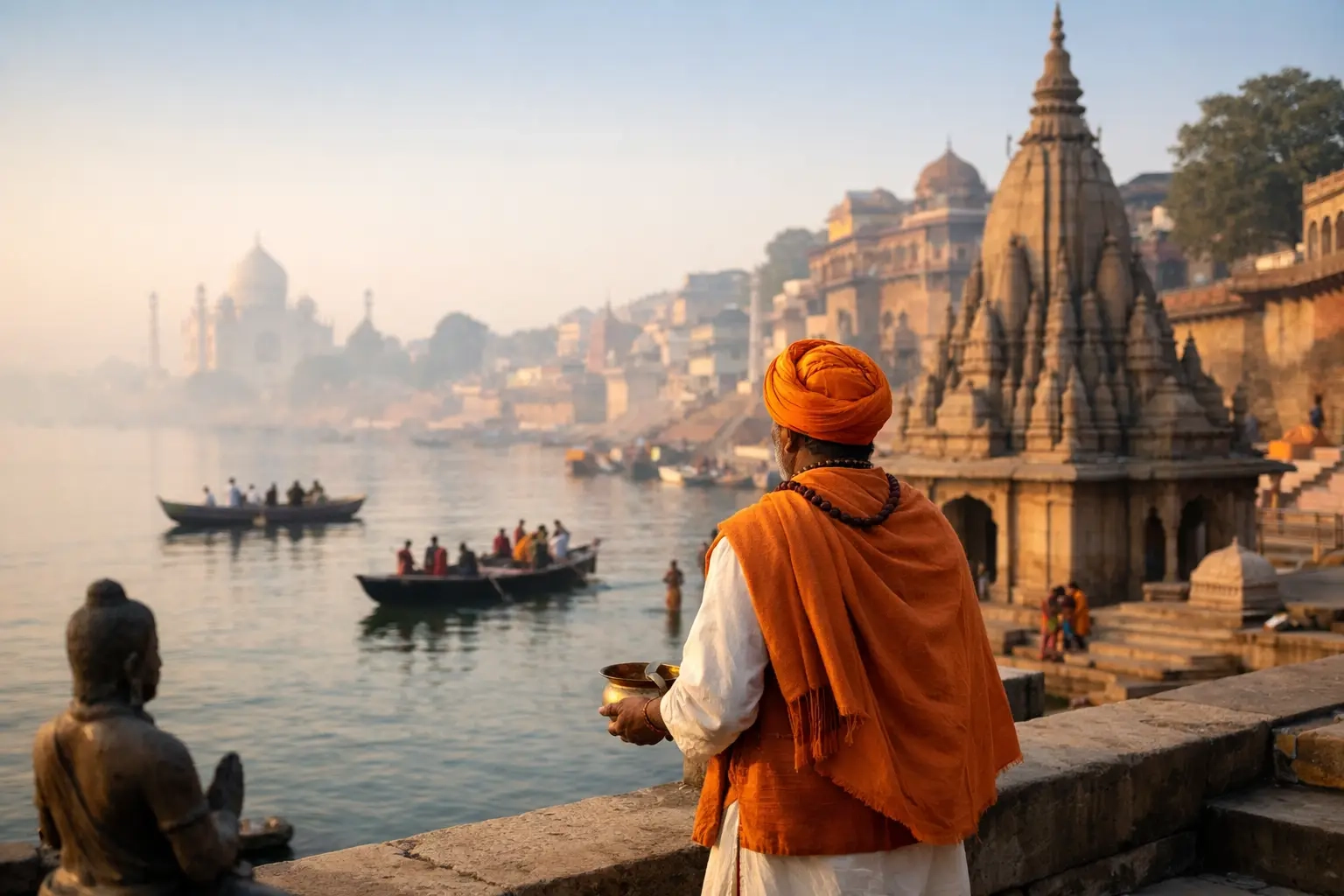
India has more pilgrimage traditions than any country on earth, and they don't share a map. The Buddhist sites cluster in the east, the Hindu river sites run along the Ganges, the great Sikh shrine is in Punjab, the Jain temples are in Rajasthan and Gujarat, and the Sufi dargahs are scattered between them.
So the first question isn't where to go. It's which thread you're following — because trying to pick up several at once produces a lot of driving and not much depth.
Here are the main routes, what each needs, and how they fit together.
The Buddhist circuit
The four principal sites of the Buddha's life sit within reach of one another across Bihar, Uttar Pradesh and the Nepali border.
Bodh Gaya is where he attained enlightenment, and the Mahabodhi Temple complex is the heart of it. Monasteries built by Buddhist nations from across Asia surround the town, so you can walk from a Thai temple to a Bhutanese one in ten minutes. Of the four, this is the one people linger at.
Sarnath, outside Varanasi, is where he gave his first sermon. Quiet, archaeological, with an excellent museum, and half a day is enough.
Kushinagar is where he died and was cremated. Smaller and less visited.
Lumbini, his birthplace, is across the border in Nepal — which makes this circuit a two-country itinerary, and means a multiple-entry Indian visa if you're returning.
Add Rajgir and Nalanda, the ruins of one of the ancient world's great universities, and you have a complete route.
Allow eight to ten days for the circuit done properly. Infrastructure in Bihar is more basic than in Rajasthan, which is worth knowing in advance rather than discovering.
The Hindu river sites
These follow the Ganges from the mountains to the plains, and they have very different characters.
Rishikesh, where the river leaves the Himalaya — green, cool, the centre of India's yoga tradition, and the gentlest introduction to all of this.
Haridwar, just downstream, one of the seven holiest cities, with a large evening aarti on the ghats.
Varanasi, the most intense of them, and the one that affects people most. We've written about it separately in our honest guide to Varanasi, because it deserves more than a paragraph.
Allahabad (Prayagraj), at the confluence of the Ganges and Yamuna, and the site of the Kumbh Mela.
Allow five to seven days for Rishikesh, Haridwar and Varanasi together. They sit roughly along a line, which makes the route efficient.
The Sikh and Jain threads
Amritsar in Punjab holds the Golden Temple, and it is one of the most moving places in India regardless of your own beliefs. The langar — the free community kitchen feeding tens of thousands daily, staffed entirely by volunteers — is as memorable as the building. Two nights, and worth adding to any northern itinerary.
Jain pilgrimage centres on the marble temples at Ranakpur and Mount Abu in Rajasthan, and Palitana in Gujarat, where several hundred temples crown a hill reached by some 3,500 steps. The Rajasthan temples slot neatly into a standard Rajasthan route; Palitana is a dedicated trip.
Sufi shrines — above all the dargah at Ajmer, between Jaipur and Jodhpur — are living, crowded, musical places, and Ajmer sits directly on the Rajasthan road.
The southern temple route
Often overlooked in pilgrimage planning, and shouldn't be. Tamil Nadu's temple towns — Madurai, Thanjavur, Rameswaram, Chidambaram — hold some of the largest and most actively used Hindu temples anywhere, with daily ritual life that has continued for a thousand years.
Different in feel from the north: less intensity, more scale and ceremony. Our South India page covers how that route works.
How to combine them, and how not to
The combinations that work geographically:
Buddhist circuit + Varanasi — Sarnath is on Varanasi's doorstep, so this is natural.
Ganges sites + Golden Triangle — Rishikesh, Haridwar and Varanasi add well to Delhi, Agra and Jaipur.
Rajasthan + Ajmer + the Jain temples — all on the same roads.
Amritsar + North India — one short flight or an overnight train.
The combination that doesn't: trying to cover Buddhist Bihar, the Ganges, Punjab and Tamil Nadu in one trip. That's four corners of a very large country, and you'd spend the trip in transit.
Pick one thread for a two-week trip. Two threads need three weeks.
Practical things that matter on this kind of trip
Dress modestly throughout — shoulders and knees covered. You'll remove shoes constantly, so slip-ons save a lot of bending.
Heads covered at the Golden Temple and at Sufi shrines; cloths are provided.
Leather is not permitted in some Jain temples, which catches people out with belts and handbags.
Photography rules vary and are sometimes strict. Ask, every time, and accept no as the answer.
These are working places of worship, not monuments. The people around you are praying, grieving or giving thanks. A good guide tells you what's happening and how to be present without intruding, and that is the single thing that most changes how a pilgrimage trip feels.
When to travel
October to March for the northern plains and Bihar. November to February are the most comfortable weeks.
Rishikesh is pleasant for much of the year and cool in winter. Avoid the northern plains from April to June, when the heat makes long temple days genuinely hard.
Festivals transform these places — Diwali at Varanasi, Dev Deepawali in November, Guru Nanak Jayanti at Amritsar. Extraordinary, and they need booking many months ahead.
How we plan it
We'd start by asking which tradition draws you, and whether you're travelling as a pilgrim or as someone who wants to understand. Both are fine, and they shape the itinerary differently — the pace, the guides, the amount of time standing still.
From there: private transport, guides who can explain the iconography and the ritual rather than just the dates, hotels chosen for being a calm place to return to, and a route that doesn't waste your days on the road.
Tell us which thread interests you and we'll build it around that rather than around a template.