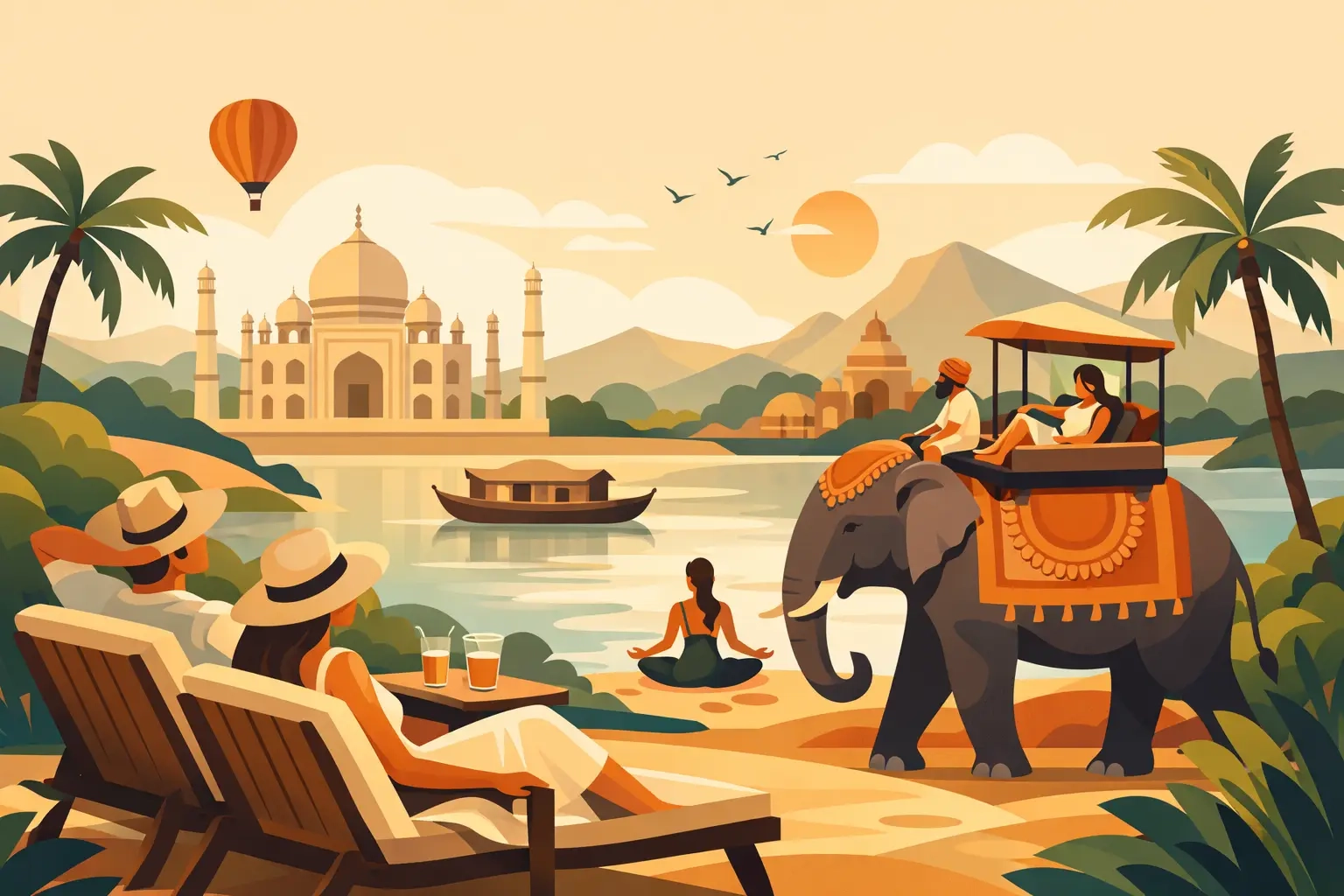
Almost every disappointing trip to India we hear about went wrong at the planning stage, not during the holiday. The hotels were fine. The guides were fine. There was simply too much in it.
India punishes an over-packed itinerary more than most countries, because the distances are long, the cities are demanding, and the best moments tend to happen in the gaps. Here's how to avoid that.
Mistake one: too many places
The single most common error. A fourteen-night itinerary with nine stops looks impressive on paper and feels like a work trip by day six.
The rule we use: no more than one move every two nights, and preferably one every three. A three-night stay gives you a full day without packing, which is where the good days live — the unhurried morning at a monument, the afternoon that wasn't scheduled, the dinner you didn't rush.
If you can't fit everything you want into that rule, the answer is a shorter list, not a faster pace. India is not a country you finish.
Mistake two: underestimating the driving
Map distances in India mean very little. Some real figures from the routes we plan most:
Delhi to Agra: 3–4 hours
Agra to Jaipur: 4–5 hours
Jaipur to Udaipur: 6–7 hours
Udaipur to Jodhpur: 5 hours
Pench to Kanha: 5–6 hours
None of those are terrible. All of them are half a day. An itinerary that treats them as transfers rather than as days is an itinerary with no days left in it.
Where a drive exceeds six hours, we'd usually look at a flight or an overnight train instead — and India's domestic network is good enough that this is often cheaper in time than it looks.
Mistake three: the wrong month for the region
India isn't one climate, and the regions want opposite halves of the year.
October and November are the best weeks for the northern plains and Rajasthan. December and January are comfortable by day, cold at night, and carry a real fog risk that delays flights and trains. April to June is punishing on the plains — and exactly when Kashmir and Ladakh open. July to September is monsoon across the north, and the traditional Ayurveda season in Kerala.
Trying to combine the plains and the Himalaya in one trip usually means doing one of them in the wrong month. Our North vs South India comparison goes into how the seasons differ between the two halves.
Mistake four: no recovery time
The flight from Australia is long, and arrivals into Delhi are often late at night. An itinerary that starts sightseeing at 8am the next morning starts badly.
Build a soft first day. Not a rest day necessarily, but a late start and something undemanding. The trip is better for it from there on.
The same applies at the end: don't book a tight international connection off the back of a morning game drive or a long transfer.
Mistake five: treating the hotel as a place to sleep
In most countries that's fine. In India the hotel is the pressure valve. A calm, well-located place to return to is what makes an intense day enjoyable rather than exhausting, and it's the thing we'd spend money on before almost anything else.
Location matters as much as quality. A beautiful hotel forty-five minutes from everything costs you ninety minutes a day.
What a well-paced first trip looks like
Ten to twelve nights, North India: Delhi (2) → Agra (1) → Jaipur (3) → Udaipur (3) → fly home from Delhi or Udaipur. Four stops, three of them multi-night, the famous sights covered, and room to breathe.
Seven to eight nights, South India: Kochi (2) → Munnar (2) → Periyar (1) → backwaters (1) → Kochi. Short drives, one region, properly seen.
Two weeks, wanting both: North India first, then fly south for a week in Kerala to finish. Intensity, then quiet — in that order, not the reverse.
The questions worth answering before you plan anything
How much moving around do you actually enjoy? Be honest. Some people are energised by a new place every two days; most aren't.
What would you regret missing? Usually a shorter list than the one people start with.
What would you rather skip? Equally useful, and rarely asked.
Who's travelling? Small children, a grandparent, or anyone with mobility considerations changes the shape of a good itinerary completely.
When can you go? This decides the region more than preference does.
What we actually do
We plan private India itineraries around those answers rather than around a template: your own car and driver, local guides at each stop, hotels chosen for where they sit as much as what they look like, and a pace that assumes you're a person rather than a schedule.
The part that's worth the most, though, is the part that sounds least like a sales pitch: we'll tell you when what you've asked for won't work. Ladakh in a week, North India in May with small children, nine cities in a fortnight. We'd rather lose the booking than send you somewhere in the wrong month or at the wrong speed, because the trips that go badly are the ones nobody pushed back on.
Taj Voyages has been planning journeys through India and South Asia for Australian travellers since 2012.
Tell us what you have in mind and we'll give you an honest view of whether it fits — before you've committed to anything.