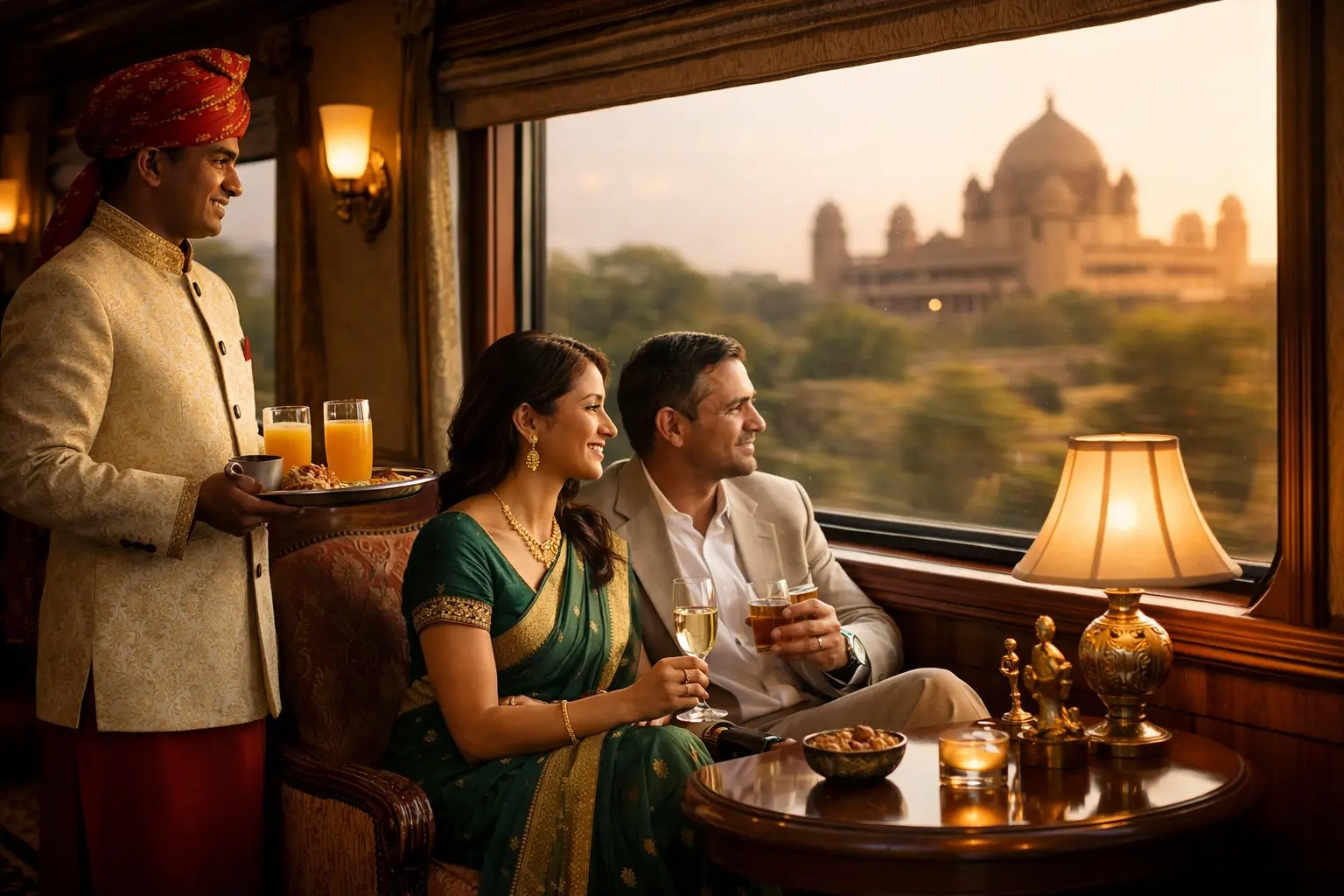
The appeal of the Maharaja Express is easy to state: you see a large part of northern India without packing a suitcase more than once.
You wake to a different landscape each morning, have breakfast as the train pulls in, spend the day at a fort or a palace or a national park with your guide and vehicle already arranged, and come back in the evening to the same cabin. The train moves overnight while you sleep. That is the whole proposition, and for the right traveller it is a very good one.
Here is what it actually involves.
Why travel India this way
India rewards time and punishes a rushed itinerary. The distances are long, the cities are intense, and a conventional multi-stop tour means a new hotel every second night, luggage in and out of cars, and a different set of logistics at each stop.
A rail journey removes most of that. Your room stays the same for the whole trip. Transfers happen while you are asleep or at dinner. The excursions, guides, entry tickets and vehicles are organised before you arrive. What you spend your energy on is the destination rather than the arrangements.
That makes it especially well suited to couples, friends travelling together, and families with older children — anyone who wants depth without friction. It suits travellers who like structure. If what you enjoy most about travel is wandering off on your own for a day, this is the wrong train.
The routes
Departures vary, and the route determines the character of the trip more than anything else. Broadly:
The Rajasthan-focused itineraries take in Delhi, Agra and the royal cities — Jaipur, Jodhpur, Udaipur, Bikaner. This is the classic choice, and the strongest one if Mughal and Rajput history is what draws you.
Longer departures extend towards Ranthambore National Park for a safari drive, Varanasi for the Ganges, or Mumbai. These add range: in one journey you can move from marble inlay work at the Taj Mahal to dry forest in a tiger reserve to the evening ritual on a riverfront.
The Treasures of India route is the shortest and works well as a segment inside a wider holiday rather than as the holiday itself.
Choose the route first. The train is the same; the trip is not.
Life on board
The atmosphere is polished rather than formal. Your cabin is a private retreat with proper bedding and private facilities, sized according to the accommodation category you choose — the difference between categories is space and inclusions, not service.
The public spaces are intimate. There are two dining cars and a lounge and bar, and because the passenger numbers are small you tend to recognise everyone by the second day. Food is Indian and international, well presented, and dietary requirements are handled properly when you tell us well before departure rather than on boarding.
The moments people remember are often the quiet ones: morning tea while the countryside goes past, the half hour between getting back from an excursion and changing for dinner, a drink in the lounge while someone explains what you both saw that day. Those gaps are what keep a packed itinerary from feeling packed.
What the excursions involve
This is the part worth being clear about, because it is where the effort is.
Excursion days are real touring days. Early starts are common — the Taj Mahal is best at dawn, and game drives at Ranthambore leave before sunrise. You will be on your feet at forts and monuments, often on uneven stone, with steps and sustained time outdoors. In Agra that means the Taj Mahal and Agra Fort. In Jaipur, Amber Fort, the city palaces and the artisan workshops. In Udaipur, the lake and the palace complex. In Bikaner, the desert and the fort.
Several itineraries include something arranged specially — a dinner set up at a heritage site, a cultural performance, a visit timed outside the busiest hours. These are genuinely good, and they are the clearest difference between the train and a well-planned road itinerary.
Where the route includes Ranthambore, the morning is a jeep safari. Sightings cannot be promised by anyone and should not be. The park itself — dry forest, lakes, the ruined fort above it — is worth the drive regardless.
If mobility is a consideration, tell us at the planning stage. It does not rule the journey out, but it should shape which route and which excursions we recommend.
Where it fits in a wider holiday
The train is usually at its best as the centrepiece of a longer trip rather than the whole of it.
A pattern that works: two or three nights in Delhi first, to adjust and to see the city properly without the clock running; then the rail journey; then something slower afterwards — a week in Kerala, a Himalayan stay, or on to Sri Lanka, Nepal or Bhutan.
What we would avoid is flying in from Australia and boarding the next morning. Departures are fixed and they do not wait, so a delayed international flight becomes an expensive problem. Give yourself a buffer at both ends.
The planning details that matter
Cabins and departure dates are limited, and the better categories go first, so this is a trip that rewards booking early. Beyond that, the surrounding arrangements need to line up with a schedule that cannot flex: international flights, the hotels either side, transfers, visa timing, insurance and any touring you add.
That is the practical case for having someone coordinate it rather than assembling it yourself. We book the train, the nights either side, the private touring and the transfers as one itinerary, so a change in one part does not quietly break another.
Is it right for you?
Yes, if you want to cover a lot of northern India, you value comfort and structure, and you would rather be guided than left to work it out.
No, if your ideal holiday is three nights in each of two places with nothing scheduled, or if early starts on consecutive days sound like work rather than anticipation.
For the travellers it suits, it is one of the few ways to see this much of India and still arrive home rested. Tell us what you have in mind and we will tell you honestly whether the train or a private road itinerary would serve you better — we plan plenty of both.