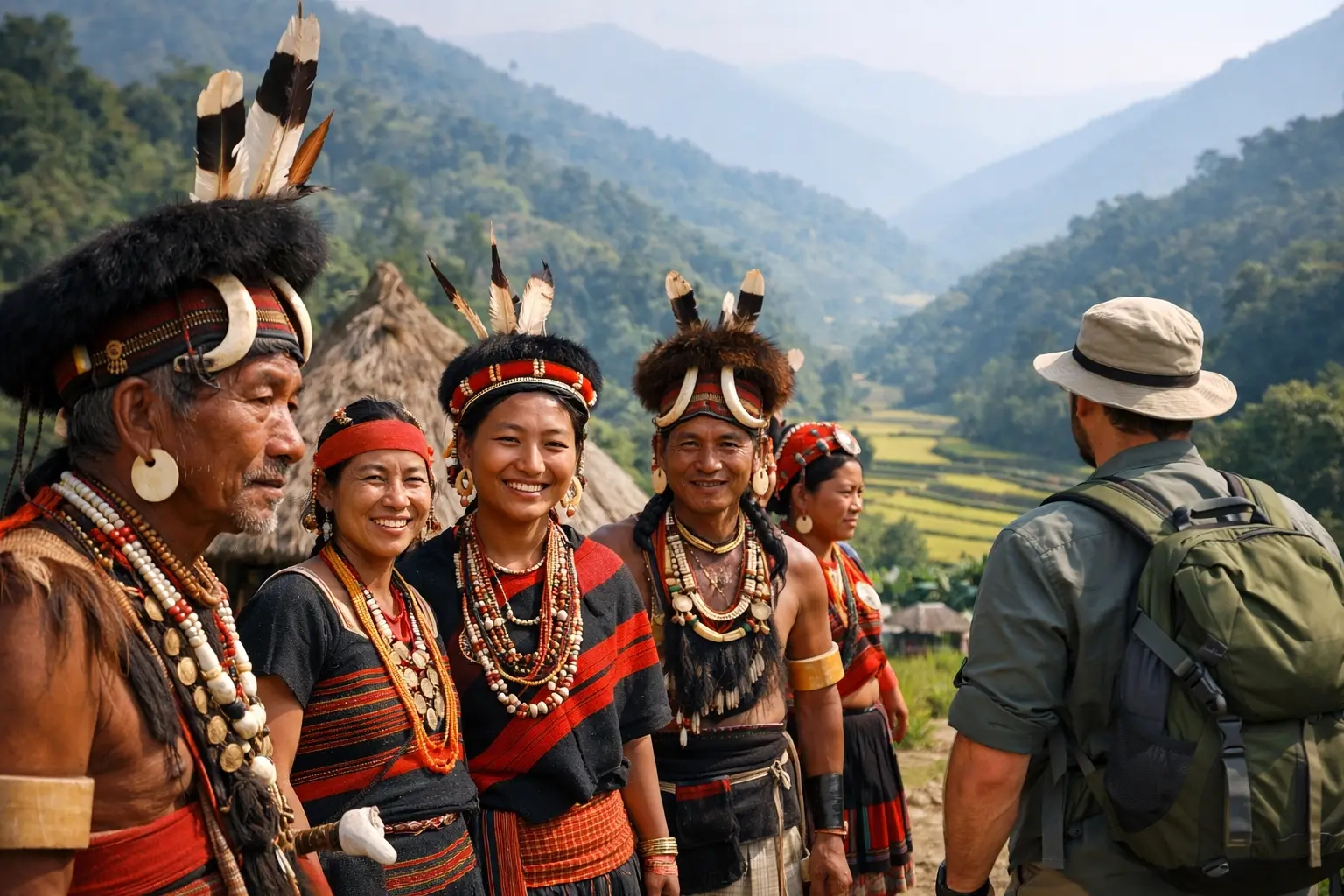
North East India is eight states connected to the rest of the country by a corridor twenty kilometres wide. It borders Bhutan, China, Myanmar and Bangladesh, and in culture, landscape and food it has more in common with Southeast Asia than with Delhi.
Almost no Australian travellers go. That's the appeal and the caveat in one sentence.
What's actually there
Assam is the gateway and the easiest part. Tea estates stretching to the horizon, colonial-era planters' bungalows you can stay in, and Kaziranga National Park — which holds the world's largest population of one-horned rhino, with sightings close to guaranteed, plus elephant, wild buffalo and a healthy tiger population. The Brahmaputra river runs through all of it, and river cruises are a genuinely good way to see it.
Meghalaya means "abode of clouds", and it earns the name. Cherrapunji and Mawsynram are among the wettest inhabited places on earth. The attraction is the living root bridges — walkways grown over generations by training the roots of rubber fig trees across rivers. The famous double-decker bridge at Nongriat is a steep 3,000-step descent and climb back, which is a real undertaking. Shillong, the capital, has an unexpected rock and gospel music culture.
Nagaland is the tribal heartland. Seventeen major tribes, each with its own language, dress and traditions, and a history of headhunting within living memory in some villages. The Hornbill Festival, 1–10 December, brings them together and is by far the most accessible way to encounter these cultures — our festival guide covers it.
Arunachal Pradesh is the far frontier — Tawang's Buddhist monastery at 3,000 metres, high passes, and the Apatani and Adi peoples. The most remote and the hardest to reach.
Sikkim sits apart to the west, with Kanchenjunga, Buddhist monasteries and much better infrastructure than the rest.
Permits, honestly
This is the part that requires planning.
Arunachal Pradesh requires a Protected Area Permit for foreign nationals, arranged in advance. Nagaland and Mizoram have registration requirements for foreign visitors. Assam, Meghalaya and Sikkim are straightforward for most itineraries.
Permits take time and are easier through an operator who does them regularly. They are not an obstacle, but they are a reason this region can't be arranged in a fortnight.
Being clear about the trade-off
Infrastructure is basic by Indian standards, let alone Australian ones. Outside Guwahati and the good tea bungalows, accommodation is simple. Roads are slow and often poor — distances that look like two hours take four. Internal flights are limited and weather-affected.
This is a trip for curious travellers, not comfortable ones. The reward is a part of India almost no foreign visitor sees, cultures that haven't been shaped by tourism, and landscapes that look nothing like the India in anyone's imagination.
If what you want is palaces, good hotels and the Taj Mahal, we'd point you at Rajasthan and say so plainly. North East India is for a second or third trip, or for travellers who specifically want the road less taken.
How long to allow
Eight to ten days covers Assam and Meghalaya — Kaziranga, a tea estate stay, Shillong and the root bridges. This is the sensible first visit.
Twelve to fourteen days adds Nagaland, and is the right length if Hornbill is the draw.
Two to three weeks for Arunachal Pradesh, given the distances and the permits.
Guwahati in Assam is the main entry point, with flights from Delhi and Kolkata.
When to go
October to April is the season. The monsoon here is genuinely extreme — this is the wettest region on the subcontinent — and travel between May and September is difficult.
November to March is the best window: clear, cool, and Kaziranga is open (the park closes during the monsoon, roughly mid-May to October).
Early December for Hornbill. March and April bring rhododendron in the higher areas.
Where this fits
North East India works as a trip of its own, or added to a wider India itinerary — Kolkata is the natural connecting point, and it's a short flight. It also pairs well with Bhutan, which shares a border with Assam and a good deal of cultural ground.
See our North East India page for how we usually shape it.
How we plan it
Permits first, because they set the timeline. Then the route, built around real driving times rather than map distances — this is the region where that mistake costs the most.
We choose accommodation honestly: a heritage tea bungalow in Assam is lovely, a guesthouse near Nongriat is not, and we'd tell you which is which before you book rather than after. Guides matter more here than almost anywhere, because the cultural context is unfamiliar and largely unexplained by signage.
Tell us what draws you to it — Hornbill, the rhinos, the root bridges, or simply the fact that nobody goes — and we'll build the route around that.