
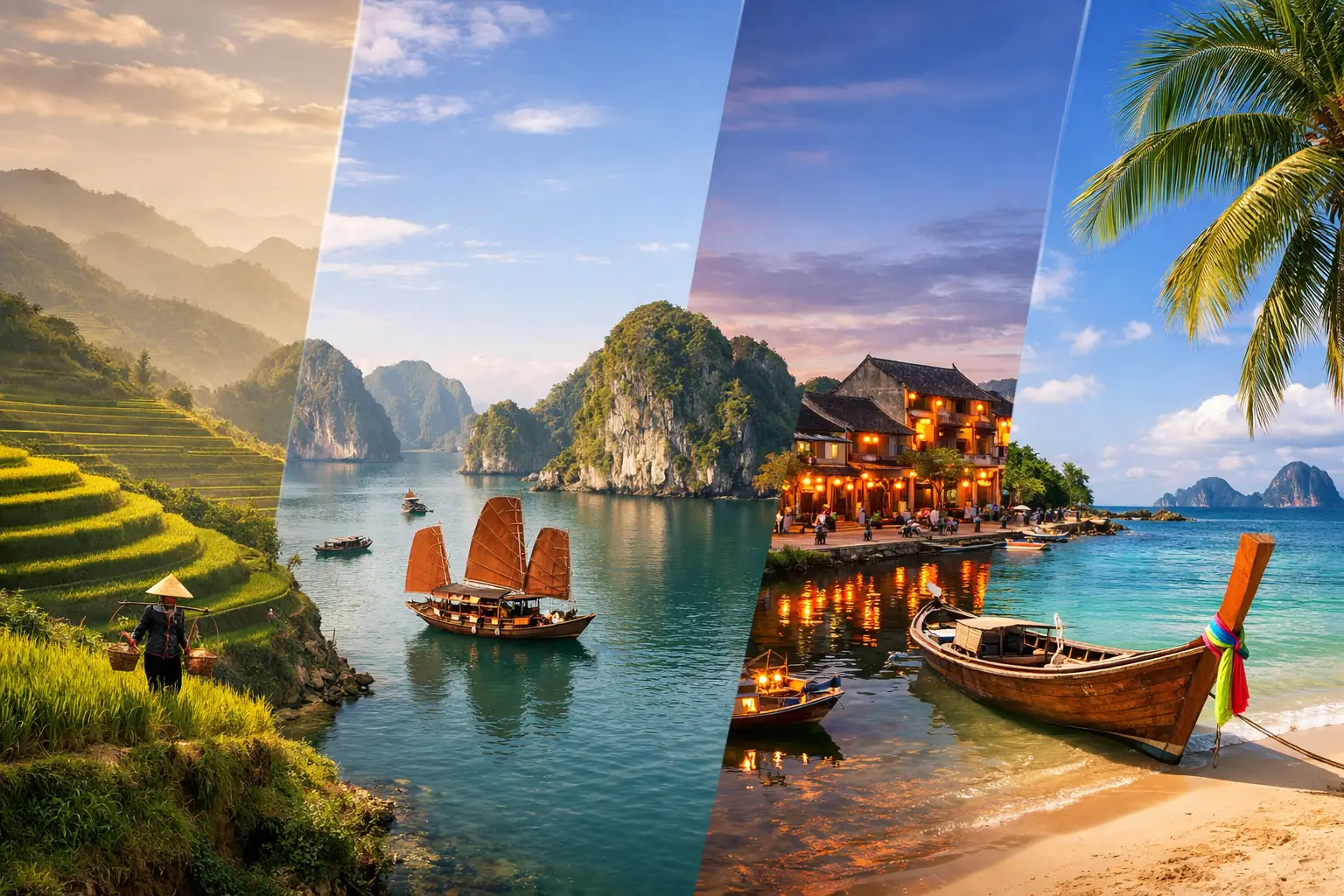
Vietnam does not offer one simple weather window. A morning can begin among Hanoi’s cool, tree-lined streets and end with a flight south to tropical heat, while central coast conditions follow an entirely different rhythm again. The best time to visit Vietnam depends on the experiences you value most, the regions you hope to combine and how much time you have to travel at an unhurried pace.
For many Australian travellers planning a considered, multi-stop holiday, March and April are the most balanced months. Much of the country is warm and relatively dry, with comfortable conditions for city exploration, coastal stays and time in the northern landscapes. Yet every season has its strengths. The right choice is less about finding perfect weather everywhere and more about designing an itinerary that works gracefully with Vietnam’s regional climate.
Understanding Vietnam’s regional seasons
Vietnam stretches for more than 1,600 kilometres from north to south, so weather patterns change markedly between Hanoi, the central coast and Ho Chi Minh City. Planning the whole country as though it has a single wet or dry season can lead to an awkward itinerary. A well-paced journey considers each region in turn, often pairing them in an order that makes the most of the prevailing conditions.
The north, including Hanoi, Ha Long Bay, Ninh Binh and Sapa, has four more recognisable seasons. Winters can be cool, particularly in the mountains, while summers are hot and humid with seasonal rain. Central Vietnam, home to Hue, Hoi An and Da Nang, enjoys its driest period earlier in the year but receives heavier rain later. The south, including Ho Chi Minh City, the Mekong Delta and Phu Quoc, is tropical, with a clear dry season and a greener, wetter period.
This variation is part of Vietnam’s appeal. It allows a single journey to move from imperial citadels and limestone waterways to lantern-lit heritage towns, contemporary cities and tranquil river landscapes, provided the route is shaped with care.
Best time to visit Vietnam across the country
March and April for the broadest itinerary
March and April are often the strongest choice for travellers wishing to experience north, central and south Vietnam in one journey. Hanoi is pleasant for walking, cycling and private guided visits, with spring growth softening the city’s boulevards and lakes. Conditions in Ha Long Bay and Ninh Binh are generally favourable, though occasional haze or mist can still lend the karst scenery an atmospheric quality.
Along the central coast, Hoi An, Hue and Da Nang are usually dry and increasingly warm. This is an excellent time to allow for a few relaxed nights beside the coast after time spent with Hue’s royal heritage or Hoi An’s food and architecture. In the south, days are hotter, but rainfall is typically limited, making it easy to include Ho Chi Minh City and the Mekong Delta.
The trade-off is warmth, especially by April in the south and central regions. Private transfers, well-located accommodation and a considered daily rhythm make a real difference. Early cultural visits, a long lunch out of the heat and quieter afternoons leave space to enjoy each place rather than simply move through it.
December to February for a drier southern escape
December through February suits travellers drawn to the south and central coast, particularly those seeking warm days alongside cultural touring. Ho Chi Minh City and the Mekong Delta are generally dry, while Phu Quoc is at its most inviting for a coastal extension. Central Vietnam is often improving after its wetter months, although rain can linger into December.
Northern Vietnam feels distinctly different at this time. Hanoi can be cool and overcast, while Sapa may be cold, misty and occasionally drizzly. For some travellers, that softer light and quieter mood are part of the pleasure, especially when the itinerary centres on Hanoi’s cafés, galleries, cuisine and heritage rather than extended mountain walking. For others, March or October will be a better fit for the north.
Christmas and New Year travel calls for early planning, particularly when combining Vietnam with other Asian destinations or particular accommodation preferences. The experience can be wonderfully festive, but the most polished journeys depend on having the right arrangements in place well ahead of departure.
May to August for coast, colour and summer energy
From May to August, central Vietnam often offers excellent beach weather. Da Nang and Hoi An are sunny and warm, and this period works particularly well for families or couples who want to balance a comfortable resort stay with cooking experiences, heritage walks and time in Hue. Coastal days are long, and the sea is generally appealing.
The north and south are warmer and receive more rain during these months. Showers are often concentrated rather than constant, but humidity can be pronounced. The countryside becomes exceptionally green, especially around the Mekong Delta and northern rice-growing areas. Travellers who do not mind adapting the day around a passing shower may find this a rewarding time for photography, food and slower regional exploration.
Summer is also a popular period for Australian family travel. It is wise to build in breathing room between flights and to choose properties that offer a restful retreat after a day of sightseeing. Thoughtful timing matters more than trying to fit too much into each day.
September to November for northern landscapes and cultural touring
Autumn can be particularly beautiful in northern Vietnam. September to November brings more comfortable temperatures to Hanoi, Ninh Binh and the mountain regions, with clearer days becoming more likely as the season progresses. Rice terraces around Sapa and nearby valleys are especially striking around the harvest period, although exact conditions naturally vary each year and by location.
This is a strong season for travellers interested in northern culture, cuisine and scenic touring. It also pairs well with a few days on the water in Ha Long Bay or Lan Ha Bay, where an overnight cruise creates a welcome change of pace after Hanoi.
Central Vietnam is the exception. Rainfall rises from around September and can be most disruptive in October and November, particularly around Hue and Hoi An. Rather than forcing a coast-heavy route at this time, a specialist can shape a journey around the north and south, or add central Vietnam only when conditions and timing are appropriate.
Choosing your timing by experience
If your priority is a refined, country-wide introduction, March and April offer the easiest balance. If you prefer a journey shaped around Hanoi, northern scenery and cultural encounters, October and November deserve close attention. For a coastal stay in Hoi An or Da Nang, February to August is generally the most reliable period, with the hottest conditions arriving in mid-year.
For the Mekong Delta and Phu Quoc, December to April is usually most suitable. The green season from May can still be very rewarding in the south, particularly for travellers who appreciate lush landscapes and do not expect every afternoon to be rain-free.
Food-focused travel works beautifully throughout the year. Hanoi’s warming soups and intimate dining rooms are especially inviting in cooler months, while central and southern Vietnam lend themselves to fresh herbs, market visits and relaxed al fresco meals in warmer weather. The key is to pace each day well and let the region guide the experience.
Festivals and dates worth planning around
Tet, Vietnam’s Lunar New Year, is one of the country’s most meaningful celebrations. It usually falls in January or February, with dates changing each year. Streets are decorated beautifully, families gather and the atmosphere can be deeply memorable. At the same time, many businesses operate on altered hours, some restaurants and attractions close, and domestic travel is especially busy.
Tet is best approached as a deliberate cultural inclusion rather than an incidental travel date. A carefully planned itinerary can accommodate it, but travellers wanting the fullest choice of dining, touring and transport arrangements may prefer to arrive before or travel after the principal holiday period.
Hoi An’s monthly lantern evening, held around the lunar full moon, adds a gentle sense of occasion to the old town. It is worth considering if it aligns naturally with your dates, though Hoi An is rewarding on any evening when you have enough time to wander its historic lanes without rushing.
A better way to shape a Vietnam holiday
The most satisfying Vietnam itineraries usually avoid trying to cover every region in a short stay. Ten to fourteen nights can allow time for Hanoi and the north, central heritage and coast, then Ho Chi Minh City and the Mekong Delta, but the route should reflect the season. In wetter months, fewer regions and longer stays often produce a more relaxed and memorable holiday.
For Australian travellers, the detail extends beyond weather: flight timing, internal connections, accommodation character, dietary preferences, touring pace and support with visa requirements all need to work together. Taj Voyages creates personalised itineraries around these practical considerations, so the journey feels composed from your first arrival through to your final coastal sunset.
Choose the season that best serves the Vietnam you want to experience, then give each region the time it deserves. The country is at its most rewarding when there is room to pause for a bowl of pho in Hanoi, linger over Hue’s layered history, or watch evening settle across a Mekong waterway.