
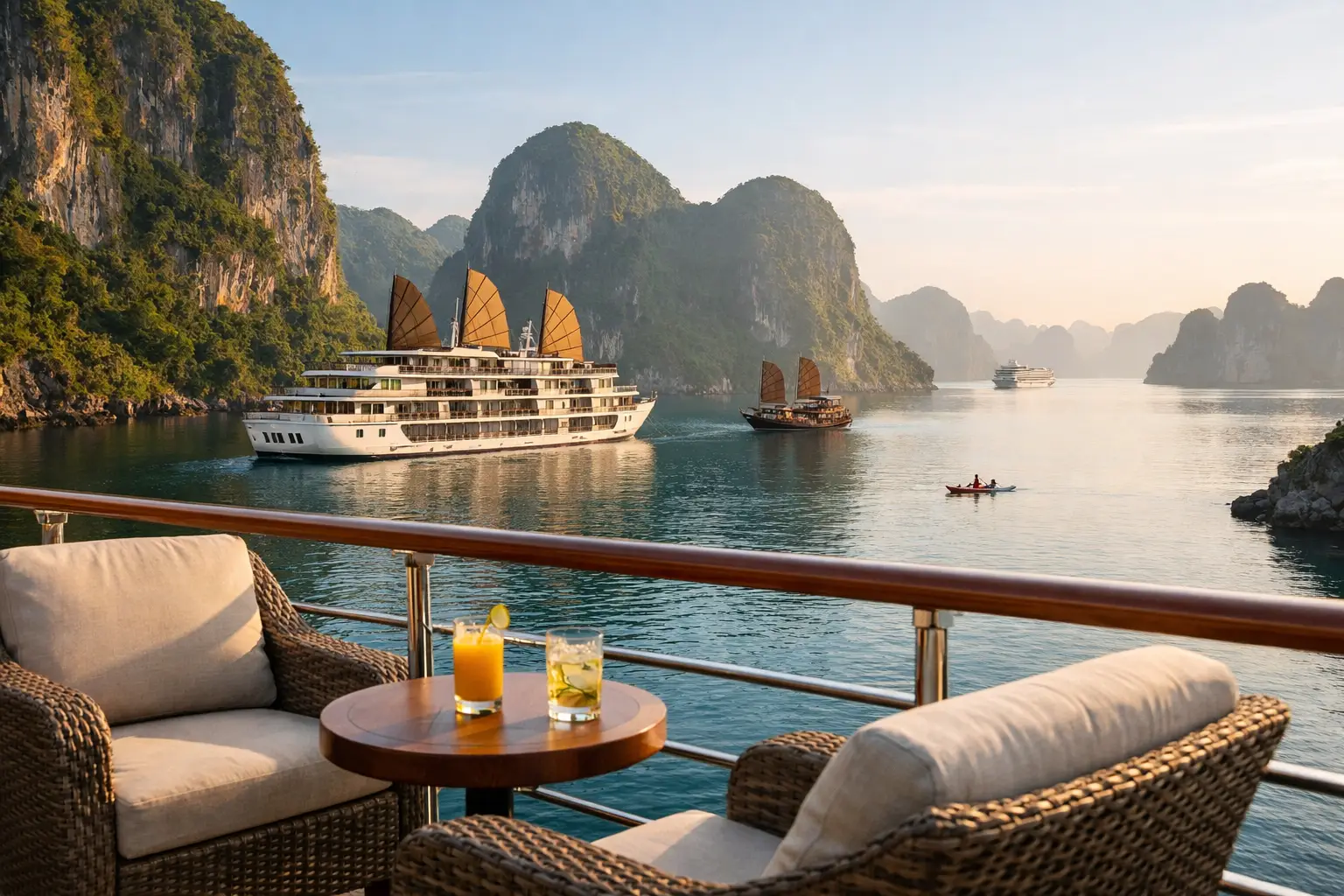
The limestone islands of Halong Bay are often pictured from the deck of a traditional-style junk at golden hour. In practice, choosing a Halong Bay cruise is less about finding the prettiest photograph and more about matching the journey to the pace, comfort and experiences you want from Vietnam. The right cruise turns a short stay on the water into a restful and memorable part of a wider itinerary. The wrong fit can leave you spending too much of your limited holiday time in transit, or on a vessel that feels busier than you had expected.
For Australian travellers combining Hanoi, central Vietnam and perhaps further time in Indochina, a cruise should be considered as one carefully coordinated element, not an isolated overnight stay. Route, vessel, cabin, inclusions and season all shape the experience.
Start with the part of the bay you want to see
Halong Bay is the best-known name, but cruises may sail through Halong Bay itself, Lan Ha Bay or Bai Tu Long Bay. These connected waters share the region's remarkable karst scenery, yet the experience on board and ashore can differ.
Lan Ha Bay, south of Halong Bay and close to Cat Ba Island, is often favoured for a slightly quieter atmosphere and opportunities for kayaking among sheltered limestone formations. It can suit travellers who want time on the water balanced with gentle activities and a more relaxed sense of space.
Bai Tu Long Bay lies to the north-east and generally has fewer vessels in some areas. It is a considered choice for those who value tranquillity, although daily activities and sailing times vary between operators. Classic Halong Bay routes remain appealing for their iconic views and established itineraries, particularly if this is your first visit.
The name of the bay alone does not tell the whole story. Ask how much actual cruising is included, where the vessel embarks, and whether the itinerary allows time in quieter anchorages rather than simply passing through the scenery. A specialist can assess the practical details behind each sailing and select the route that complements the rhythm of your broader Vietnam journey.
Choosing a Halong Bay cruise by duration
A two-day, one-night cruise is the most common option. It offers an afternoon and evening on board, an early morning activity, then a return to shore the following day. For travellers with a tightly planned itinerary, it can provide a satisfying introduction to the bay without taking too much time from Hanoi, Hoi An or other destinations.
However, the first and last day include road transfers and embarkation procedures. If you have the time, a three-day, two-night sailing is usually the more unhurried choice. It gives the landscape time to settle around you and permits a fuller programme of kayaking, village visits, cave exploration or a day excursion by smaller boat. It is especially worthwhile for couples and families who prefer not to feel that every hour has been scheduled.
Longer is not automatically better. Some travellers enjoy a single night precisely because they want the bay as a beautiful interlude within a varied itinerary. Others will value the second night because it creates room to slow down. The answer depends on your overall travel dates, arrival timing in Hanoi and the balance of cities, heritage and countryside you would like to experience.
Look beyond the vessel's photographs
Cruise vessels range from intimate boats with a small number of suites to larger contemporary ships with restaurants, lounges, spa facilities and varied accommodation categories. Neither approach is inherently superior. The important question is whether the atmosphere suits you.
A smaller vessel can feel personal and calm, with attentive service and fewer fellow guests during excursions. A larger vessel may offer more choice in cabins, public spaces and dining, which can work well for multigenerational families or small groups travelling together. On either, examine the details that affect your comfort: cabin size, private balcony, bathroom layout, bed configuration, sound insulation and the location of your room relative to the engine or public areas.
A balcony is particularly valuable for travellers who would like private time with the scenery, away from the main deck. Yet a well-positioned cabin and a generous observation area may matter more than the size of the vessel itself. If accessibility, mobility or dietary requirements are relevant, these should be discussed before confirming a cruise. Gangways, tender boats, stairs and shore excursions can vary considerably.
Consider how active you want the days to be
Most itineraries combine scenic sailing with a selection of activities. These may include tai chi at sunrise, kayaking, a bamboo boat ride, a visit to a cave, swimming when conditions permit, or cycling and village exploration on Cat Ba Island. The activities are generally optional, but their timing and intensity can influence your enjoyment.
Travellers seeking a restorative stay may prefer a programme with a little more time on deck and fewer early departures. Those keen to be active may appreciate longer kayaking sessions or a second-day excursion away from the main vessel. Families should consider whether children will be comfortable with tender transfers and whether the vessel offers enough flexibility between scheduled outings.
Do not assume an itinerary described as ‘leisurely’ means there are no early starts. Sunrise activities are common, and disembarkation is typically in the morning. A well-planned Vietnam itinerary allows for this, rather than arranging a demanding onward journey immediately afterwards.
Dining and service set the tone on board
Meals are a central part of a Halong Bay cruise. Many vessels present Vietnamese cuisine alongside familiar international options, often in a formal dining room or a more relaxed setting on deck when weather allows. Menus, service style and beverage arrangements differ, so expectations should be clear before departure.
For some travellers, polished dining and an extensive wine selection are essential. For others, the priority is thoughtful Vietnamese dishes, warm service and an unhurried table overlooking the water. Both preferences can be accommodated when the cruise is selected with care. Dietary needs should be advised well in advance, particularly for allergies or specific medical requirements.
It is also worth considering the guest profile. Some ships attract couples looking for quiet time, while others have a more social ambience. Neither is a judgement on quality, but it can affect whether the cruise feels appropriately private, lively or family-friendly.
Choose timing with realistic expectations
Halong Bay changes character through the year. Cooler months can bring soft light and atmospheric mist, lending the limestone peaks a quiet, almost monochrome beauty. Warmer months tend to offer greener landscapes and opportunities for swimming, though rain or changing conditions can occur. Clear skies are possible at many times of year, but they cannot be planned with certainty.
Rather than selecting dates solely for a particular photograph, consider the season across your full Vietnam itinerary. If you are travelling from the north to the centre and south, weather patterns may differ markedly between regions. A considered plan makes room for these variations and ensures the cruise fits naturally with the destinations before and after it.
Operational adjustments can occasionally be necessary due to weather or port conditions. Experienced planning means allowing sensible flexibility around transfers and selecting established cruise partners with clear service standards and responsive on-the-ground coordination.
Give the journey around the cruise equal attention
The transfer between Hanoi and the cruise port is often overlooked, yet it shapes the start and finish of your time on the bay. Depending on the port and traffic conditions, the journey can take several hours. Private transfers offer a more comfortable, direct experience and make it easier to coordinate with your hotel, flights or onward rail and air arrangements.
The night before the cruise is usually best spent in Hanoi, rather than arriving from an international flight and travelling straight to the coast. On return, some travellers continue to Hanoi for another night; others connect onwards to central Vietnam. The most suitable arrangement depends on flight times and the level of pace you are comfortable maintaining.
This is where a tailored itinerary has real value. Taj Voyages can coordinate the cruise with your Hanoi accommodation, private transfers and onward arrangements, so the experience feels properly placed within your holiday rather than added on at the last minute.
A Halong Bay cruise is at its best when you have enough time to sit quietly on deck as the islands drift by, knowing the practical arrangements have already been considered. Choose the sailing that gives you that space, then let the bay do what it does best: slow the journey down.