
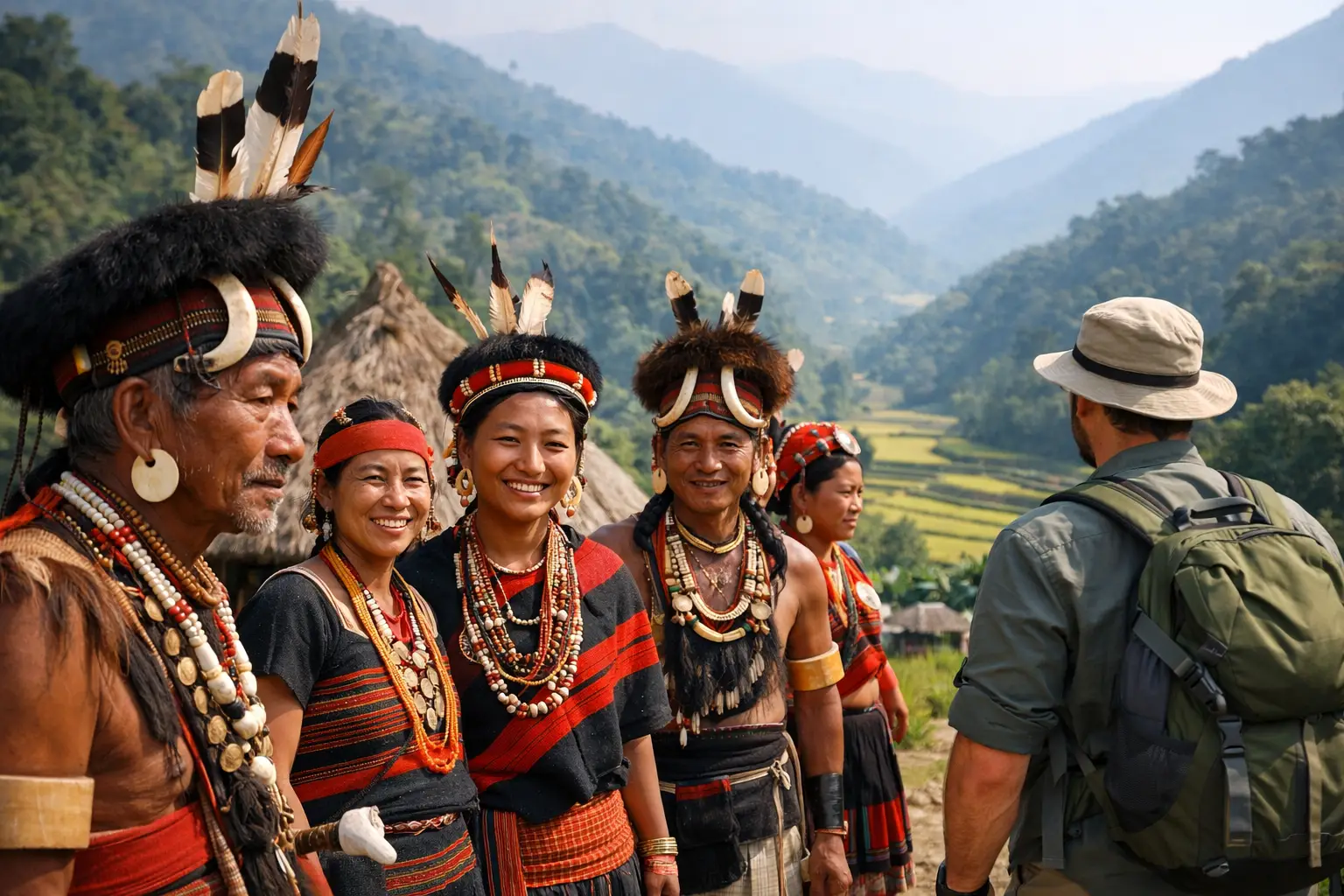
A morning in a village in Nagaland may begin with woodsmoke lifting from the kitchen hearth, woven shawls catching the early light and a local host explaining the work behind a ceremonial textile. These are the quiet, human moments that give north-east India tribal tours their enduring value. This is not a region to hurry through or observe from a distance. It rewards a measured itinerary, thoughtful introductions and time to understand that each community has its own language, customs, history and relationship with the land.
India’s north-east comprises eight states, connected to the rest of the country by a narrow corridor and shaped by the eastern Himalayas, dense forests, river valleys and international borders. For travellers who have already experienced Rajasthan, Kerala or the Golden Triangle, it offers a markedly different perspective on India: more intimate in scale, richly regional and exceptionally varied.
Why north-east India tribal tours need careful planning
The word “tribal” is often used broadly, yet it can conceal the remarkable diversity of the region. Nagaland alone is home to numerous Naga communities, each with distinct traditions and artistic practices. In Arunachal Pradesh, travellers may encounter the cultural worlds of the Apatani, Monpa, Adi or Nyishi peoples, among others. Meghalaya is known for the Khasi, Jaintia and Garo communities, while Assam brings together tea-growing landscapes, river island life, wildlife and a wide range of cultural influences.
A considered journey avoids treating these identities as a performance or a checklist. The most rewarding visits are arranged around genuine local connection: a village walk with a knowledgeable guide, a conversation with an artisan, a meal prepared in a family home where appropriate, or time spent learning how a community’s architecture, agriculture and festivals reflect its environment.
It also takes operational experience. Roads can be scenic but slow, weather can affect travel times, and some areas require permits or advance arrangements. The right sequence of flights, private road transfers and overnight stops makes a substantial difference to how relaxed the journey feels. Rather than fitting too much into each day, a well-designed itinerary allows for unplanned encounters, changing conditions and the pleasure of simply being present.
The Regions That Shape a Meaningful Journey
Nagaland: village traditions and powerful craft
Nagaland is often a highlight for travellers drawn to living heritage. Its hill villages, known for their distinctive gateways, communal spaces and carved timber structures, offer context for traditions that continue to evolve rather than sit still in history. Textiles are especially compelling, with colour, pattern and weaving techniques carrying deep cultural meaning.
Kohima and the surrounding villages provide a natural starting point, particularly when visits are facilitated by local people who can introduce places respectfully. The Hornbill Festival, generally held in early December, can be an engaging way to see music, dance, food and craft from across the state in one setting. It is lively and well attended, however, so it suits travellers comfortable with a more energetic atmosphere. At other times of year, village-based experiences can feel quieter and more personal.
Arunachal Pradesh: mountains, monasteries and valley life
Arunachal Pradesh has a grander, more remote character. High mountain roads lead towards Buddhist monasteries and alpine scenery in the west, while fertile valleys and forested foothills reveal entirely different cultural landscapes elsewhere in the state.
The Ziro Valley is often included for its beautiful rice fields and the cultural heritage of the Apatani people. Here, local knowledge adds depth to what you see: carefully managed wetlands, village layouts and agricultural systems developed over generations. Further west, the Monpa cultural sphere around Tawang offers monasteries, Himalayan views and a deeply contemplative pace.
Distances in Arunachal Pradesh should never be underestimated. A comfortable itinerary may include fewer locations than a map suggests, with well-placed stays and time to acclimatise to altitude where needed. That restraint is not a compromise. It is what allows the region’s landscapes and cultural encounters to be properly absorbed.
Meghalaya: community, craft and extraordinary landscapes
Meghalaya combines cultural encounters with some of north-east India’s most dramatic natural scenery. Around Shillong, local music, markets and Khasi heritage create an appealing urban-rural contrast. Further into the hills, villages are linked by footpaths, forest and the renowned living root bridges, formed over decades by guiding the roots of rubber fig trees.
A visit here works best when it balances activity with comfort. Some viewpoints and villages are readily accessible, while certain walks require good fitness and a willingness to take uneven steps at an unhurried pace. Your itinerary can be shaped around what matters most to you, whether that is village life, gardens, local cuisine, gentle walks or time in serene hill-country accommodation.
Assam: a graceful gateway to the north-east
Assam is often the most practical arrival point and deserves far more than a brief transit stop. Guwahati provides air connections, while the Brahmaputra Valley opens into tea estates, temples, markets and riverine landscapes. Kaziranga National Park can add a rewarding wildlife dimension, with its one-horned rhinoceros, elephants and prolific birdlife.
Assam also gives a useful sense of the wider cultural geography of the region. A river cruise or a carefully chosen stay near the tea country can create breathing room between more remote overland sections. For travellers who prefer a gentler pace, combining Assam with Meghalaya may be ideal. Those with more time can continue towards Nagaland or Arunachal Pradesh for a fuller regional journey.
Travelling Respectfully Is Part of the Experience
Cultural immersion is most meaningful when it is guided by courtesy. Communities are not museum exhibits, and local customs around photography, dress, sacred spaces and private homes deserve attention. Your guide should advise when photographs are welcome, when a simple request is appropriate and when it is better to put the camera away.
It is equally worthwhile to arrive with curiosity rather than assumptions. Ask about contemporary life as well as heritage, listen to how people describe their own community, and allow conversations to unfold naturally. Buying directly from craftspeople where possible can be a thoughtful way to value skills such as weaving, cane work, woodcarving and food preparation, provided it is done through trusted local arrangements.
This approach also helps ensure visits are paced and structured in ways that respect hosts. The best cultural access is never intrusive. It is based on relationships, local expertise and the understanding that a warm welcome is something to appreciate, not expect.
When to Travel and How Long to Allow
October to April is often the most comfortable period for a broad north-east itinerary, with clearer conditions in many areas and cooler temperatures in the hills. Festival dates can add colour and purpose to a journey, although they need to be planned well in advance due to demand for suitable accommodation and transport.
The monsoon brings vivid green scenery and impressive waterfalls, particularly in Meghalaya, but may also make road journeys less predictable. For some travellers, this is a worthwhile trade-off; for others, a drier-season itinerary will be more comfortable. The ideal timing depends on whether your priority is a festival, wildlife, Himalayan scenery, village encounters or simply a relaxed rhythm.
Allow at least 10 to 14 nights for a journey that includes two or three states without feeling rushed. A deeper exploration of Nagaland, Assam, Meghalaya and Arunachal Pradesh is better treated as a longer private itinerary, with flights and driving days arranged around your preferred level of activity. Accommodation may range from characterful heritage stays and refined hotels to simple, carefully selected lodges in remote areas. In the north-east, comfort is often defined less by formality and more by warmth, location and the quality of local hosting.
A Journey Designed Around You
For Australian travellers, the logistics of a north-east India journey can appear intricate well before departure. International flights, domestic connections, regional permits, varied road conditions and remote accommodation all need to work together. Taj Voyages can coordinate these details into a personalised itinerary, with experienced local guides and a sensible pace that reflects your interests.
Perhaps you want to pair village culture in Nagaland with wildlife in Assam, spend more time in the mountain monasteries of Arunachal Pradesh, or build a gentler route through Meghalaya’s hills. Each calls for a different approach. The enduring pleasure of this region lies in allowing its people, places and rhythms enough room to speak for themselves.