
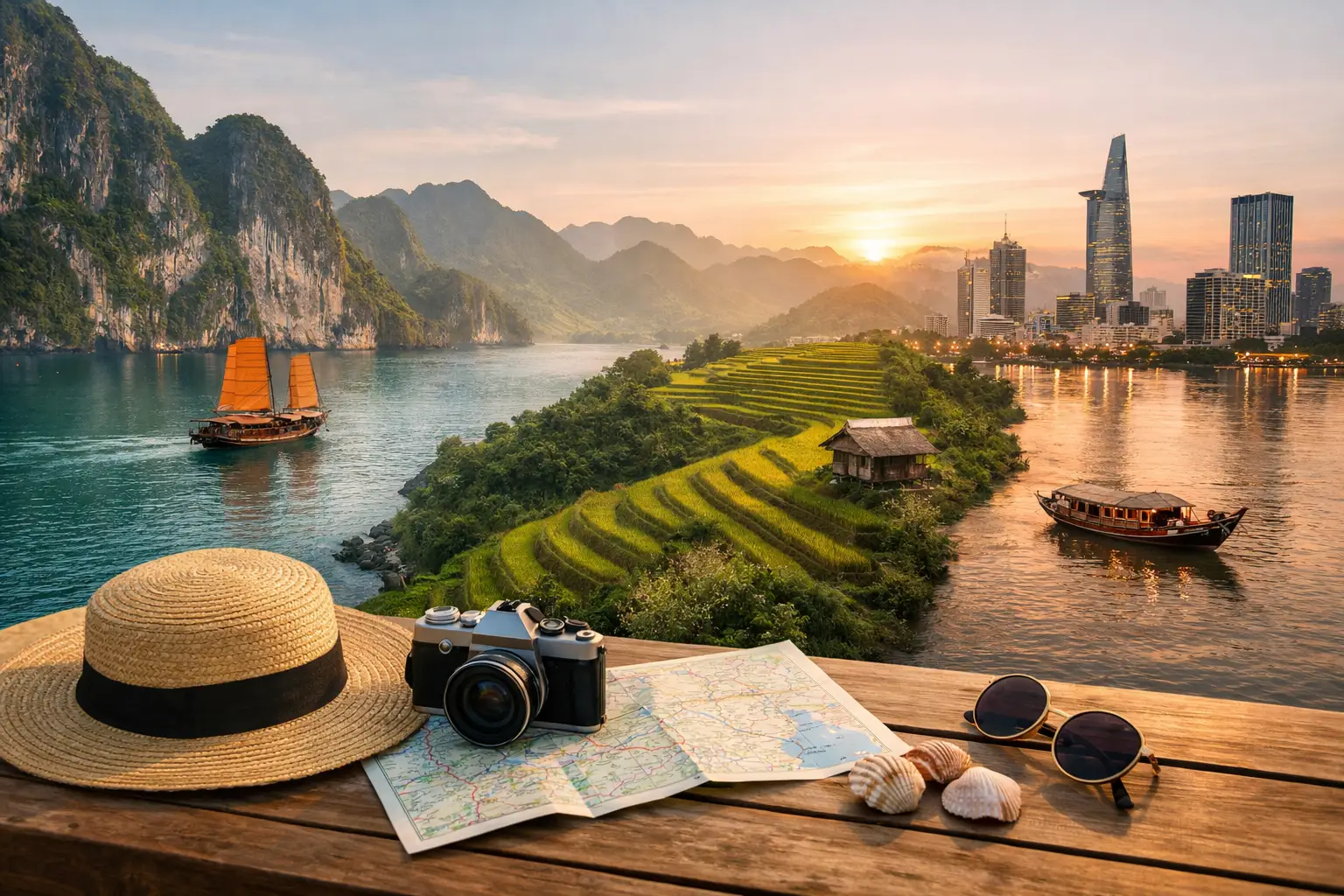
The pleasure of Vietnam in 10 days: a north-to-south itinerary is in its contrasts. You might begin the morning beside Hanoi’s serene lakes and end it amid the fragrance of street-side cooking; several days later, you can be gliding through the limestone waters of Ha Long Bay before arriving in the energetic southern metropolis of Ho Chi Minh City. The route is richly rewarding, but it asks for considered pacing. With domestic flights, well-located accommodation and private transfers arranged around your plans, ten days can feel generous rather than rushed.
This itinerary follows the country’s natural north-to-south flow, pairing its essential cultural centres with time to settle into each place. It is particularly well suited to first-time visitors who want a sophisticated introduction to Vietnam without treating every day as a transit day.
Vietnam in 10 days: the ideal route
The most comfortable direction is Hanoi, Ha Long Bay, Hoi An, Hue and Ho Chi Minh City, with the Mekong Delta as a final contrast. Vietnam is long and narrow, so travelling by road from north to south would consume too much of a ten-day holiday. Two carefully timed internal flights preserve time for the experiences that matter: an unhurried dinner in Hoi An, a thoughtful guided visit to Hue’s Imperial City, or a quiet hour on deck in Ha Long Bay.
This route works best with a private guide in the cities and a well-run overnight cruise in the bay. The balance can be adapted for families, couples or small groups. Travellers who are especially interested in food may add a market visit and cooking experience in Hanoi or Hoi An, while those drawn to history may choose deeper exploration in Hue and Ho Chi Minh City.
Days 1 and 2: Arrive in Hanoi and find its rhythm
Arrive in Hanoi and allow the first afternoon to remain light. After a long flight from Australia, a calm transfer to your hotel and time to refresh makes a genuine difference. A property in or near the Old Quarter places you within easy reach of the city’s historic streets while giving you a comfortable retreat from their lively energy.
Your first evening might include a relaxed welcome dinner featuring northern Vietnamese cuisine. Hanoi’s food culture is defined by freshness and restraint, with fragrant herbs, clear broths and carefully balanced flavours.
Dedicate your second day to the capital’s layered character. With a knowledgeable local guide, visit key landmarks such as the Temple of Literature, Ho Chi Minh’s historic precinct and the graceful French-era architecture around Hoan Kiem Lake. The Old Quarter deserves time on foot, not merely a quick drive-through. Its narrow lanes reveal specialist trades, small temples, cafés and everyday commerce that give the city its unmistakable texture.
In the evening, a water puppet performance offers a distinctly northern cultural tradition. It is a charming way to end the day, especially after the concentration of Hanoi’s museums and monuments.
Days 3 and 4: Ha Long Bay at a gentler pace
Leave Hanoi after breakfast for Ha Long Bay, generally a two-and-a-half to three-hour drive depending on traffic and your chosen embarkation point. An overnight cruise is the right use of time here. It allows you to experience the bay after day visitors have departed, when the limestone karsts take on softer colours and the water feels more spacious.
Once aboard, settle into your cabin and enjoy lunch as the vessel moves between the dramatic islands. Cruise programmes vary, but may include a visit to a floating village or cave, kayaking in a sheltered area, a cooking demonstration or simply time on deck. The finest part is often the unstructured time: tea in hand, watching the landscape shift beyond the rail.
On day four, enjoy an early morning on the water before returning to the mainland. A private transfer can take you directly to Hanoi airport for an afternoon flight to Da Nang. From there, it is a straightforward drive to Hoi An. Arriving by evening means you can check in, dine well and wake up ready to enjoy the town rather than lose a prime sightseeing day in transit.
Days 5 and 6: Hoi An and Hue, two sides of central Vietnam
Hoi An has a measured beauty that rewards a slower stay. On day five, explore its preserved trading-town streets with your guide, taking in old merchant houses, assembly halls and the Japanese Covered Bridge. Vietnamese, Chinese, Japanese and European influences are visible here, but Hoi An never feels like a museum piece. It remains a working town, with tailors, artisans, market stalls and family-run restaurants woven into daily life.
Leave part of the afternoon free. You may prefer a spa treatment, a cycling excursion through nearby villages, a visit to an organic farm or time by the pool. Hoi An is also an excellent place for a private cooking class, particularly if you enjoy understanding a destination through its ingredients and regional specialities.
On day six, travel north to Hue via the Hai Van Pass, where the road offers broad views over the coast and forested slopes. This is a far more memorable transition than simply flying between central Vietnamese destinations. In Hue, the former imperial capital, check in before an evening at leisure.
Day 7: Imperial Hue, then on to Ho Chi Minh City
Spend the morning with a guide in Hue’s Imperial City, a vast walled complex that conveys the scale and ceremony of the Nguyen dynasty. Depending on your interests, continue to an imperial tomb, a garden house or the Thien Mu Pagoda beside the Perfume River. Hue’s history is substantial, so a well-paced private visit is valuable. It brings context without making the day feel overly formal.
Fly south in the afternoon to Ho Chi Minh City. The shift is immediate: Hanoi is contemplative and Hoi An softly lit, while Ho Chi Minh City is dynamic, commercial and full of forward momentum. A central hotel gives you easy access to restaurants, galleries and the city’s handsome colonial-era streets.
Days 8 and 9: Ho Chi Minh City and the Mekong Delta
Day eight is for understanding the city beyond its traffic and skyline. A private tour can take in the Reunification Palace, the Central Post Office, Notre-Dame Cathedral Basilica precinct and the War Remnants Museum, approached with appropriate time and sensitivity. The city is equally compelling in its smaller details: a morning coffee, a flower market, the geometry of an old apartment block or a carefully prepared southern Vietnamese meal.
For those who enjoy culinary experiences, an evening food-focused tour can be tailored to your preferences. It may centre on refined local restaurants, neighbourhood favourites or a combination of both.
On day nine, travel into the Mekong Delta. This region offers a quieter perspective on southern Vietnam, shaped by waterways, orchards and agricultural life. A private day journey may include a boat excursion, local produce tastings and a visit to a family workshop. If you would rather avoid a long return drive, an overnight stay in a thoughtfully chosen riverside property can be arranged, though this usually means adjusting the final departure logistics.
Return to Ho Chi Minh City by late afternoon and keep the evening unplanned. It is a useful buffer before an international flight, and a chance to enjoy one final dinner at your own pace.
Day 10: Departure with room to breathe
On your final day, take advantage of a later departure if your flight schedule permits. Enjoy breakfast, a final stroll or a relaxed visit to a gallery before your airport transfer. Leaving this time deliberately open is not wasted time. It protects the itinerary from the fatigue that can come with a full final morning and gives your holiday a more composed finish.
A few decisions that shape the journey
Ten days is enough for Vietnam’s highlights, but not every experience belongs in the same itinerary. Sapa’s mountain landscapes, Ninh Binh’s river scenery and a longer Mekong cruise are all worthwhile, yet each needs additional nights to be properly enjoyed. Adding them would mean reducing time elsewhere, usually in central Vietnam or the south.
The time of year also matters. Vietnam’s climate differs considerably from north to south, and conditions in Hanoi, central Vietnam and the Mekong can vary on the same journey. A specialist can advise on the most suitable routing, accommodation and cruise choice for your preferred travel dates, while coordinating flights, transfers, guides and practical pre-departure arrangements.
At Taj Voyages, this kind of itinerary is designed around the pace you prefer, not a rigid sequence of hotel nights. Vietnam rewards curiosity, but it rewards breathing room too. Give each region enough time to reveal its character, and the distances between them become part of a beautifully connected journey.